What FADS1 Means in Your 23andMe Raw Data
FADS1 affects conversion of plant omega-3 ALA into EPA and DHA. HealthOS includes a FADS1 finding from your 23andMe raw data about whether plant omega-3s actually work for you, not a diagnosis.
In your 23andMe raw data, FADS1 variants are markers HealthOS uses to interpret plant omega-3 conversion, not a diagnosis. FADS1 is a gene involved in converting the plant omega-3 alpha-linolenic acid (ALA) into eicosapentaenoic acid (EPA) and docosahexaenoic acid (DHA). HealthOS includes a FADS1 finding from your uploaded file when the data is interpretable, and reports whether plant omega-3s actually work for you.
What does FADS1 mean in my 23andMe raw data?
FADS1 sits on chromosome 11 and codes for an enzyme called fatty acid desaturase 1, or delta-5 desaturase. That enzyme inserts a double bond into long-chain fatty acids. It is one of the steps that converts ALA from flax, chia, walnuts and leafy plants into EPA, and then on to DHA.
23andMe exports typically include FADS-region markers. HealthOS does not ask you to interpret a single allele or strand orientation. Instead, it reports a FADS1 finding about whether plant omega-3s actually work for you.
The mechanism: why plant omega-3 is not the same as fish oil
The conversion chain matters because ALA and fish oil are not interchangeable. ALA is a precursor. EPA and DHA are the forms your body uses directly in cell membranes, retina and brain tissue. To make EPA from ALA, your body runs the fatty acid through several steps, and FADS1 acts late in the chain.
Most people convert only a small fraction of ALA to EPA, and even less to DHA.
That is why a tablespoon of flax oil and a fish oil capsule are not the same thing. A flax oil dose may raise ALA in your blood, but it does not reliably produce much EPA or DHA. A FADS1 finding shifts the interpretation within that small conversion window. It does not turn flax into a strong direct source of omega-3s.
How to read your HealthOS FADS1 result
HealthOS reports your FADS1 result in plain language. The report includes a FADS1 finding about whether plant omega-3s actually work for you. You do not need to flip alleles, check strand orientation, or read a genotype table.
This is a common place people get confused. They see plant omega-3 and assume the body can make enough EPA and DHA from flax if they just eat enough. FADS1 explains why that does not work the same for everyone.
What this means for fish oil, algae oil and flaxseed
If you already eat fatty fish two or three times a week, the preformed EPA and DHA bypass the FADS1 step. Your genotype matters less.
If you are vegan or vegetarian and relying on flax, chia or walnuts for omega-3, the FADS1 finding matters more. If the report says plant omega-3s may not actually work for you, plant ALA is a less reliable way to reach meaningful EPA and DHA blood levels.
Algae oil is the direct plant-source alternative. It contains preformed DHA and often EPA, so it also bypasses the FADS1 bottleneck. The practical split is: - If you eat fish regularly, the FADS1 result is not urgent. - If you rely on plants and your HealthOS finding says plant omega-3s may not actually work for you, direct EPA/DHA such as algae oil may be worth considering, especially if an omega-3 index blood test shows low EPA and DHA. - If your HealthOS finding says plant omega-3s actually work for you, flax and chia still give you only small amounts of EPA and DHA, but you are less disadvantaged.
Consider clinical confirmation before starting supplements.
What FADS1 does not tell you
FADS1 is one part of a pathway affected by FADS2, diet, age, sex and baseline fatty acid status. Those factors also change conversion.
It is not a disease gene. A FADS1 finding that plant omega-3s may not actually work for you is not a red flag on its own. The FADS1 finding is not diagnostic. HealthOS does not sequence genomes; the HealthOS DNA Kit is a genotyping chip, and the tool's results are not medical diagnoses.
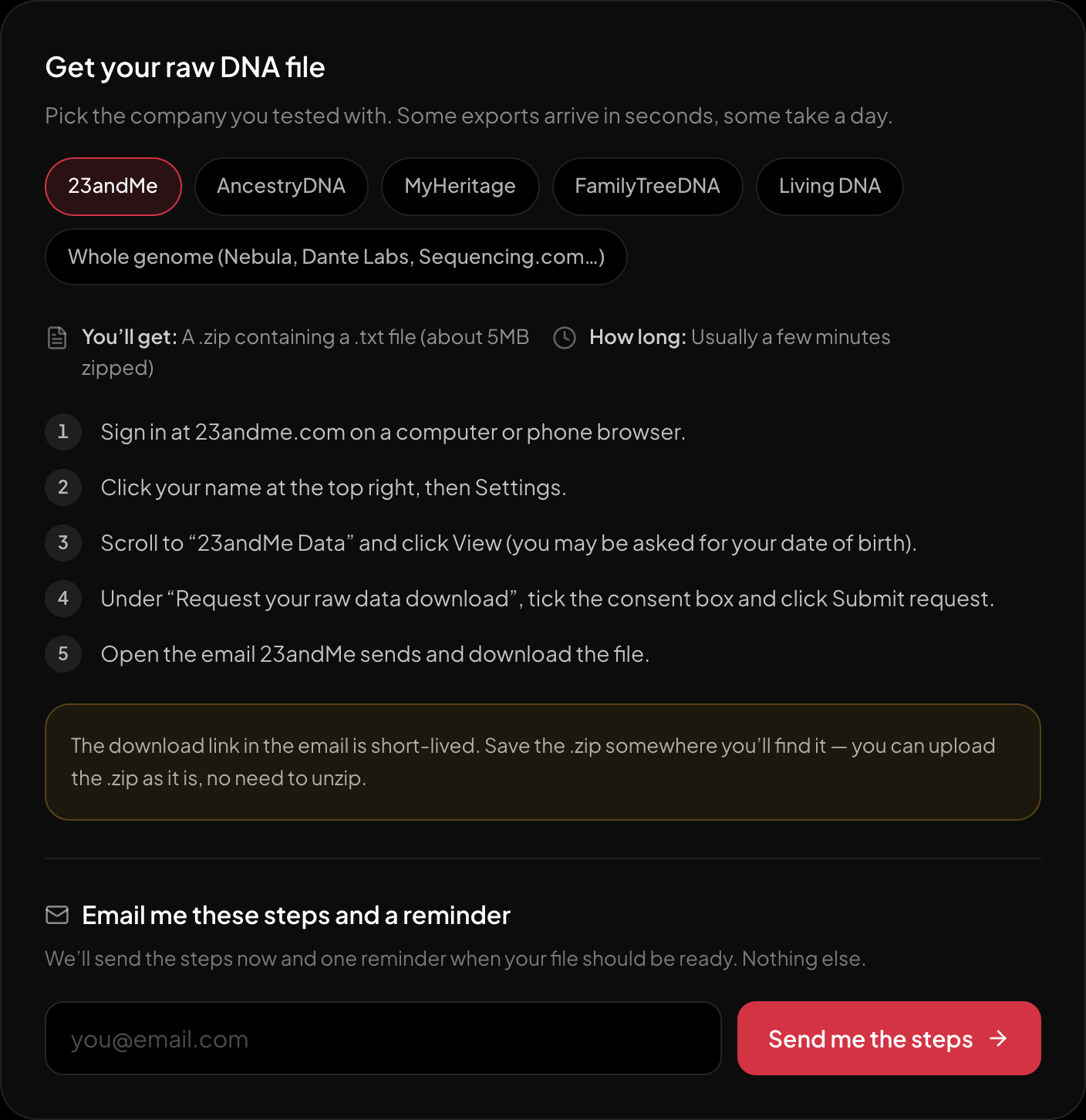
The download steps for 23andMe, on the page itself.
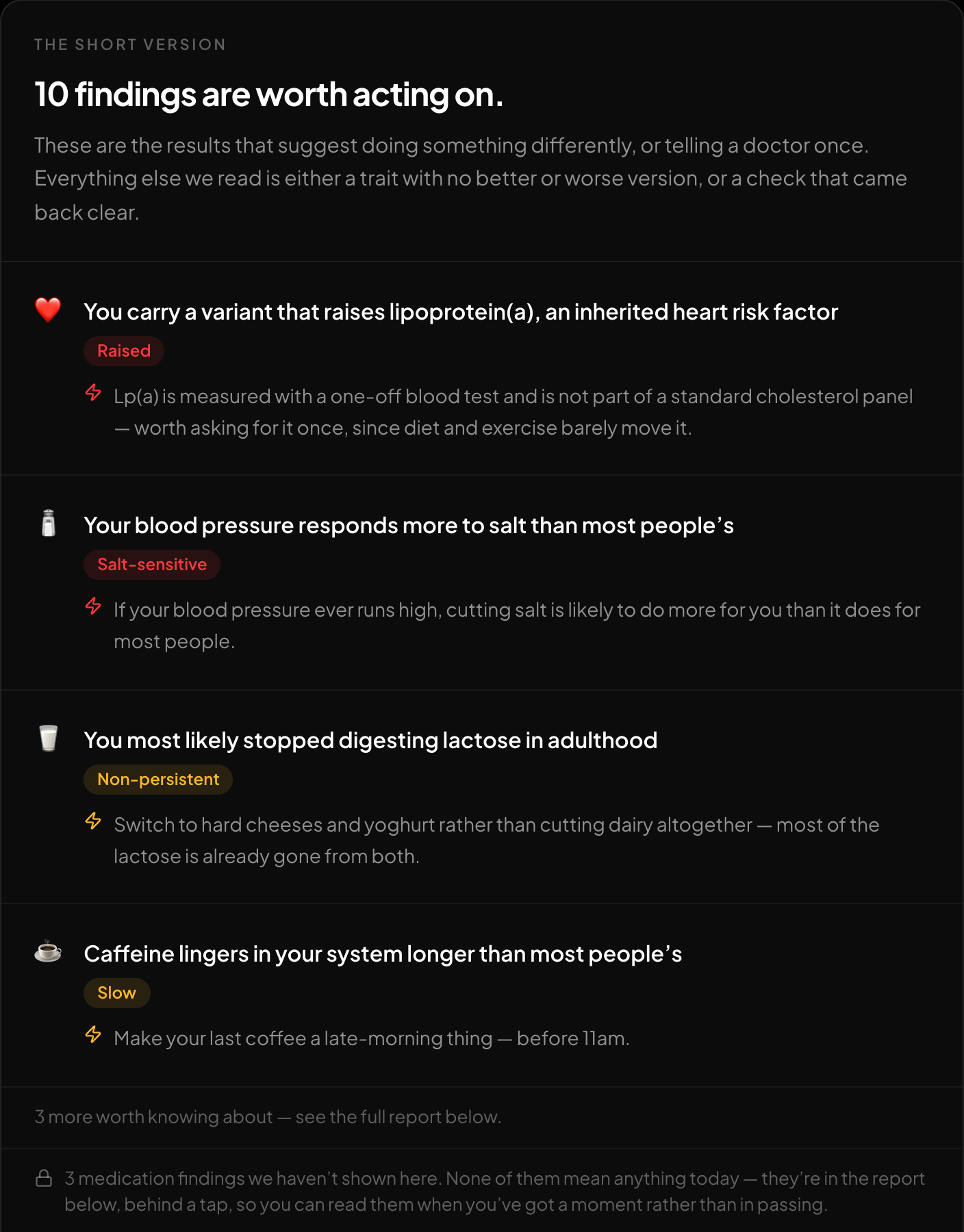
The short version: what is worth acting on, first.
To see this in your own numbers, upload your raw file to the free HealthOS DNA report. It parses 23andMe, AncestryDNA, MyHeritage and whole-genome VCF files in the browser. The trait and health story appears in your browser with no email or account needed. The full report is free but opens after a one-time email code.
New to raw DNA files? Start with the full guide: How to Download & Analyze Your 23andMe Raw Data Free
Written by
HealthOS Research