What DPYD Means in My 23andMe Raw Data
A 23andMe raw file may contain one or more DPYD positions, depending on chip version and raw-file format. A flag can point to fluoropyrimidine chemotherapy toxicity risk, but it needs clinical confirmation before treatment decisions.
A 23andMe raw file may contain one or more DPYD positions, depending on chip version and raw-file format. Those positions can point to how your body handles fluoropyrimidine chemotherapy drugs such as 5-FU and capecitabine. A DPYD-related flag can point to a higher chance of severe treatment toxicity, but it is not a diagnosis. A consumer DNA file is not complete clinical DPYD testing, and any result that could affect treatment needs confirmation before a drug decision.
What does DPYD mean in my 23andMe raw data?
DPYD makes DPD, dihydropyrimidine dehydrogenase. This enzyme is the first major step that inactivates fluoropyrimidines. If DPD activity is low, more active drug remains for longer. That increases exposure in normal tissues as well as tumour tissue.
In raw data, a 23andMe file may show one or more DPYD positions if those positions are included in the file. You might see a line with an rsID in DPYD and two bases, not a plain-language sentence. Coverage depends on chip version and raw-file format. A report may call one of those lines a reduced-function variant. The practical meaning is a drug safety question, not a cancer diagnosis. It means that if you ever receive 5-FU, capecitabine, tegafur, or another fluoropyrimidine, your risk of severe side effects may be higher than average. Those side effects can include severe mouth sores, severe diarrhoea, low white-cell counts, and hand-foot syndrome. They can show up early in treatment, sometimes during the first cycle.
DPYD-related findings in a consumer file are a warning light, not a treatment plan.
Why one chip result is not a full DPYD test
Consumer chips look at a fixed set of positions. DPYD has many possible pharmacogenomic changes. Clinical decisions often depend on which change is present and whether it affects one copy or both. Sometimes they also depend on measured enzyme activity. A 23andMe file may include one or more DPYD positions, but it does not sequence the whole gene. It also does not usually report copy-number changes or rare variants that matter in clinical pharmacogenomics.
This is why a no-flag result in your raw data or the HealthOS report does not rule out DPD deficiency. The chip may simply not test the variant you carry. Clinical testing may still be needed if treatment is planned. The common mistake is reading a normal-looking DPYD-related line in a raw file as proof that DPD activity is normal. It is not.
A clinical DPYD assessment may use a broader genotype panel or full gene sequencing. In some settings it may also use a phenotype test such as blood uracil. What it can show depends on the ordered test. The raw file can be a useful starting point, but it cannot be the last test.
| Question | Consumer raw file | Clinical workup (depends on ordered test) |
|---|---|---|
| Looks for selected DPYD variants | Partial | Only if the ordered panel includes them |
| Detects rare or private DPYD variants | No | Depends on sequencing or panel |
| Measures actual DPD activity | No | Only if a phenotype test is ordered |
| Rules out DPD deficiency | No | Depends on test scope and result |
| Decides chemotherapy dosing by itself | No | No |
Scroll the table sideways for the rest →
Illustrative comparison, not a clinical interpretation.
What the free DNA report can and cannot say about DPYD
HealthOS reports DPYD only under the headline "A chemotherapy safety marker". It does not provide dosing advice, a full pharmacogenomic certificate, or variant-level clinical interpretation. The file is read in the browser, free, and the DNA story needs no account; the full report opens in the HealthOS app after a 6-digit email code.
- It does not show whether every DPYD position is present.
- It cannot detect every DPYD variant. It also cannot measure DPD activity or confirm the result by itself.
- It cannot give a chemotherapy dose or say that a drug is definitely unsafe for you.
- If you upload a VCF without rsIDs, the health and trait report cannot read it. A DPYD health-report finding requires rsIDs.
- A no-flag result in raw data or the HealthOS report does not rule out DPD deficiency; clinical testing may still be needed if treatment is planned.
A DPYD-related flag is a prompt to verify before treatment
If your raw file or the HealthOS report contains a DPYD-related flag, keep the file and bring it up before any fluoropyrimidine treatment. Ask the oncology team whether clinical DPYD testing is appropriate. The conversation may include genotype testing beyond the consumer chip. It may also include a phenotype marker such as uracil. If reduced DPD activity is confirmed, it may lead to alternative regimens or adjusted dosing.
Do not change a medication plan yourself based on a raw genotype. Do not ignore it either. The raw result is most useful when it reaches the care team early, before the first infusion or pill, not after severe toxicity has already happened.
If you have already had 5-FU or capecitabine without major toxicity, that history is useful. Tell your team what you received and when. Include the side effects you had. Prior tolerance does not estimate DPD activity and does not replace testing if a new treatment plan depends on it.
If you are currently having severe diarrhoea, mouth sores, fever, or dehydration during chemotherapy, that is urgent medical care, not a genetics website question.
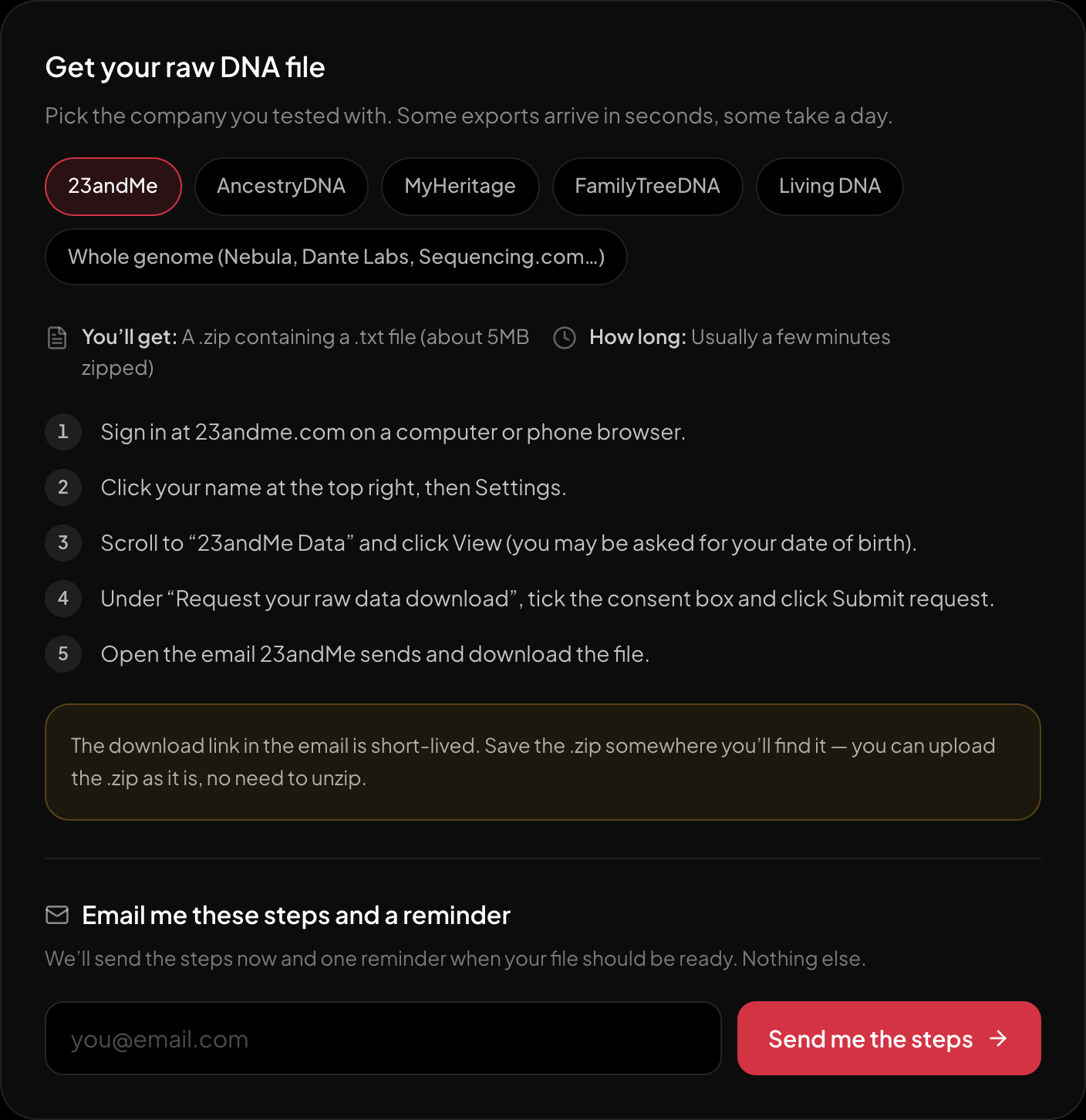
The download steps for 23andMe, on the page itself.

The short version: what is worth acting on, first.
For the free HealthOS DNA report, use the tool at https://healthosx.com/dna. It is a screening view, and any DPYD result that could affect chemotherapy should be confirmed clinically before treatment.
New to raw DNA files? Start with the full guide: How to Download & Analyze Your 23andMe Raw Data Free
Written by
HealthOS Research