What Does 30x Coverage Mean in My Whole-Genome VCF File
30x coverage usually means the aligned, usable reads average about 30 per base. It is not a guarantee every variant call is real, and depth alone is not clinical-grade.
30x coverage in a whole-genome VCF usually means the aligned, usable reads average about 30 per base after mapping and quality control. It is a post-sequencing mapped-depth average, not the sequencer's raw output. That average is not recorded in the VCF itself. Genome-wide coverage is normally in the sequencing provider's QC report or computed with tools such as mosdepth or bedtools, not inferred from a plain variant-only VCF. A VCF DP field is site-specific and may be absent, so depth at the exact variant matters more than the genome-wide average.
What does 30x coverage mean in my whole genome VCF file?
Coverage is a mapped-depth metric, not a value stored in every VCF record. The VCF file is not a position-by-position record of all bases. It is a list of positions where the variant caller found something worth reporting: a SNP, an insertion, a deletion, or in a gVCF, blocks that include low-confidence and no-call regions.
At a variant site, the sample's DP field, when present, says how many reads covered that exact position. A heterozygous SNP in a 30x genome might show DP=27, and another might show DP=8; these are illustrative examples, not expected values. The headline 30x is an average across the genome, not a uniform layer.
How a variant call is made from coverage
A sequencer does not read a whole chromosome at once. It reads millions of short fragments, maps them to a reference genome, and builds a pileup at each base. The variant caller counts the reads that support the reference allele and the reads that support an alternate allele.
For a diploid germline autosomal call with no mosaicism or contamination, a real heterozygous SNP usually has roughly half alternate reads. At 30x, that is around 15 alternate reads, but 12/18 or 18/12 can happen by chance; these splits are illustrative. A call with very few alternate reads is often sequencing error or a mapping artifact. Exceptions such as low-level mosaicism, sex chromosomes, haploid regions, or contamination can also produce skewed allele counts. In the VCF, the AD field splits the depth into reference and alternate counts. A line like GT:AD:DP:GQ 0/1:14,13:27:99 is a strong balanced call, and a line like 0/1:28,2:30:15 has very little alternate support and low genotype quality; both example values are illustrative. A heterozygous call with only 2 alternate reads would usually have low genotype quality unless the caller has other evidence. The GQ field is a genotype quality score, phred-scaled. As illustrative GQ examples, a GQ of 20 means the software assigns about a 1 in 100 chance the genotype is wrong, and a GQ of 99 means it is very confident. That confidence is only as good as the model's assumptions.
30x is an average. Judge each variant by its DP, AD and GQ fields when they are present, not by the kit's headline depth.
Why 30x depth alone does not make a finding clinical-grade
The common mistake is to treat 30x as if it certifies every base. It certifies the experimental yield, not the interpretation. Clinical-grade reporting usually requires coverage in specific clinically relevant regions, and it requires examining regions that fall below a minimum. A consumer whole-genome VCF with 30x average can still have a disease-relevant gene sitting in a low-coverage pocket where no confident call was made.
Depth is one part of a call. Mapping quality, strand bias, local sequence context, repetitive DNA, read quality, and variant calling algorithms all affect whether a variant is real. A pathogenic-looking variant found at 30x is a candidate, not a diagnosis. Many clinical laboratories use orthogonal confirmation or a validated pipeline for important variants, depending on the variant and the test. If your own file flags something serious, it is worth asking a clinician to confirm it before acting on it.
Does 30x mean every base was read 30 times?
No. Coverage is random and uneven. Some regions sequence poorly because they are GC-rich, repetitive, or hard to map. A genome with an average depth of 30x can still leave a small but important percentage of bases below 10x, or with no usable reads.
Illustrative distribution only; real genomes vary by library, platform and region.
That is why a VCF alone cannot tell you whether a missing variant means reference or not covered. If your file is a gVCF, low-confidence and no-call regions may be recorded explicitly. If it is a plain VCF of variant sites only, absence of a variant is not proof your DNA matches the reference at that position. Ask for the coverage file or the gVCF if you need to investigate a specific gene.
What to actually check in your own VCF
- Check the VCF header for
DP,AD, andGQdefinitions, becauseDPcan be INFO-level or FORMAT-level and may be absent or defined differently. Then check the FORMAT and sample columns to see which fields are present. Not every VCF includesDP,AD, orGQ. If a field is absent, you cannot use it to judge that site. DP: total read depth at that variant. Low depth weakens the call, regardless of the genome average.AD: allele depths, usually two numbers. A credible heterozygous call should show both alleles with support.GQ: genotype quality. Very low values mean the software is not sure about your genotype at that site.QUAL: variant quality in some VCFs. It is not the same as genotype confidence and can be misleading for large cohorts or complex events.- If a report says a panel is clear, that means no pathogenic or likely pathogenic variant was called in the file. It is not a diagnostic all-clear.
A VCF at 30x is useful for many consumer and research analyses. It can call millions of common and rare variants. But you use it best when you read it at the variant level, not when you trust the average.
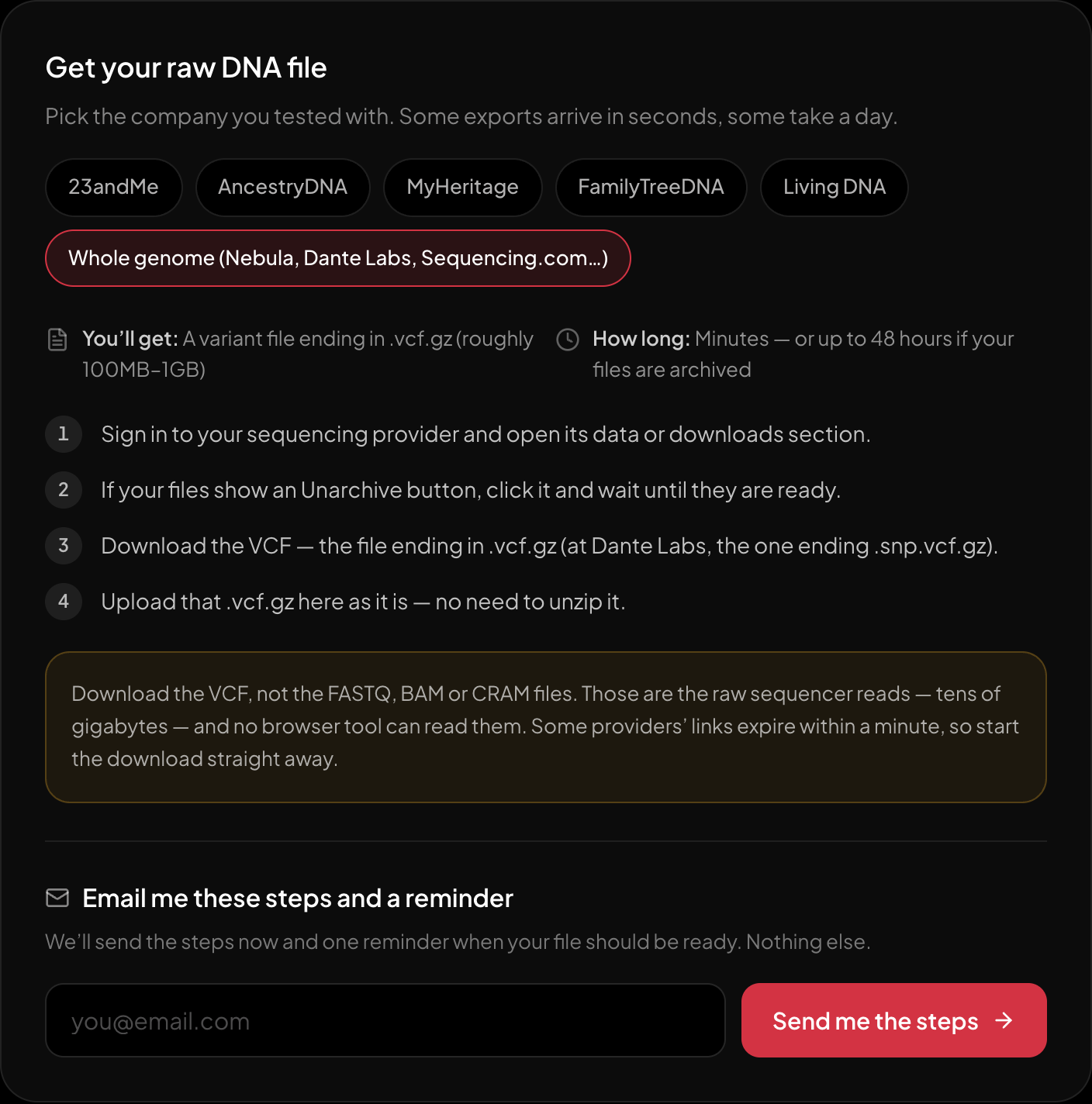
The download steps for whole-genome sequencing, on the page itself.

The short version: what is worth acting on, first.
HealthOS limitation: raw GATK/Sentieon VCFs whose ID column is '.' can work for ancestry when matched on GRCh37 coordinates, but cannot produce health findings; ClinVar and health panels require named positions. If you use the free DNA tool at https://healthosx.com/dna, the trait and health story appears in the browser for supported files, while the full report opens after a one-time email code. If a WGS VCF lacks rsIDs, health findings cannot be produced. A clear panel means no pathogenic or likely pathogenic variant was called in the file, not a diagnostic all-clear.
New to raw DNA files? Start with the full guide: How to Download & Analyze Your 23andMe Raw Data Free
Written by
HealthOS Research