What Do DD, DI and II Mean in My 23andMe Raw Data Instead of A, C, G and T
D and I in a 23andMe genotype column mark a deletion or an insertion, not a letter. Here is how to read DD, DI, II, D and I, find them in your file, and look one up.
In a 23andMe raw data file, D means deletion and I means insertion. They appear in place of A, C, G and T on rows where the variant is a stretch of DNA rather than one swapped letter. DD is two copies of the D version, II is two copies of the I version, and DI is one of each. 23andMe does not publish how its D and I labels map to the reference and alternate alleles in dbSNP. The code alone therefore cannot tell you which bases are involved or what the variant does.
What each code means
Every row in the file has four columns: rsid, chromosome, position and genotype. For most rows the genotype is two letters from A, C, G and T, one per copy of the chromosome. On indel rows, the letters are D and I instead.
| Code | What it says | In genetic terms | What you can safely conclude |
|---|---|---|---|
| DD | Both copies carry the version labelled deletion | Homozygous: the same version on both copies | Two copies of one deletion-labelled version. Not which bases, not whether it matters, and not which dbSNP allele it is. |
| DI | One copy labelled deletion, one labelled insertion | Heterozygous: the two copies differ | One of each version. Which is rarer or riskier is not shown. |
| II | Both copies carry the version labelled insertion | Homozygous: the same version on both copies | Two copies of one insertion-labelled version. Not which dbSNP allele it is, and not whether it is the reference. |
| D or I (one letter) | One copy only, so only one allele is reported | Single call, as for male X outside the pseudoautosomal tips, Y and mitochondrial DNA | One version was read. It carries the same limits as the two-letter codes. |
| -- | No call: the chip could not read this position | No genotype was read | Nothing about the variant. It is not a deletion. |
Scroll the table sideways for the rest →
Based on how 23andMe raw data files are laid out. D means deletion and I means insertion. 23andMe does not publish how these map to dbSNP reference and alternate alleles.
The single-letter versions are not errors. Men carry one X and one Y, and mitochondrial DNA comes in a single version, so on those chromosomes the file usually reports one allele. How your file labels the shared tips of X and Y (the pseudoautosomal regions) is best checked in the file itself. A lone D or I means one version was read, with the same limits as the two-letter codes.
The -- entry means the chip could not read that position. It is not a deletion. In the same way, D does not mean disease, and DD is not a double dose of something bad.
Why the file uses D and I instead of letters
A SNP is one base swapped for another, so two letters describe it fully. An indel is different. One base might be gone, or twelve, or a short repeat might be added. A one-base and a twelve-base deletion both show as D, so two very different variants can carry the same code. The code means little without the ID or position beside it.
23andMe documents D as deletion and I as insertion, and nothing more. A deletion or insertion is always relative to something, and the file does not say what. Do not assume that I is the dbSNP reference allele or that D is the alternate. People work it out variant by variant, and two tools can disagree.
The coordinates are build 37 (GRCh37). Many indels are common in healthy people, so neither D nor I means damaged, and neither means rare.
What the genotype column does not tell you
- Which bases were removed or added, and how many.
- Which gene the variant sits in, if any.
- What the variant does, if anything.
- Whether D or I is the less common version in people of your ancestry.
Some rows carry an ID beginning with i and a number, such as i4000123, instead of an rs number. These look like 23andMe's own identifiers and may have no matching dbSNP entry. For those rows, chromosome plus build 37 position is the handle to work from.
D and I label a deletion or an insertion. They never say what the DNA is, and the file does not say which dbSNP allele each one matches.
How to find the D and I rows in your own file
- 1.Unzip the download and open the
.txtfile in a spreadsheet such as Excel, Numbers or Google Sheets. The file is tab-separated, and the lines at the top that start with#are comments. - 2.Filter the
genotypecolumn forD,I,DD,DIandII. Select those values only, so that rows with--or letters stay hidden. - 3.Sort the filtered rows by chromosome and position, and copy the ones you want to look up.
In a text editor, search for a tab followed by DD, DI, II, D or I at the end of a line. Searching for the bare letters also hits the comment lines. The number of D/I rows differs between chip versions, so count them in your own file.
Why some tools may skip these rows
Most interpretation tools match your letters against a table of known alleles for each variant. A, C, G and T can be matched, and flipped to the other strand when the chip and the database disagree. D and I have no letters to match. Converting them to a standard format such as VCF would need the actual inserted or deleted sequence, and the raw file does not contain it. Some converters and analysis sites may therefore drop these rows or leave them unmatched. If a report never mentions your D and I variants, the cause may be how that tool handles them, not a problem with your file.
How to find out what a D or I variant actually is
Start with the row's ID and position, then work outward.
- 1.Copy the rsID, or the chromosome and build 37 position if it is an
inumber. - 2.For an rsID, look it up in dbSNP. It lists the alleles as sequences, so you can see what the insertion or deletion really is.
- 3.For an
inumber, find the position in a genome browser set to GRCh37 (UCSC or Ensembl both offer that) and see which gene, if any, it falls in. - 4.Check ClinVar for any classification, and the frequency data for how common each version is.
- 5.Confirm which allele is the shorter one. In dbSNP, compare the length of each allele. Reading D as the shorter allele and I as the longer is a working assumption, because 23andMe publishes no mapping. SNPedia's notation can differ from the file's, so do not assume a D/I genotype written there matches your row. If you cannot tell which allele is which, treat the row as unresolved. Getting it backwards reverses your result.
Even then, a single variant from a consumer chip is a lead, not a diagnosis. If it turns out to have a clinical classification, a doctor or genetic counsellor can arrange confirmation with a clinical-grade test.
Two worked examples
These are indels that are often written as D/I in raw files. Check whether your file's row for them uses D/I before relying on anything below. The allele descriptions come from how dbSNP and ClinVar describe each variant. APOL1 is among the findings in the HealthOSX report. CFTR is not.
APOL1 G2 (rs71785313). This is a 6-base deletion in the APOL1 gene that removes two adjacent amino acids. The shorter allele is the one called G2. If D marks the shorter allele, the genotypes map like this:
DD: two copies of the G2 deletion.DI: one copy of G2 and one copy of the longer allele.II: two copies of the longer allele, so no G2.
Here the shorter allele is the one with clinical interest. APOL1 risk also involves the separate G1 variants, so G2 alone is not the full picture.
CFTR F508del (rs113993960). This is a 3-base deletion in the CFTR gene that removes one phenylalanine, at position 508 of the protein. ClinVar classifies it as pathogenic for cystic fibrosis. The mapping works the same way:
DD: two copies of F508del.DI: one copy of F508del and one copy of the longer allele, the pattern seen in carriers.II: no copy of F508del.
A chip result like this still needs confirming with a clinical test before anyone acts on it.
Do not carry this mapping over to another row without running step 5. For some variants the longer version is the common one, and sources write the notation differently.
Check a variant or your file on HealthOSX
HealthOSX offers a free tool at healthosx.com/dna that reads a raw 23andMe file in your browser and reports traits, medication response and carrier-relevant findings, with an optional ancestry breakdown.
- To check a single rsID, use healthosx.com/dna/lookup.
- To check a file, use healthosx.com/dna/check.
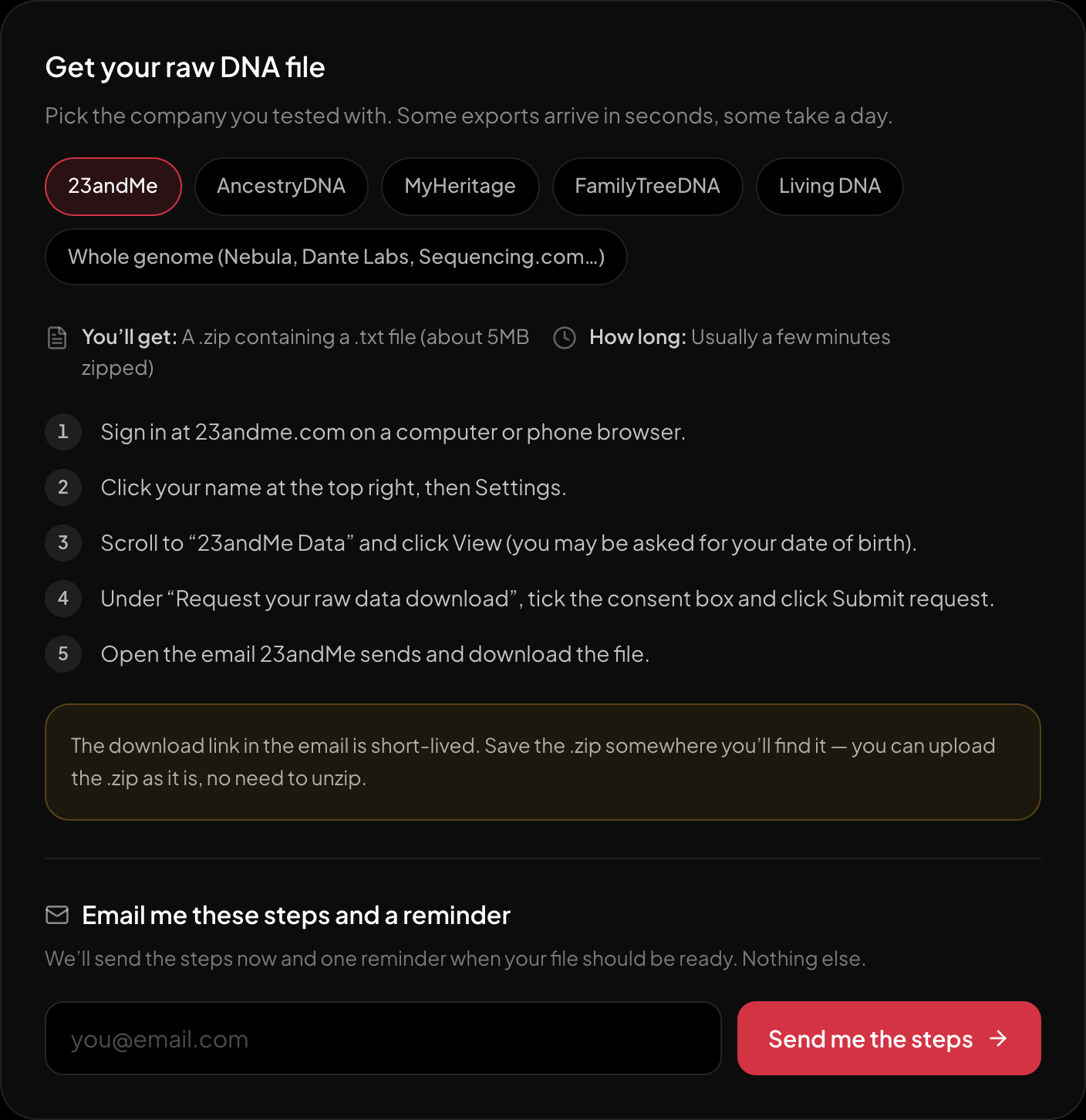
The download steps for 23andMe, on the page itself.
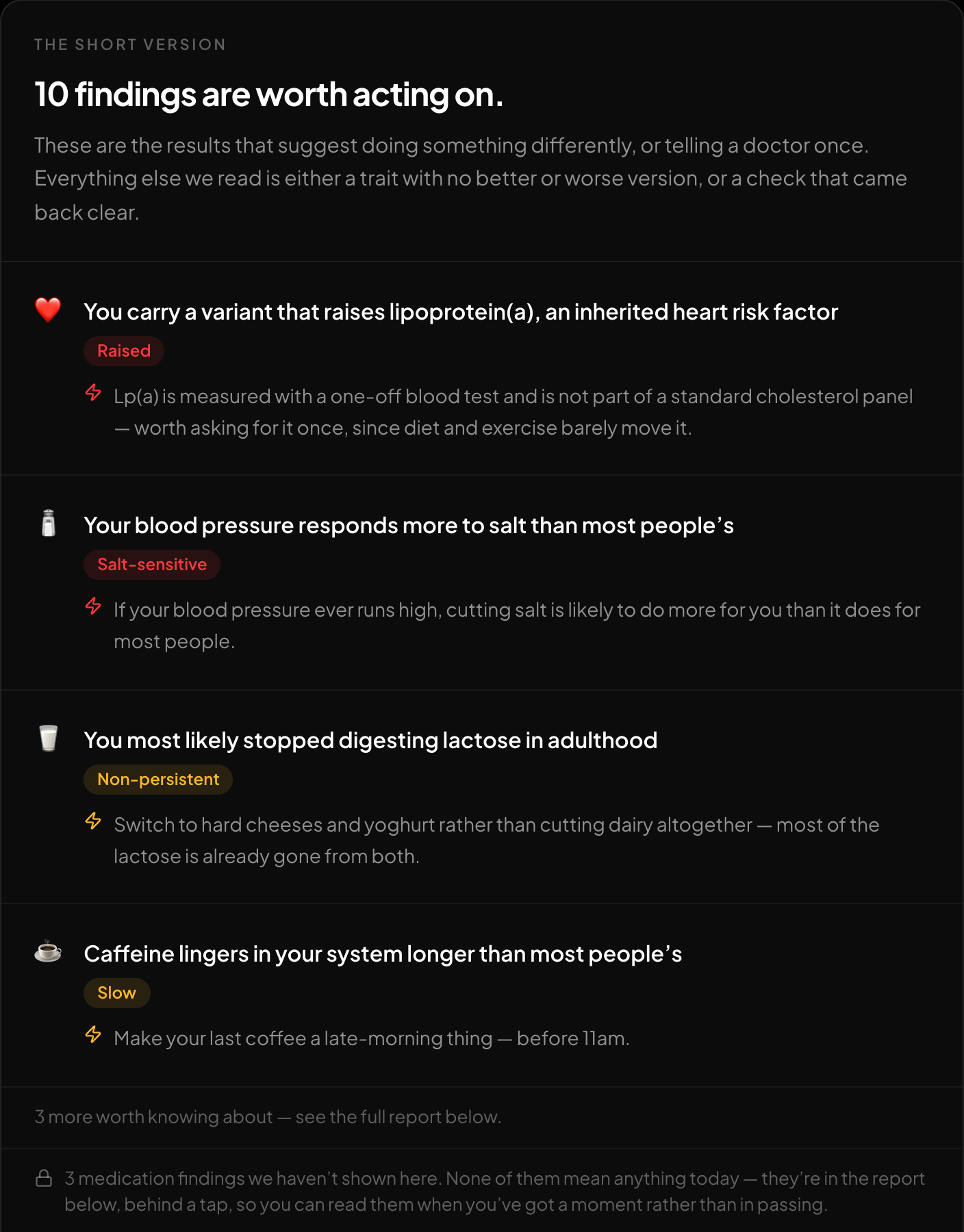
The short version: what is worth acting on, first.
For a D/I row, start by copying its rsID into the lookup.
New to raw DNA files? Start with the full guide: 23andMe Raw Data Interpretation Free in Your Browser
Written by
HealthOSX Research