What CYP2C19*17 Means in Your 23andMe Raw Data
CYP2C19*17 is an increased-function star allele. In 23andMe raw data, a T at rs12248560 can suggest it, but this marker alone cannot define your full CYP2C19 diplotype or phenotype.
CYP2C1917 is an increased-function star allele. In 23andMe raw data, the usual marker is rs12248560, and a T at that marker can suggest 17, but it is not a definitive star-allele call. The full CYP2C19 diplotype and phenotype require phasing and testing for loss-of-function alleles such as 2 and 3.
If your file has a line for rs12248560, each T is associated with the *17-linked increased-function allele. People with one or two T alleles may make more CYP2C19 enzyme than people without them, provided no reduced-function or no-function alleles are present elsewhere.
Important limitation: rs12248560 is a single-marker read, not a full CYP2C19 star-allele call. Raw 23andMe data generally cannot rule out or phase 2, 3, or other CYP2C19 alleles.
CYP2C19*17 makes more enzyme. Whether that is good, bad or neutral depends on whether the drug is broken down by the enzyme or activated by it.
What does CYP2C19*17 mean in my 23andMe raw data?
Open the raw text file and search for rs12248560, not the gene name. The line starts with the rsID, then chromosome 10, a position, and your genotype. In some GRCh37/hg19 files a CT line may show a position such as 96521657, but that coordinate is build-dependent and illustrative. Search rs12248560, not the position. If the SNP is missing or uses other alleles, do not infer 17 from that file. If the genotype is CT, one T is present and is linked to 17. If TT, two T alleles are present. CC means no *17 signal from this marker. These genotypes only suggest increased-function allele(s) if no reduced-function or no-function alleles are present, and they do not assign a final CYP2C19 phenotype.
| Genotype | T alleles | Possible interpretation |
|---|---|---|
| CC | 0 | No *17 signal detected. Overall CYP2C19 phenotype cannot be determined from this marker alone. |
| CT | 1 | Suggests one *17-linked increased-function allele if no reduced-function or no-function alleles are present |
| TT | 2 | Suggests two *17-linked increased-function alleles if no reduced-function or no-function alleles are present |
Scroll the table sideways for the rest →
T at rs12248560 is associated with CYP2C19*17. This single marker cannot determine the full diplotype or phenotype. CT and TT only suggest increased-function allele(s) if no reduced-function or no-function alleles are present.
If the file has no rs12248560 line, your chip version did not genotype it and you cannot call *17 from that file alone.
A star allele is a named version of a gene. CYP2C191 is normal function. CYP2C1917 is increased function. One important limit: rs12248560 only tells you about *17. It does not rule out other CYP2C19 changes elsewhere in the gene. 23andMe arrays may not include all CYP2C19 markers, and a normal rs12248560 CC result does not rule out other CYP2C19 variants.
Why more enzyme changes the drug result
CYP2C19 is a liver enzyme that helps process a subset of drugs. The *17 variant sits in the promoter region and raises transcription of the gene, so the liver builds more enzyme molecules. More enzyme means faster processing of CYP2C19 substrates.
The direction of the effect depends on the drug, not the enzyme:
- If CYP2C19 breaks an active drug down to an inactive form, more enzyme means lower parent-drug exposure.
- If CYP2C19 activates a prodrug, more enzyme means more active metabolite.
This is the difference between a lower omeprazole level and a stronger clopidogrel effect. The enzyme is doing the same job; the drug is not.
What *17 can mean for omeprazole, citalopram and clopidogrel
Omeprazole and citalopram are partly inactivated or cleared by CYP2C19. With a *17-linked increase, the body may clear them faster. Standard omeprazole can produce less acid suppression, and standard citalopram can produce a lower blood level than expected. That can look like the drug simply doing less, especially when two T alleles are present and no loss-of-function alleles are found. The effect is usually modest. Other enzymes, dose, indication and clinical response also matter.
Clopidogrel goes the other way. It is a prodrug that needs CYP2C19 to become active. A 17-linked increase can create more active metabolite, so platelet inhibition may be a little stronger. The effect on platelet reactivity is measurable, but the effect on heart attack, stroke or bleeding is inconsistent. Current CPIC-style guidance is mainly actionable for reduced- or absent-function CYP2C19 alleles, while 17 alone usually does not change clopidogrel recommendations.
The common mistake is treating 17 as fast metabolism of everything*. It applies only to CYP2C19 substrates, and the direction reverses for prodrugs.
Does 17 cancel out a 2 or *3 result?
No. A T at rs12248560 is linked to 17, but it does not cancel a loss-of-function allele on the other copy. You could have a 17-linked T on one copy and 2 or 3 on the other. That combination may leave you near normal overall, or at least not truly rapid. Assigning the full diplotype needs phasing and more than one marker. A raw 23andMe file may also include rs4244285 for *2, but that is still only one piece of the CYP2C19 picture.
If a tool reports only CYP2C19*17 from rs12248560, treat it as one piece of the CYP2C19 picture. The loss-of-function side is often more clinically important when a doctor is choosing clopidogrel.
What to do with a *17-linked result
- If omeprazole or citalopram feels weak, mention the genotype when discussing a dose change or alternative.
- Do not change a dose yourself. The effect is real but usually modest.
- If you take clopidogrel, do not treat a T at rs12248560 as a reason to stop it. The stronger signal is loss-of-function alleles.
- If your file has no rs12248560, you cannot call *17 from that raw data alone.
This is not a diagnosis and it is not a reason to avoid a drug. It is one pharmacogenomic variable among many.
See it in your own file
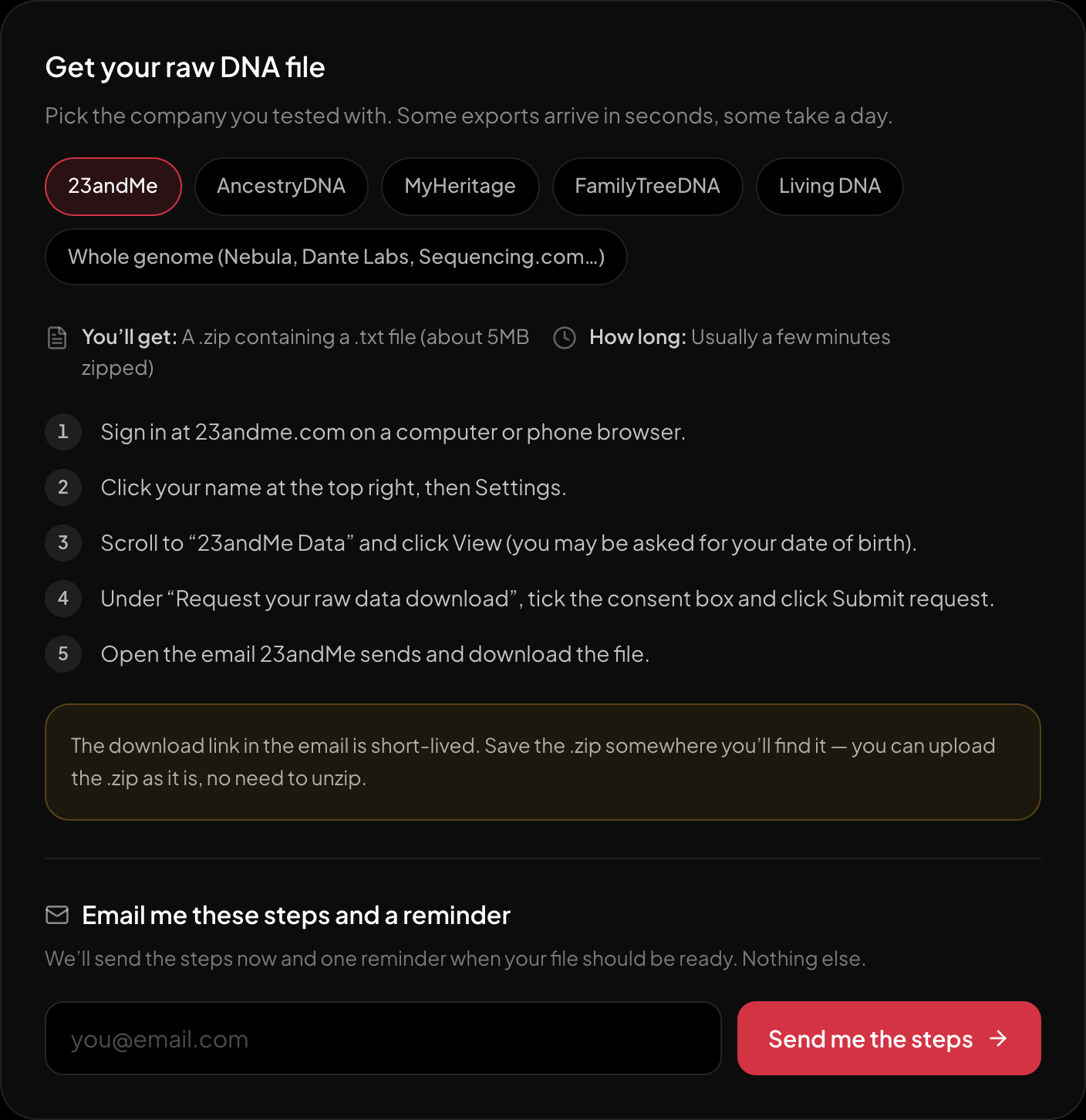
The download steps for 23andMe, on the page itself.
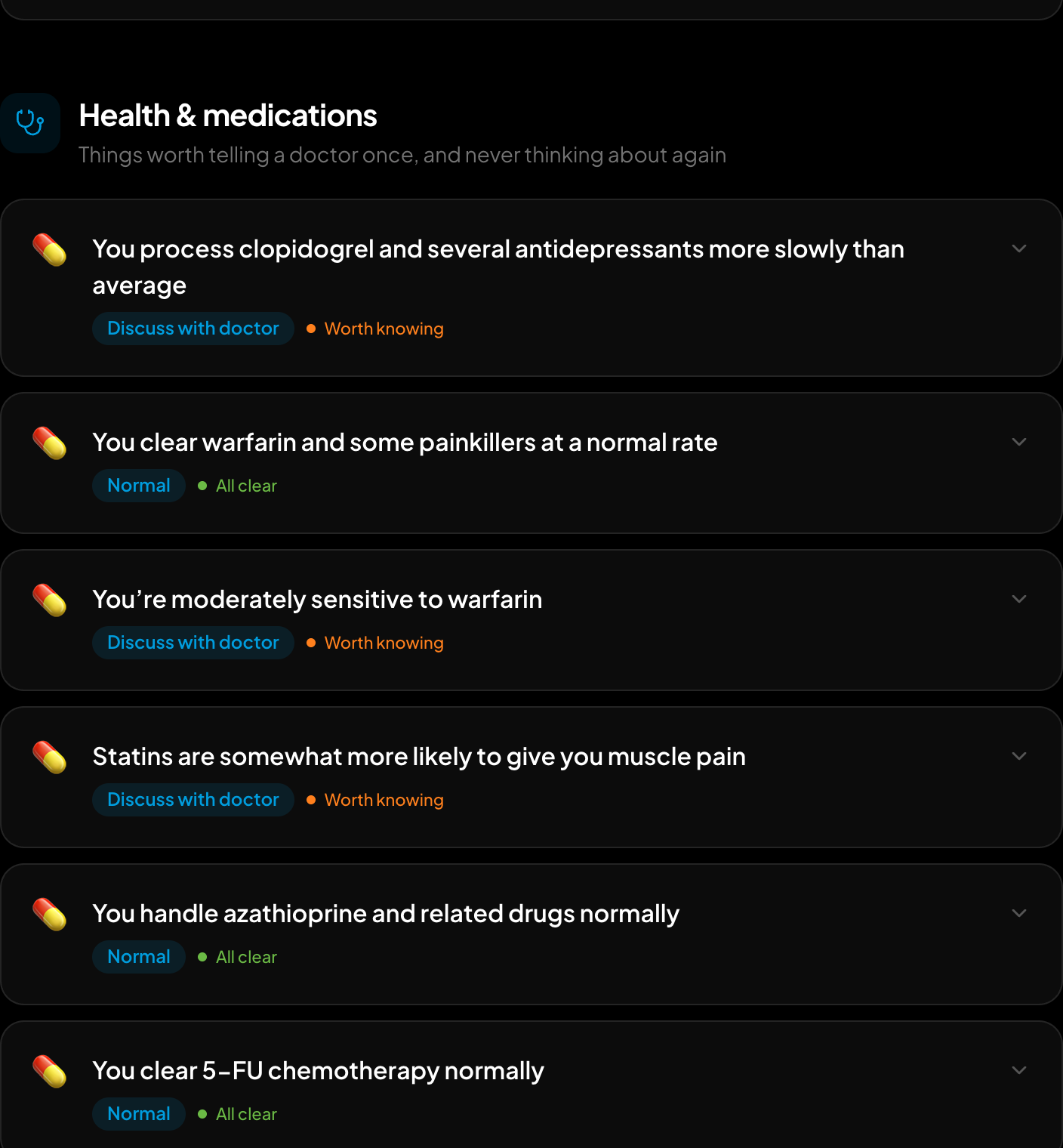
Medication genes, kept behind a tap rather than sprung on you.
To see it in your own file, HealthOS DNA accepts 23andMe, AncestryDNA, MyHeritage, and whole-genome VCF files. The initial DNA story is parsed in the browser and needs no account, email or upload. The full report is free and opens after a one-time email code. Medication response is listed drug by drug from CPIC gene-drug guidance.
New to raw DNA files? Start with the full guide: How to Download & Analyze Your 23andMe Raw Data Free
Written by
HealthOS Research