What UGT1A1*28 Means in Your 23andMe Raw Data
UGT1A1*28 is the 7-repeat UGT1A1 promoter allele associated with Gilbert syndrome and increased irinotecan toxicity risk. Missing data is not 6/6.
What does UGT1A1*28 mean in my 23andMe raw data?
If you see UGT1A1*28 in a 23andMe raw data file, it refers to the 7-repeat UGT1A1 promoter allele. Missing data is not 6/6. The TA repeat may not be assayed or may be represented inconsistently depending on the chip version and file format, so a usable result requires a callable marker or clinical confirmation. Consumer raw-data findings are not diagnostic.
The UGT1A1 gene makes an enzyme in the liver. Its job is to attach glucuronic acid to bilirubin, the yellow breakdown product from old red blood cells. Only after that attachment is bilirubin water-soluble enough to leave through bile. The *28 variant inserts an extra TA into the TATA box, a promoter element that controls how often the gene is read. Fewer transcripts mean fewer enzyme molecules, so unconjugated bilirubin may build up in blood.
UGT1A1*28 is a 7-repeat UGT1A1 promoter allele associated with Gilbert syndrome and, in irinotecan treatment, increased risk of toxicity.
Heterozygous vs homozygous: what 6/7 and 7/7 actually do
The genotype is a repeat count per chromosome. Most people have six TA repeats (6/6). Having one seven-repeat allele makes you heterozygous (6/7). Having two makes you homozygous (7/7).
- 6/6: typical enzyme activity and bilirubin clearance.
- 6/7: mildly reduced enzyme activity, bilirubin often normal to mildly elevated.
- 7/7: reduced enzyme activity, bilirubin sometimes mildly to moderately elevated, especially after fasting or illness.
| Genotype | UGT1A1 enzyme activity | Possible bilirubin pattern | Irinotecan caution |
|---|---|---|---|
| 6/6 | Typical | Usually within lab range | No special caution |
| 6/7 | Slightly reduced | Normal to mildly elevated | Standard monitoring |
| 7/7 | Reduced | Mild to moderate elevation, varies with fasting and illness | Dose reduction or closer monitoring considered |
Scroll the table sideways for the rest →
Illustrative only. Not a reference range. Enzyme activity and bilirubin patterns overlap by genotype and vary with ancestry, fasting, illness, and other variants.
The same enzyme deactivates SN-38, the active metabolite of the chemotherapy drug irinotecan. Do not change chemotherapy based on raw data alone. CPIC-style guidance indicates homozygous 28 (28/*28) increases irinotecan toxicity risk, so clinicians may adjust the dose or monitor more closely. Heterozygotes have intermediate clearance and may need standard monitoring unless other risk factors are present. Consumer raw-data findings are not diagnostic, and UGT1A1 status should be confirmed with a clinical test before changing medical care.
What your bilirubin looks like on a lab report
A metabolic panel may show an isolated total bilirubin elevation. A fractionation test may show most of the elevated bilirubin is indirect (unconjugated). Direct bilirubin is typically normal. Liver enzymes ALT, AST, and ALP may be normal. Hemolysis markers such as LDH, haptoglobin, and reticulocyte count may also be normal. This pattern fits Gilbert syndrome, but other causes of isolated indirect hyperbilirubinemia must be excluded. Bilirubin can climb after a 24-hour fast, an infection, poor sleep, or alcohol, then come back down.
Illustrative only. These are non-real example values, not a reference range. Actual values vary with lab range, fasting, illness, ancestry, and other variants. Ranges overlap by genotype.
Doctors sometimes see this and call it Gilbert syndrome after excluding other causes. That is usually the whole story.
Does this need treatment, or is it bad for me?
Isolated Gilbert syndrome is generally benign and usually needs no treatment. High bilirubin or abnormal liver tests need clinical evaluation. No special diet is required for isolated Gilbert syndrome. If mild jaundice bothers you, avoid unnecessarily long fasting and stay hydrated during illness.
A high bilirubin is worth investigating further when it does not fit this pattern. Look for these red flags:
- Direct (conjugated) bilirubin is high.
- ALT, AST or ALP are abnormal.
- You have anemia, dark urine, pale stools or new jaundice.
Those can point to something other than Gilbert syndrome, and they need a proper workup.
When the simple answer does not hold
The 28 allele is not the whole story for everyone. In people of East Asian ancestry, a different variant called UGT1A16 can also reduce enzyme activity and is more common than 28 in some populations. A 28-only view may miss that. If you have 6/6 at the 28 marker but have East Asian ancestry, you could still have reduced UGT1A1 activity from 6, and irinotecan toxicity risk may still be higher. A clinical test that includes *6 can clarify risk.
Not everyone with 7/7 has high bilirubin. Enzyme activity is also affected by other genetic and non-genetic factors, so penetrance is incomplete. Not everyone with 7/7 gets severe irinotecan toxicity, because dose, liver function and other drug clearance pathways matter too. The genotype tells you about a tendency, not a certainty.
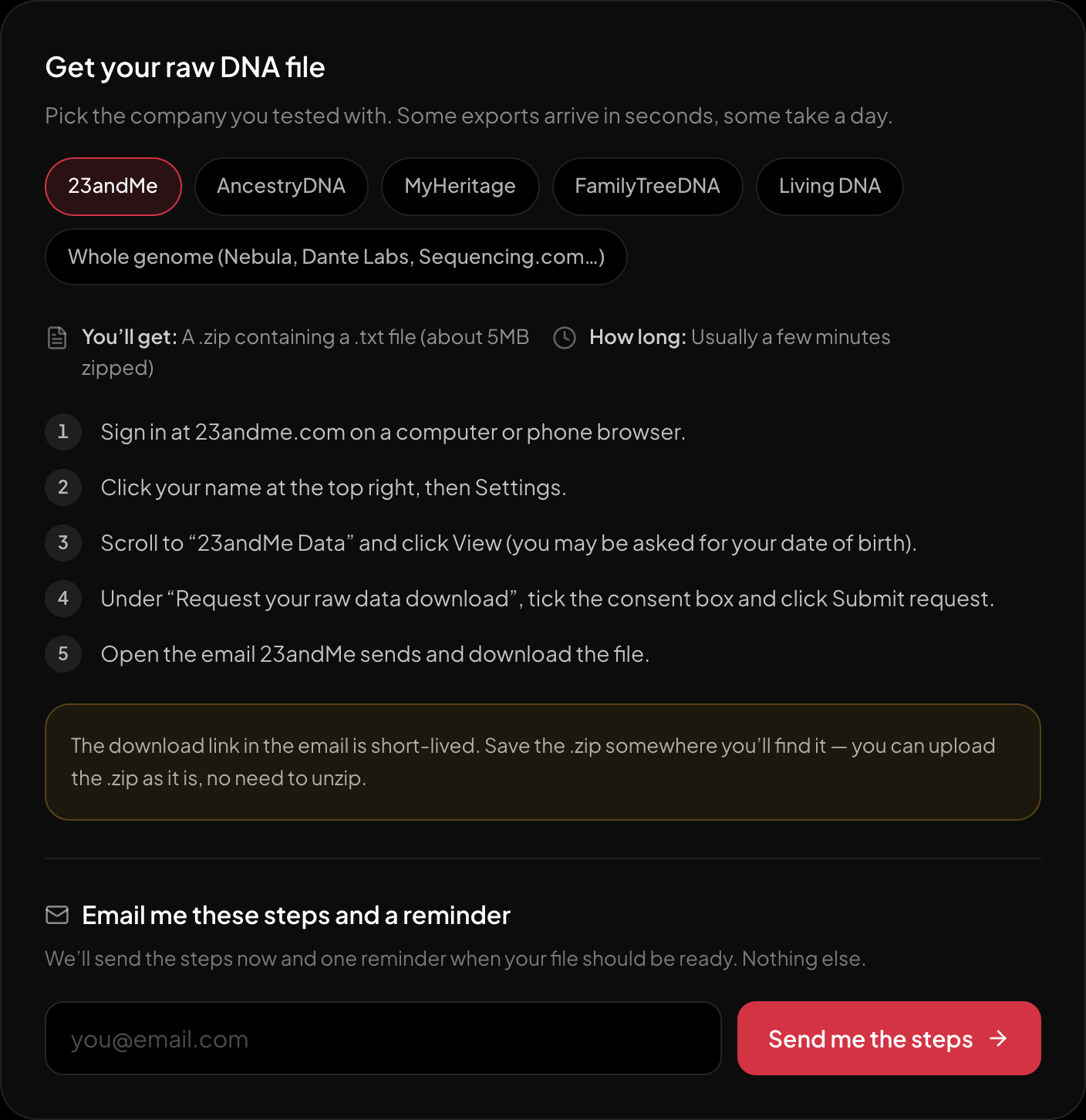
The download steps for 23andMe, on the page itself.

The short version: what is worth acting on, first.
The free DNA tool at https://healthosx.com/dna reads a raw 23andMe, AncestryDNA, MyHeritage or whole-genome VCF file in the browser. The initial story appears in the browser with no account and no upload. The full free report opens after a one-time email code. If you have a file, run it and look for the UGT1A1 line in the full report. Medication response information comes from CPIC gene-drug guidance and does not make a diagnosis.
New to raw DNA files? Start with the full guide: How to Download & Analyze Your 23andMe Raw Data Free
Written by
HealthOS Research