Should Turkish DNA Results Include Central Asian Ancestry
Turkish and Central Asian are not the same, and Turkish DNA results do not have to include Central Asian ancestry; many people from Turkey may see none.
Turkish and Central Asian are not the same, and Turkish DNA results do not have to include Central Asian ancestry. A person from Turkey can get zero Central Asian without that being a mistake.
Should Turkish DNA results include Central Asian ancestry, or are Turkish and Central Asian the same?
No. Turkish and Central Asian are not the same, and Turkish DNA results do not have to include Central Asian ancestry. A DNA test compares chunks of your genome to present-day reference groups, not to an ancient tribe or a language. Estimates vary by method, reference panel, and region.
Why some tests may separate Turkey or West Asia from Central Asia
Commercial ancestry tests are not reading a passport. They chop your autosomal DNA into short windows and compare each window to reference panels made from living people whose family trees are reported to be local to a region. Some tests may separate a Turkey or West Asian category from a Central Asian category because the two labels are built from different present-day reference samples.
Some tests use Turkey or West Asian reference samples drawn from modern Turkish and nearby populations. Central Asian labels may be built from groups such as Uzbeks, Kazakhs, Kyrgyz, and Turkmens. These reference groups can look different in aggregate because they have different population histories. The test labels what a segment looks like now, not what it meant centuries ago.
Reference panels are curated datasets, not fixed natural kinds. If a company changes its reference samples or smoothing settings, the same segment can move from one box to another. That is why a 2% Central Asian result on one test might disappear into a Turkey or West Asian label on another.
In commercial panels, many people from Turkey get a primary Turkey or West Asian result. Some may also see a smaller Central Asian slice, depending on the test and reference panel.
Why a Turkish person might see zero Central Asian
- Ancestry varies by family and region. Some families may have very low or undetectable Central Asian admixture.
- Recombination dilutes a minority signature over centuries. A few Central Asian ancestors many generations back may now leave segments below the reporting threshold.
- The Turkey or West Asian reference category is not a pure isolate. If the reference panel contains segments that resemble Central Asian references, the algorithm may call those segments Turkey or West Asia rather than Central Asia because they resemble the reference average.
- Company thresholds differ. A low-confidence Central Asian result on one platform can be smoothed away on another or merged into a broader West Asian label.
What a small Central Asian result does and does not prove
A 5% Central Asian result is not a certificate that your ancestors rode with the Seljuks. It means a small portion of your DNA matches present-day Central Asian reference populations more than it matches your other reference groups. That is consistent with the historical Turkic migration into Anatolia, but it cannot name a tribe, a date, or a specific ancestor.
It also does not prove Turkishness. Identity is social, linguistic, genealogical, and legal. DNA does not overrule it. The reverse is true too. Zero Central Asian does not mean you are not Turkish. In commercial panels, many people from Turkey get a primary Turkey or West Asian result, depending on the test.
A Central Asian percentage in a Turkish DNA result is a trace of migration, not a certificate of identity, and its absence does not erase the history.
Does zero Central Asian mean I am not Turkish?
No. It means the test did not detect a segment that matches its Central Asian reference panel at its reporting threshold. That is a limited technical statement, not a verdict on identity. If your family is from Turkey and you speak Turkish, your result is Turkish by any meaningful definition. If you want to understand the genetic side, the practical step is to look at the specific populations and confidence levels rather than scanning for one label.
A useful way to read the label is to keep the two sides separate.
That distinction stops most of the confusion around this question.
Choosing a file. The report is read on your own device.
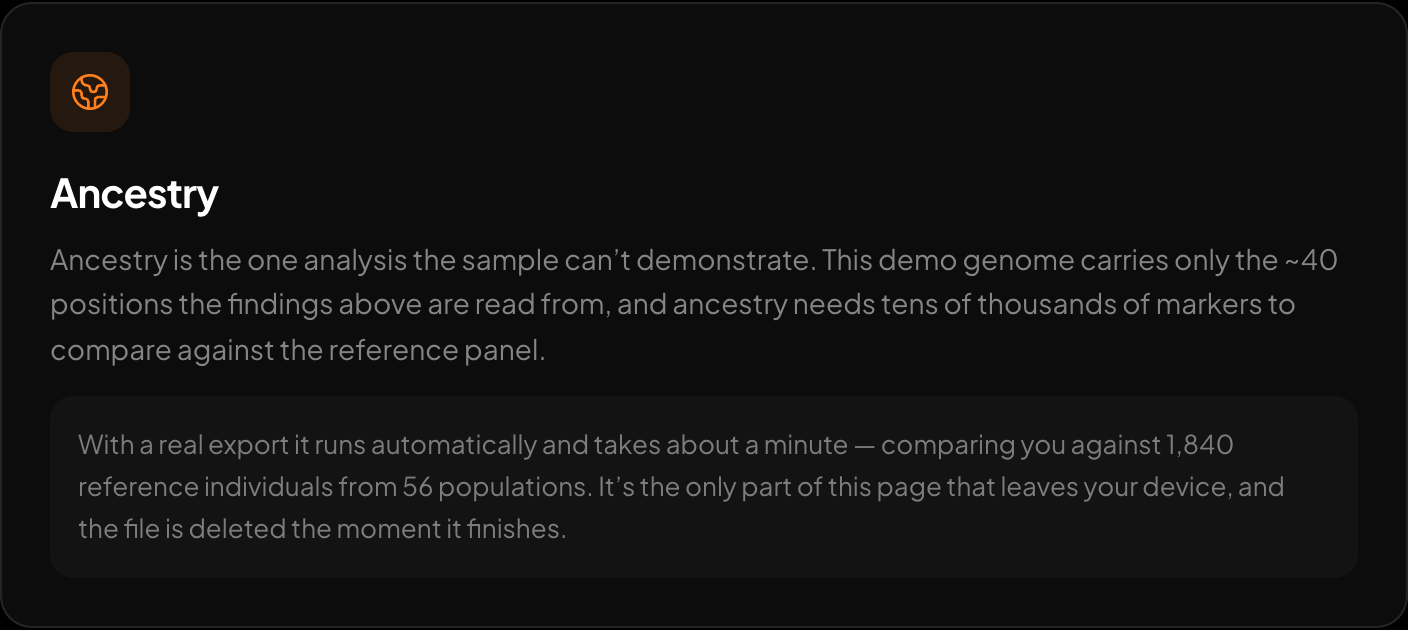
Ancestry against 1,840 reference genomes.
If you already have a raw DNA file from a consumer test, the free tool at HealthOS /dna can read it in your browser. Trait and health analysis runs locally in the browser and requires rsIDs; a whole-genome VCF without rsIDs can receive ancestry only. Optional ancestry uses a server: only the markers needed for the ancestry report are sent, and the file is deleted unless you choose to keep it. The optional ancestry report compares your genome to 1,840 reference genomes and reports 14 world regions and closest present-day populations. Ancestry results depend on the reference panel and thresholds used. HealthOS cannot confirm Turkish identity or absence of Central Asian ancestry.
New to raw DNA files? Start with the full guide: How to Download & Analyze Your 23andMe Raw Data Free
Written by
HealthOS Research