What TTR V122I Means in Your 23andMe Raw Data
TTR V122I in 23andMe raw data is a single-variant health finding linked to late-onset hereditary transthyretin amyloidosis, not a diagnosis.
If your 23andMe raw data flags TTR V122I, it is a specific missense change in the transthyretin gene. At the marker rs76992529 on chromosome 18, the plus-strand reference allele is G and the V122I risk allele is A. One A copy is enough to be a carrier. It is linked to hereditary transthyretin amyloidosis, a late-onset condition that can stiffen the heart, but many carriers remain asymptomatic.
What does TTR V122I mean in my 23andMe raw data?
TTR V122I is a specific missense variant in the gene that makes transthyretin. The variant swaps a valine for an isoleucine at position 122 of the mature protein, so it is sometimes written p.Val142Ile when the 20-amino-acid signal peptide is included in the numbering. Cardiology notes use both names for the same thing.
In a 23andMe raw file the marker is usually rs76992529. The gene sits on chromosome 18. Open the raw text file and search for that rsID. The line will show your two base calls at that position. On the plus strand, GG means no V122I allele, AG or GA means heterozygous carrier, and AA means homozygous, which is rare and may have higher or earlier risk, but penetrance is variable and needs specialist interpretation. A -- or no-call does not mean negative; it means the chip did not read that marker.
| Genotype at rs76992529 | Carrier status | What it means |
|---|---|---|
| GG | Not a V122I carrier | No added TTR V122I risk from this marker |
| AG/GA | V122I carrier | Lifetime risk is higher for late-onset ATTR-CM; many carriers remain asymptomatic |
| AA | Homozygous V122I | Rare, may have higher or earlier risk, but penetrance is variable and needs specialist interpretation |
| No call / -- | Unknown | The chip did not read this marker; do not read it as negative |
Scroll the table sideways for the rest →
What a consumer-chip call can and cannot tell you.
The raw file tells you whether you carry V122I. It does not tell you that you have, or will get, amyloidosis.
The mechanism, not just the label
Transthyretin is made mainly in the liver and circulates as a four-piece complex called a tetramer. It carries thyroid hormone and a retinol-binding protein. The V122I change makes that four-piece complex less stable. Over years, pieces separate, misfold, and deposit as amyloid fibrils in tissue. The heart is the most affected organ in V122I carriers. The muscle wall thickens and stiffens. This shows up later as heart failure with preserved ejection fraction.
The process is slow. Amyloid burden accumulates over decades before symptoms appear. A positive raw data result in a 30-year-old does not by itself prove current disease, but it still warrants clinical interpretation.
What the raw file can and cannot say
- It can tell you whether the chip read the V122I position and whether you carry one or two A risk alleles.
- It cannot tell you whether amyloid is currently building up, how fast it is building, or whether you will develop heart failure.
- A negative call at
rs76992529does not rule out other TTR variants, and it says nothing about AL amyloidosis, the other main type. - A positive call from a consumer array should be confirmed clinically before it drives invasive decisions. The arrays are good, but they are not diagnostic instruments.
V122I is inherited in an autosomal dominant pattern with incomplete penetrance. If you carry one copy, each child has a 50% chance of inheriting it. Because symptoms usually appear after age 60, a family can look unaffected while the variant passes quietly.
The obvious follow-up: does this mean I will get heart disease?
No, not by itself. Some studies estimate that roughly 3 to 4 percent of African Americans carry one copy of V122I, but that is an approximate, population-specific estimate and not a universal figure. If every carrier developed symptomatic cardiac amyloidosis, the disease would be far more common than it is. Many carriers remain asymptomatic. But the risk is real and rises with age. When it appears, it usually does so after 60, often in the 70s or later. Red flags include bilateral carpal tunnel syndrome, spinal stenosis, and a thick left ventricle on an echocardiogram.
The common mistake is reading a carrier result as a disease result. The raw file tells you your genotype, not your phenotype. The clinical picture depends on age, symptoms, imaging, and biomarkers.
What to do with the result
Treat the raw result as a flag, not a diagnosis. If you carry V122I, discuss cardiac monitoring with a doctor, especially if you have shortness of breath, swelling, palpitations, or carpal tunnel symptoms in both hands. A cardiology workup may include an echocardiogram, an ECG, NT-proBNP or troponin, and tests to exclude AL amyloidosis. Where appropriate, technetium bone-scintigraphy can help identify transthyretin cardiac amyloidosis. Clinical-grade TTR genetic confirmation and genetic counseling are reasonable before invasive decisions. TTR stabilisers and silencers exist for selected patients and indications, but an asymptomatic raw-data carrier does not automatically need treatment.
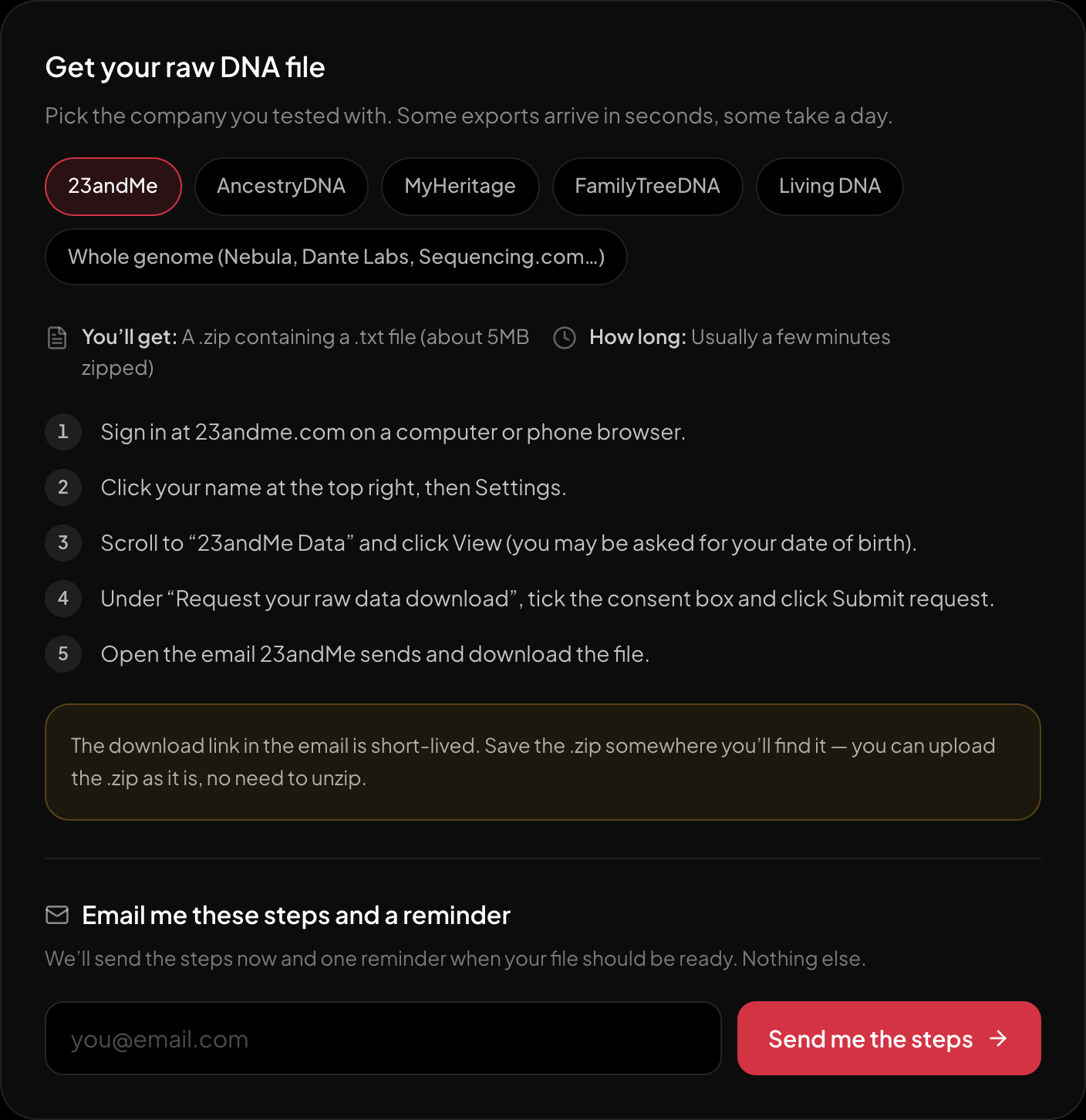
The download steps for 23andMe, on the page itself.
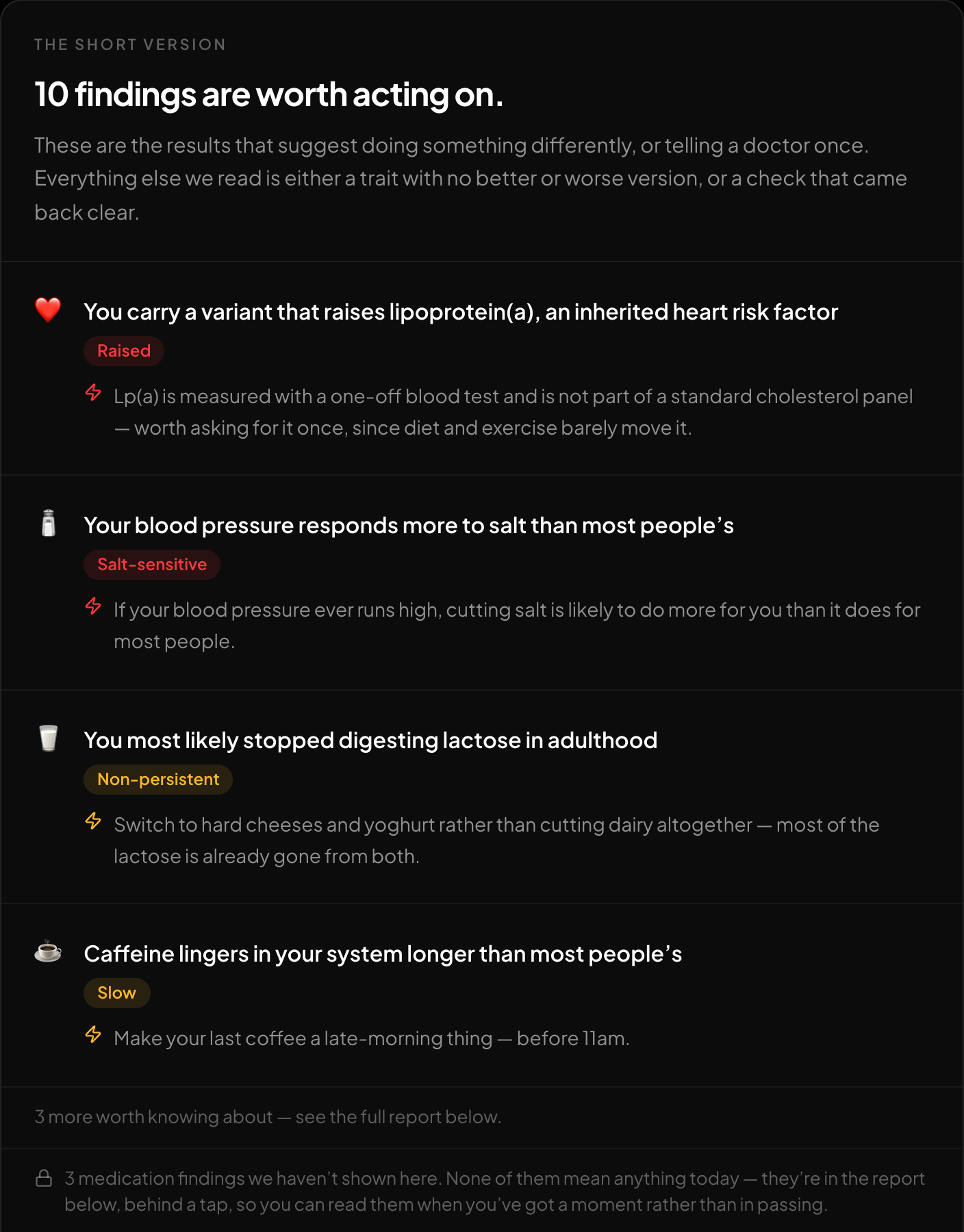
The short version: what is worth acting on, first.
If you want to see the call in your own file, the free DNA tool at healthosx.com/dna can parse supported named-genotype files such as 23andMe, AncestryDNA, or MyHeritage in your browser. Whole-genome VCFs without rsID annotations can be used for ancestry, but they cannot produce named health findings such as TTR V122I. The TTR single-variant finding appears only if the file contains a usable call at the named position. The free full report, including pharmacogenomics and the TTR single-variant health finding, opens after a one-time email code.
New to raw DNA files? Start with the full guide: How to Download & Analyze Your 23andMe Raw Data Free
Written by
HealthOS Research