Why Does MyHeritage Say I'm South Italian When I'm Lebanese
MyHeritage may say South Italian because Lebanese and South Italians share old East Mediterranean DNA. Here is how to tell a proxy from a real Italian ancestor.
MyHeritage may say South Italian because your DNA is closer to its South Italian reference samples than to its Lebanese samples, due to shared eastern Mediterranean ancestry. The estimate is not proof of an Italian ancestor. It means some of your DNA resembles the South Italian reference samples MyHeritage currently uses, and MyHeritage may assign the nearest available label when Levantine and South Mediterranean patterns overlap.
Why does MyHeritage say I'm South Italian when I'm Lebanese
MyHeritage compares your DNA to its current reference labels. If your DNA is closer to South Italian reference samples than to Lebanese samples, it may assign South Italian. This does not trace a paper trail.
If you are Lebanese, parts of your DNA may resemble Anatolian, Levantine, Aegean and South European reference samples. MyHeritage may label those parts as South Italian if that is the closest reference pattern available for the overlap.
South Italian on MyHeritage is usually a proximity label for shared East Mediterranean DNA, not proof of an Italian ancestor.
How a South Italian label gets made
South Italians and Lebanese do not have one uniform genetic profile. People from different communities and families can receive different MyHeritage results. When a panel groups shared East Mediterranean patterns into broad modern labels, a Lebanese genome can fall closer to South Italian than to some Lebanese reference samples if those samples do not represent your specific background. The label is a statement about similarity to the people in the reference database, not a place of origin.
Lebanese and South Italians share more than a sea
The Eastern Mediterranean has been a connected region for thousands of years through trade, migration and empire. Phoenician networks, Greek and Roman colonies, Byzantine rule, Arab expansion and Italian trading cities moved people and ideas. The sea connected people more than it separated them.
That shared DNA is old. It may appear as many small pieces scattered across your chromosomes rather than one long recent Italian block. That matters when you want to know whether the estimate is a proxy or a real line.
How to tell real Italian ancestry from a proxy
Look for these in your actual data and in a separate relative-matching service. HealthOS has no relative-matching database.
| Signal | Proxy from shared East Mediterranean DNA | Recent Italian ancestor |
|---|---|---|
| Segment pattern | Smaller scattered pieces may suggest older shared ancestry, but cutoffs are not validated. | Longer, fewer blocks may suggest recent ancestry, but cutoffs are not validated. |
| DNA matches | Few or no Italian matches with local trees in a separate relative-matching service. | A cluster from one Italian town or province in a separate relative-matching service. |
| Stability after update | Results may change when reference panels or methods change. | South European label may persist, but persistence alone is not proof. |
| Chromosome pattern | Scattered across many chromosomes. | A few chromosomes carry most of the Italian-looking DNA. |
Scroll the table sideways for the rest →
Read segment patterns as illustrative only. Percentages alone are not enough. DNA matches require a separate relative-matching service.
The common mistake is treating an ethnicity percentage as an ancestor count. A label like 12% South Italian does not mean one Italian great-grandparent, especially in the Eastern Mediterranean. It means the estimate assigned that share to the reference group.
What if it really is Italian?
The obvious follow-up question is whether this could still be real.
It can be. Southern Italy and Sicily had Greek, Albanian, Norman, Arab and Jewish communities, and people did move between Beirut, Smyrna, Thessaloniki, Corfu, Malta and Naples. A smaller but real number of families have a recent Italian or Aegean ancestor. That usually shows up as:
- A cluster of DNA matches with trees from one Italian town or province in a separate relative-matching service. DNA matches and documented evidence are stronger than a label.
- A long block of Italian-looking DNA on one or two chromosomes. Longer, fewer blocks may suggest recent ancestry; smaller scattered pieces may suggest older shared ancestry, but cutoffs are not validated.
- The South Italian label persisting after a reference panel update or on another service is not proof by itself. It may be supportive only with DNA matches or documented evidence.
Without those, treat the estimate as a Mediterranean echo, not a missing ancestor. If you already know of an Italian grandparent, the estimate is not a proxy. Use it to focus the paper-trail search.
Put your raw file through a different reference panel
The cleanest next step is to look at the raw data with a different reference panel. The free DNA tool at https://healthosx.com/dna reads raw 23andMe, AncestryDNA, MyHeritage or whole-genome VCF files in the browser for an initial story that needs no upload. The full health report, including traits, medication response and carrier-relevant findings, opens after a one-time email code. Optional genetic ancestry runs on the server only with explicit consent, sends only the needed markers, and can be deleted. HealthOS has no relative-matching database. VCF files without rsID annotations can work for ancestry but cannot produce the health findings. The ancestry run uses the AADR Human Origins panel, reports proportions across 15 regions, and names closest reference populations including Lebanese and Sicilian where available. HealthOS ancestry is expressed as similarity to reference populations, not descent or proof of origin.
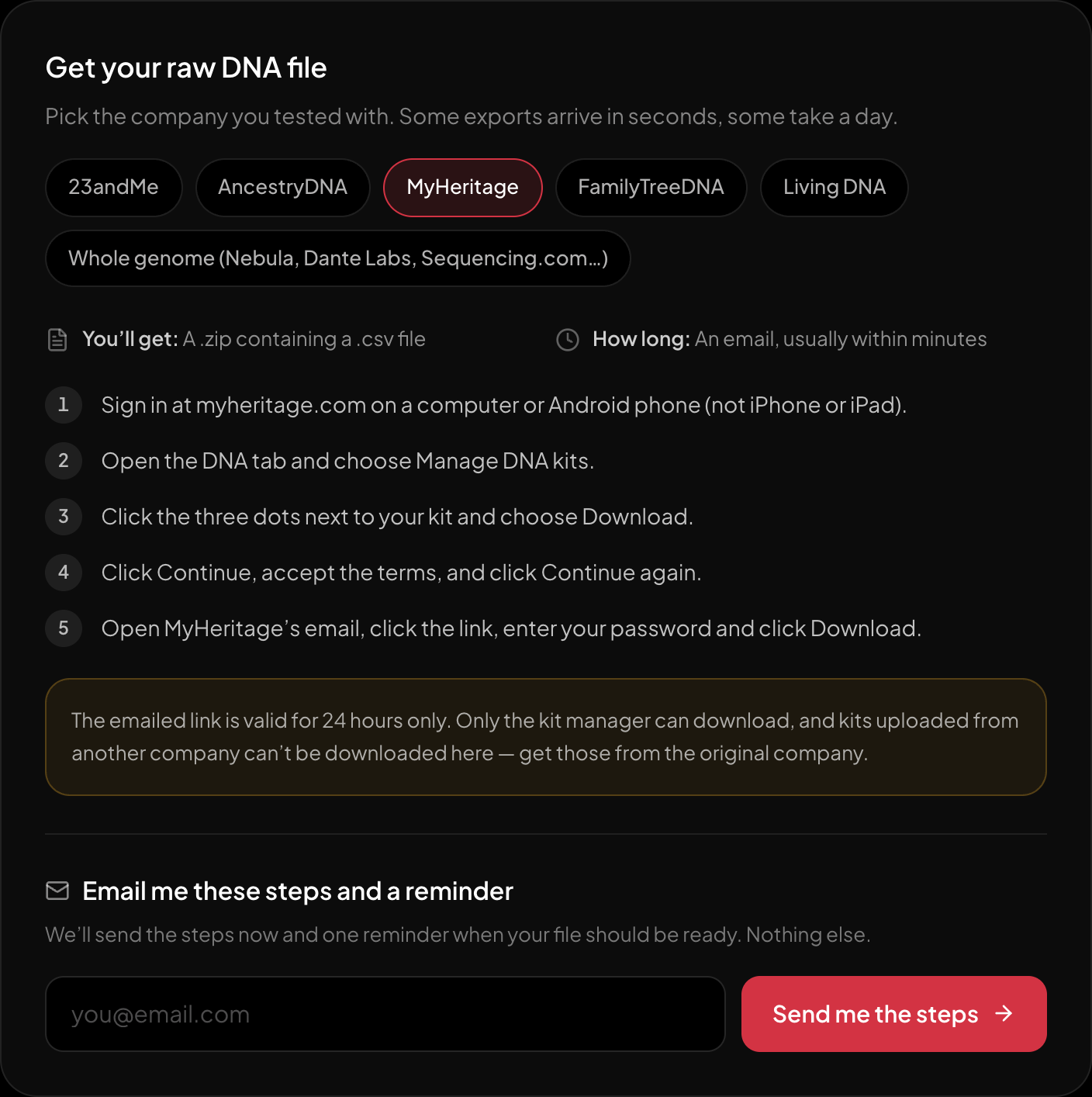
The download steps for MyHeritage, on the page itself.
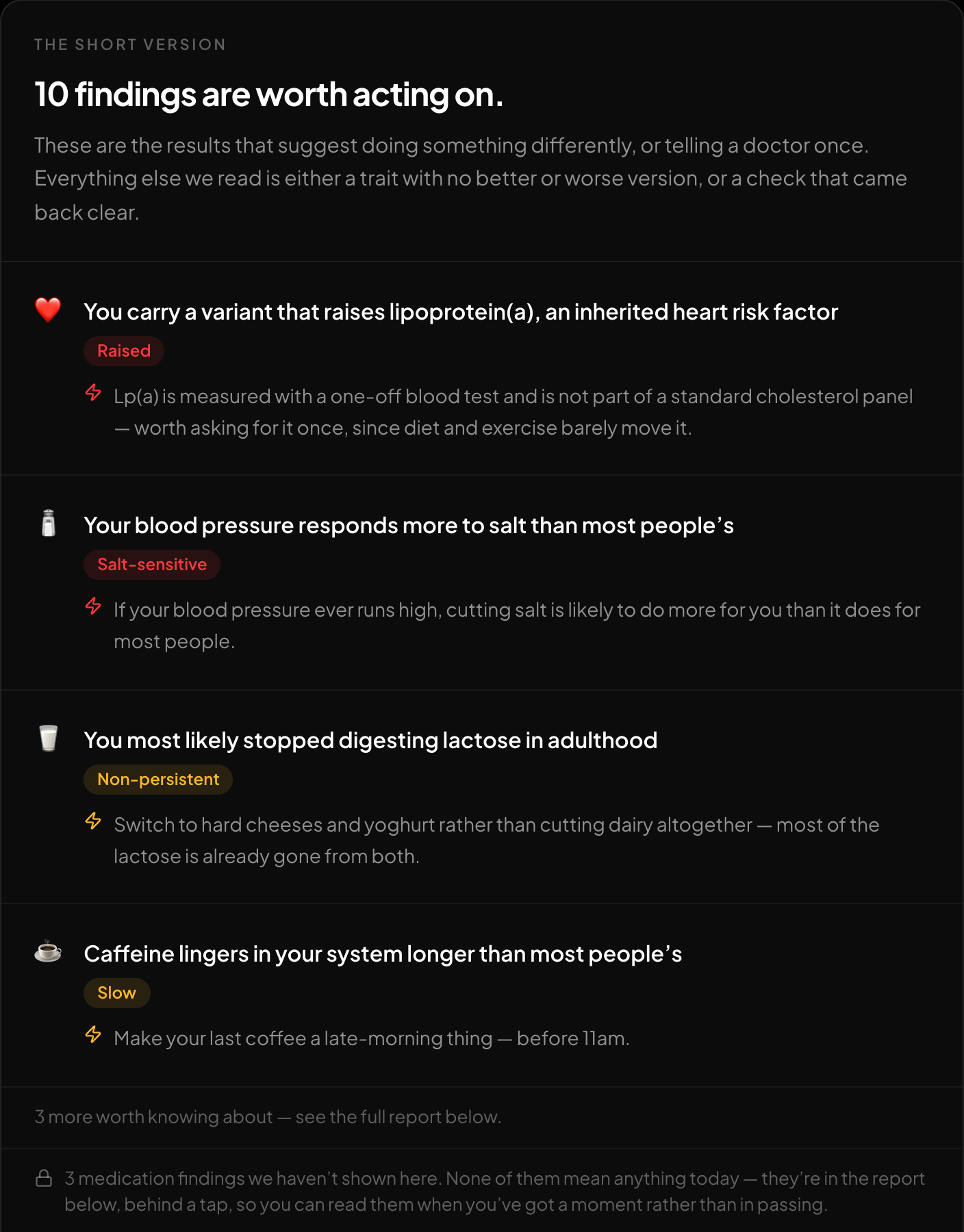
The short version: what is worth acting on, first.
Running your file through a different reference panel may provide another similarity-based view, but it does not guarantee finer separation or resolve the MyHeritage result. Use it as a complement to DNA matches and documented evidence before you rewrite a family story.
New to raw DNA files? Start with the full guide: How to Download & Analyze Your 23andMe Raw Data Free
Written by
HealthOS Research