What the PAX8 Region in Your 23andMe Raw Data Means for Sleep
The PAX8 region in 23andMe raw data is a small sleep-associated marker, not a sleep disorder diagnosis.
If your raw 23andMe file is read by a free health report, the PAX8 region under sleep refers to a small genome-wide association between a common DNA marker near the PAX8 gene and the sleep trait HealthOS labels as How easily your nights come apart. It is a common genetic tendency, not a sleep disorder diagnosis, and the effect is small.
What does the PAX8 region in my 23andMe raw data mean for sleep?
Your 23andMe raw data does not label genes. It lists rs numbers, chromosome positions and genotypes. A report maps one of those markers to a region near PAX8 and gives it a plain-language label. If you carry the copy associated with the sleep finding, the report may flag it. Many people carry at least one copy of the risk version and still sleep normally.
If you open your raw file in a text editor and search for PAX8, you probably will not find it. The file indexes by rs number, not gene. The report does the mapping. If your version of the chip did not include that marker, the report may skip the line. That does not mean you lack the association. It means the file has no data for it.
A PAX8 region result is background genetics, not a verdict. If your nights are coming apart, look at caffeine, timing, alcohol, stress and sleep apnea before this variant.
PAX8's day job is not sleep
PAX8 encodes a transcription factor, a protein that switches other genes on during development. It is best known for building the thyroid, the kidneys and the Müllerian ducts. Rare damaging mutations in PAX8 can cause congenital hypothyroidism. That is not what a common raw-data variant does. A common marker near a gene and a rare disease mutation in that gene are different things.
One hypothesis is thyroid hormone. Thyroid hormone affects wakefulness, body temperature and metabolic rate. But the sleep association may not run through PAX8 at all. In genetic studies the signal near PAX8 could be tagging a nearby regulatory region that controls a different gene. The gene name is a signpost, not a confirmed mechanism.
How much sleep difference are we talking about?
Common sleep-associated variants usually have small effects. For example, in large genetic studies, one copy of a common sleep duration variant often moves average sleep duration by roughly one to three minutes. That is an illustrative range for common sleep variants, not a measured effect for this exact PAX8 marker. The PAX8 finding is reported as a tendency toward more easily broken sleep, and should be read as a small shift, not a large or diagnostic effect. Some reports phrase it as higher odds of short sleep or of waking during the night. Think of that as moving your odds a few percent, not doubling them.
If you already sleep badly, this variant is rarely the reason. A 30 minute difference in time in bed, a late coffee, a few drinks, or untreated sleep apnea moves sleep more than this marker does.
Does this mean I have a sleep disorder?
Short answer: no. A sleep disorder requires symptoms that cause distress or daytime impairment, not a genotype. The marker is common in people with normal sleep. If you have insomnia, short sleep or non-refreshing sleep, this result is useful only because it tells you the main driver is probably elsewhere. If sleep problems persist, a sleep diary or a sleep study answers more than this SNP can.
| What it is | What it is not | |
|---|---|---|
| Finding type | A common marker near PAX8 | A sleep disorder test |
| Effect size | A small shift in the HealthOS sleep trait | Hours per copy or a diagnosis |
| Clinical meaning | A background genetic tendency | A reason to start treatment on its own |
| Thyroid link | Unrelated to rare congenital hypothyroidism | A sign you have thyroid disease |
Scroll the table sideways for the rest →
Use it as background.
A common mistake is seeing PAX8 and worrying about thyroid because PAX8 is linked to congenital hypothyroidism. The sleep-associated marker is not a thyroid diagnosis. If you have fatigue, weight changes, cold intolerance or a swollen thyroid, thyroid blood tests are the way to answer that, not this SNP.
What is still unknown
The exact causal gene is not settled. Because markers are inherited in blocks, the sleep signal may point at PAX8 while the real variant sits in a nearby regulatory region and controls a different gene. Many sleep genome-wide association studies are European-heavy, so transferability to other ancestries is uncertain. And no raw DNA result can tell you whether your current sleep problem is caused by behaviour, stress, medication, thyroid disease or another condition.
That is the honest limit. The finding is a small statistical association, not a medical answer.
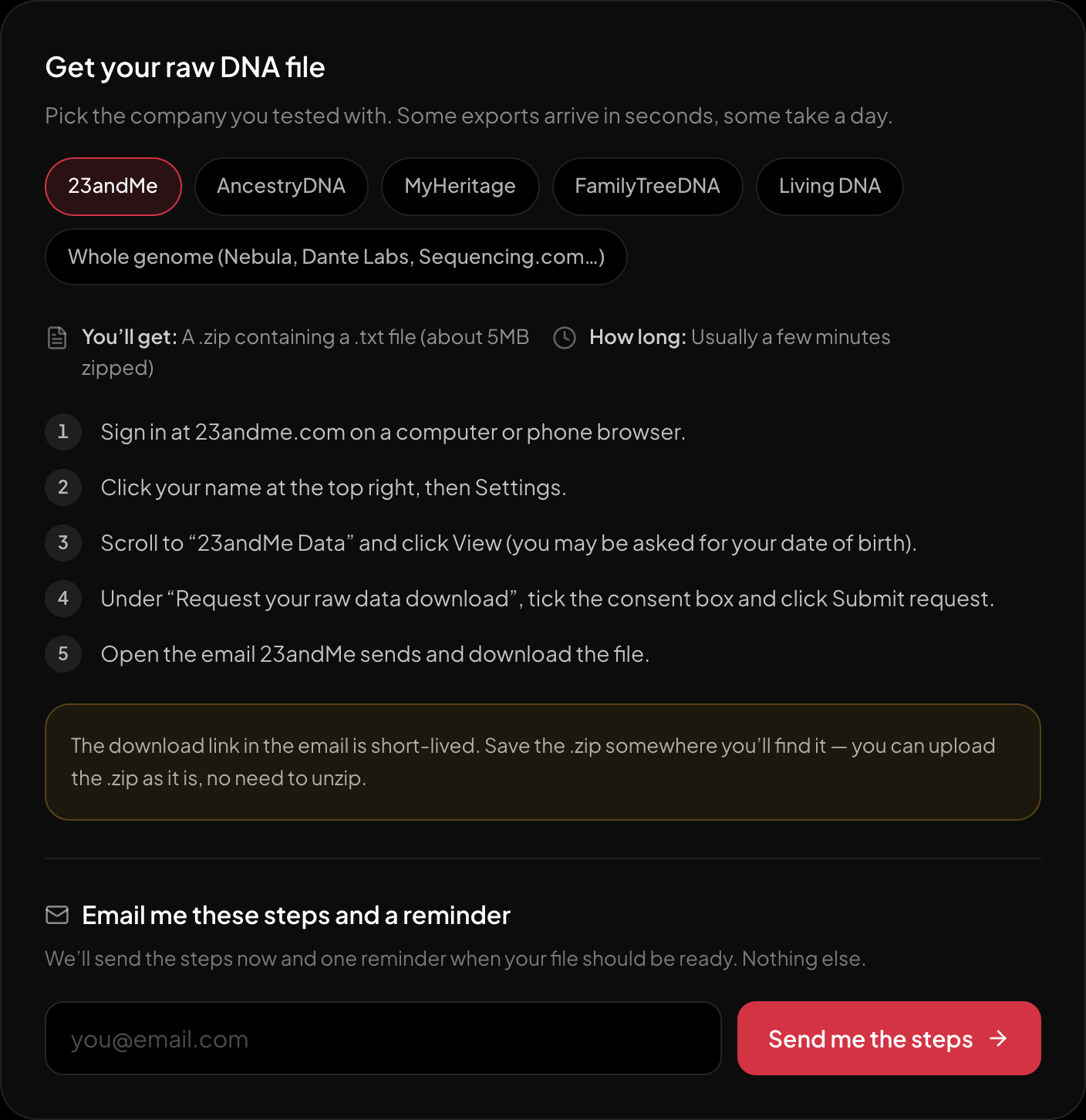
The download steps for 23andMe, on the page itself.

The short version: what is worth acting on, first.
To see it in your own numbers, open your file with the free HealthOS DNA tool. It reads 23andMe, AncestryDNA, MyHeritage and whole-genome VCF files in the browser and reports this finding, medication response, carrier-relevant findings and ancestry. The first story needs no account.
New to raw DNA files? Start with the full guide: How to Download & Analyze Your 23andMe Raw Data Free
Written by
HealthOS Research