Does the OPRM1 A118G Gene in My Raw DNA Mean Opioid Painkillers Won't Work for Me
OPRM1 A118G (rs1799971) is linked to slightly higher average opioid doses in some studies, but the difference is small and it cannot tell you whether opioids will work for you. CYP2D6 is the gene with real codeine and tramadol guidance.
Probably not, and the A118G result alone cannot tell you. The G allele of rs1799971 (A118G, Asn40Asp) in the OPRM1 gene is associated with slightly higher opioid dose needs on average in some studies, but the difference is small, people with every genotype overlap heavily, and CPIC has no OPRM1 dosing guidance for opioids. If opioids have felt weak for you, the drug itself, the type of pain and a different gene, CYP2D6, are all better suspects.
What A118G changes in the receptor
OPRM1 codes for the mu-opioid receptor, the main docking site for morphine, fentanyl, oxycodone and your own endorphins. The A to G change swaps asparagine for aspartate at position 40 and removes a sugar-attachment (glycosylation) site on the receptor's outer tip. Lab studies disagree on what that does: some find less receptor protein, others find different binding, and nobody has shown a single clean mechanism that explains a clinical effect.
How common A118G is, and how much it shifts dose
In a 23andMe or AncestryDNA raw file the genotype is written as two letters. The G allele is an ordinary variant, not a rare fault, and how often people carry it depends a great deal on ancestry.
| Ancestry | Carry at least one G (approximate) |
|---|---|
| European | Roughly 25-30% |
| East Asian | Roughly 60-80% |
| African | Roughly 1-5% |
Approximate, rounded percentages of people with A/G or G/G. Frequencies vary between studies and subgroups.
In some studies of people after surgery, G carriers used more morphine or similar drugs than A/A patients in the first day or so. The pooled difference is small and varies by cohort, so there is no single reliable figure to quote. Dose needs also differ widely between patients for reasons such as body size, age, kidney function, the type of surgery and prior opioid use. The genotype groups therefore overlap heavily: many A/A patients need more than the average G carrier, and many G carriers need less than the average A/A patient. G does not mean opioids are resistant, and A/A does not mean they will work well.
| Genotype | Receptor (position 40) | Reported average effect |
|---|---|---|
| A/A | Asparagine on both copies | Reference. No expected change in opioid need. |
| A/G | One asparagine, one aspartate | Reported in some studies to go with a slightly higher average dose need. Does not predict one person. |
| G/G | Aspartate on both copies | Reported in some studies to go with a larger average difference than A/G; groups still overlap heavily. |
Scroll the table sideways for the rest →
Averages from some studies. Individual results vary widely and the result is not used to set a dose.
Why the evidence stays modest
Two things limit what the studies can show.
- Studies are small and pain is hard to measure. Self-reported pain scores and dose used both depend on the surgeon, the ward and the patient's expectations.
- Results differ between populations and between studies, partly because the G allele is less common in some groups and studies lack the numbers to see a small effect.
A separate line of research asks whether G carriers respond better to naltrexone for alcohol use disorder. Findings there are inconsistent too, and it is not a standard clinical test.
CYP2D6 is the gene with prescribing guidance
The opioid gene that does carry formal guidance is CYP2D6. It codes for a liver enzyme that converts codeine into morphine and tramadol into its more active form. Those drugs are prodrugs, so if the enzyme is absent or sluggish you get little pain relief. If it is unusually fast, you can get too much morphine, which is a real safety problem, especially for children and for breastfeeding mothers taking codeine. The CPIC guideline for codeine and tramadol is built on this gene.
| OPRM1 A118G | CYP2D6 | |
|---|---|---|
| What it is | The drug target: the mu-opioid receptor | The liver enzyme that activates codeine and tramadol |
| Prescribing guidance | No CPIC opioid dosing guidance | CPIC codeine and tramadol guidance |
| Size of effect | Small average shift in dose in some studies | Large for poor and ultrarapid metabolizers |
| Readable from a raw chip file | Yes, one letter pair, if the position is in your file | Only partly, deletions and duplications are missed |
| Next step | Nothing to act on | A clinical test is the reliable route |
Scroll the table sideways for the rest →
CPIC is the Clinical Pharmacogenetics Implementation Consortium.
This matters if your experience is that codeine or tramadol did nothing. Morphine, hydromorphone and fentanyl do not depend on CYP2D6 activation, so those would not fail for that reason. Oxycodone and hydrocodone are partly affected, with weaker guidance. Some common drugs, including fluoxetine, paroxetine and bupropion, block CYP2D6 and can make a normal metabolizer behave like a poor one.
Other causes of a weak response are more mundane and more common than any gene variant:
- Tolerance after weeks of regular use
- Nerve pain, which responds poorly to opioids in general
- A dose or timing that does not match the pain
What to do with your result
The free HealthOSX report does not cover OPRM1. To see your A118G result, look up rs1799971 with the lookup tool at healthosx.com/dna/lookup.
- Expect A/A, A/G or G/G. 23andMe and AncestryDNA may show the genotype on a different strand or in a different letter format (for example T/C instead of A/G), and A/G on the lookup is the expected heterozygous reading, one copy of each.
- If the lookup returns "no call" or finds nothing, that position was not read or is not on your chip version, so you cannot infer a genotype. It is not worth a separate test for this gene.
- Treat the result as background with a small statistical lean, not as a reason to change a prescription.
- If a painkiller really failed, tell the prescriber what you took, how much and what happened. That is more useful to them than a raw genotype.
- CYP2D6 is not among the report's headline findings. Check whether your report's medication list includes it, but a chip cannot see deletions or duplications of the gene, so a clinical pharmacogenetic test is the reliable route for the codeine or tramadol question.
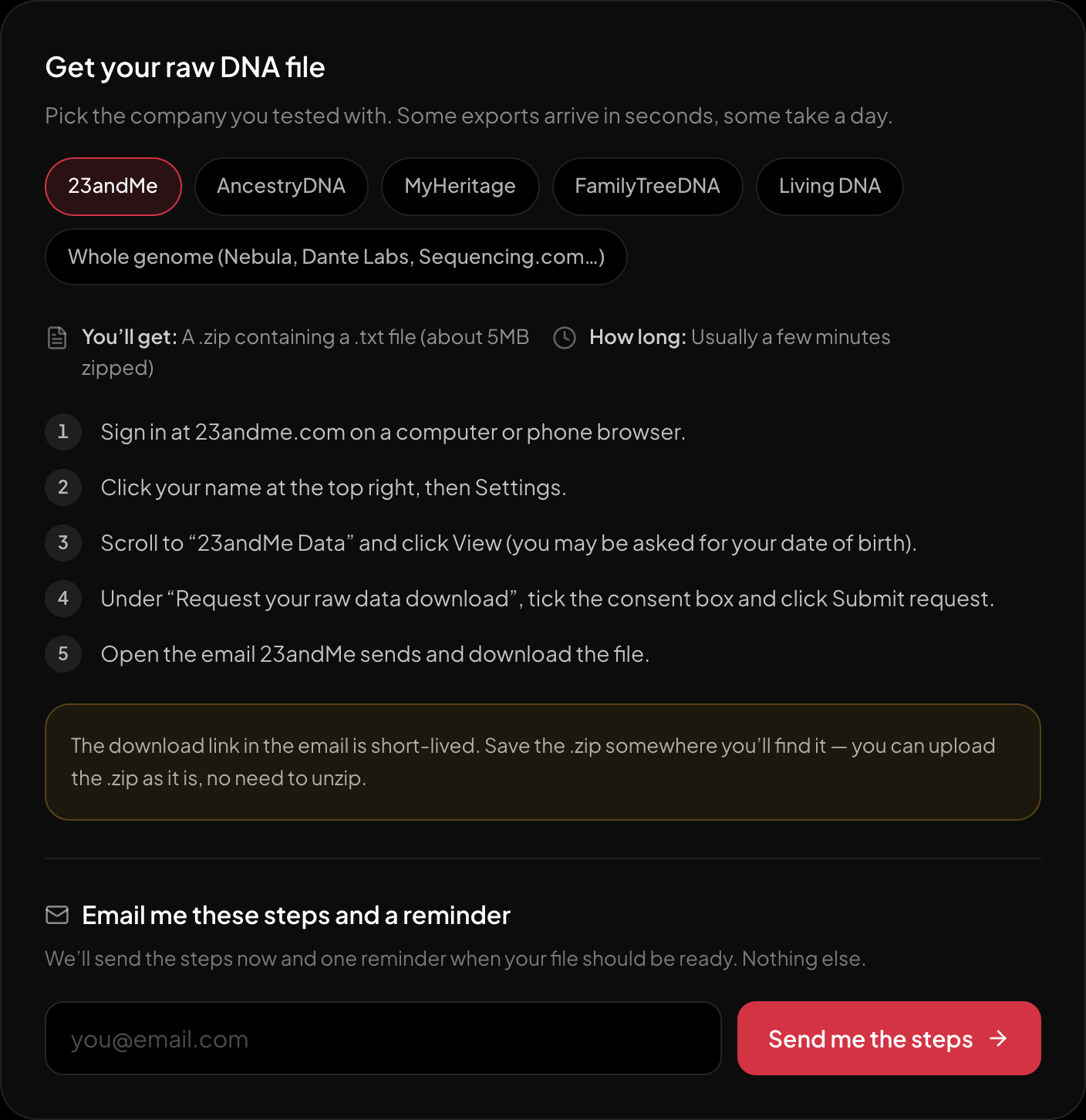
The download steps for 23andMe, on the page itself.
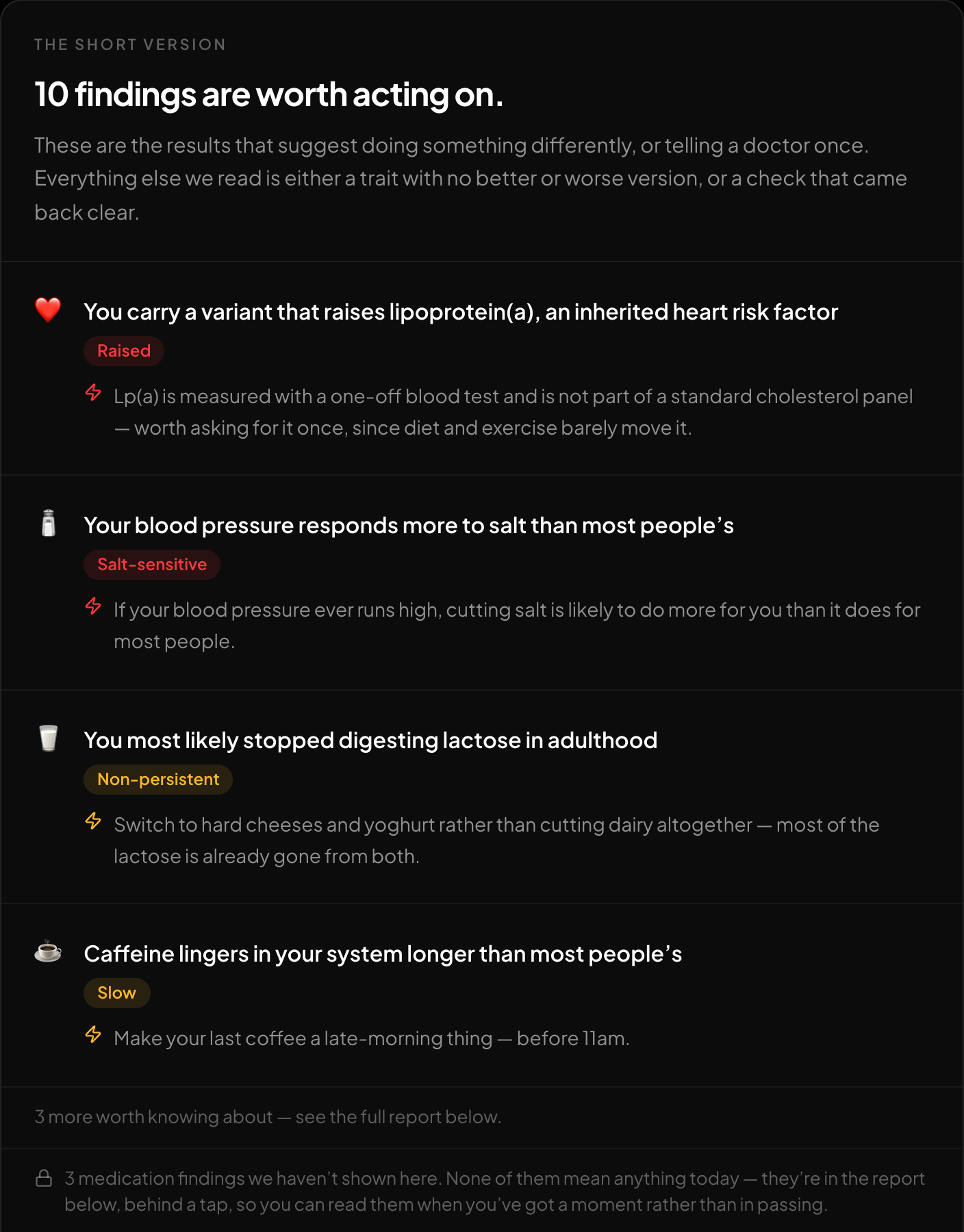
The short version: what is worth acting on, first.
The free DNA tool reads a raw 23andMe, AncestryDNA, MyHeritage or whole-genome VCF file and lists medication response drug by drug from CPIC guidance.
New to raw DNA files? Start with the full guide: 23andMe Raw Data Interpretation Free in Your Browser
Written by
HealthOSX Research