Why Do I Have No Big Y or Y-DNA Matches on FamilyTreeDNA?
No Big Y or Y-DNA matches usually means no tested man is close on your direct paternal line, not that you have no paternal relatives.
Why Do I Have No Big Y or Y-DNA Matches on FamilyTreeDNA?
If your FamilyTreeDNA Y-DNA or Big Y match list is empty, the most common explanation is simple. Nobody in FTDNA's database is close enough to you on your direct paternal line at the matching threshold. It does not mean your father, grandfather, or paternal line is missing from your biology. A zero match list also does not mean the test failed, especially if a haplogroup was reported.
Why do I have no Big Y or Y-DNA matches?
| Test | What counts as a match | Why zero happens |
|---|---|---|
| Y-37 | STR genetic distance, usually 0 to 4 differences at 37 markers | Your haplotype is too distant or nobody in your region tested |
| Y-67 | STR genetic distance across 67 markers | More markers than Y-37, but coverage is still limited for rare lines |
| Y-111 | STR genetic distance across 111 markers | More markers tighten the match, but rare lines still have no comparison |
| Big Y-700 | Non-matching variants, roughly 30 or fewer | Your terminal branch may have no other tested man yet |
Scroll the table sideways for the rest →
Approximate thresholds for common STR tests and Big Y-700; FTDNA may adjust display as the tree changes.
A Y-DNA match is not the same as an autosomal DNA match. Y-DNA follows only the direct paternal line. Most of your relatives share no Y-DNA with you because the connection is through mothers, grandmothers, or sisters, not the father's father's father line. So the number of possible Y matches is far smaller than your total relatives.
FamilyTreeDNA uses two kinds of Y-DNA matching. STR tests like Y-37, Y-67, and Y-111 count differences at rapidly changing markers. Big Y-700 sequences far more of the Y chromosome and compares non-matching variants across a SNP tree. A Big Y match appears when another man sits close enough to your terminal branch or a neighbouring branch. In practice that means roughly 30 non-matching variants or fewer, though the display can change as the tree is refined.
Zero Y-DNA matches means no tested man is close on that one line. It says nothing about whether you have paternal relatives.
Why zero is normal for rare and under-tested lines
The biggest reason is coverage. FTDNA has the largest Y-DNA database, but it is still tiny next to autosomal databases. Tens of millions of people have taken autosomal tests from 23andMe or AncestryDNA. The number who have taken a Y-DNA test is a small fraction of that. A rare terminal branch may have only one or two men in the entire database, and you might be one of them.
Under-testing is uneven. If your paternal line comes from South Asia, the Middle East, North Africa, sub-Saharan Africa, East Asia, or indigenous American communities, you are far more likely to see zero matches. Even inside Europe, some regions have few testers. A surname project full of English or German testers does not help a man whose line is from Lebanon or Madagascar.
A broad haplogroup such as R-M269 can still produce Y-STR matches because STR matching uses marker differences, not only the terminal SNP. That does not guarantee Big Y matches. Zero matches, especially for Big Y-700, means no tested man is close on your terminal branch or a neighbouring branch. If your terminal SNP is rare, private, or not yet placed on the public tree, no match list is the expected result.
What does a match actually mean?
A Big Y match does not mean you found a cousin in the ordinary sense. It means you and another man share a paternal ancestor recently enough that your Y chromosomes have not drifted far apart. With Y-37, a match at genetic distance 0 means identical markers. That can still be misleading because those 37 markers are a tiny view. With Big Y, the match is based on SNP differences, which are slower and more stable.
You can have zero Y matches and still have plenty of autosomal matches on the same paternal side, through your father's mother, your grandfather's mother, and so on. Those relatives do not carry the same Y chromosome.
What should I do next?
Start with the quick checks. Many people who are sure they should have matches simply have matching turned off.
- Check Account Settings > Privacy & Sharing. Confirm that Y-DNA matching is enabled for the relevant test.
- Look at your terminal SNP. A haplogroup displayed means the sequencing did work. No match is not a failed test.
- If your only Y test is Y-37, Y-67, or Y-111, consider Big Y-700. SNP matching can find a branch even when STRs look distant.
- Join a surname project and a haplogroup project. Project administrators can see kits within the projects you join, which may include kits that are not in your personal match list.
If you have Big Y data, upload it to a second database such as YFull or mitoYDNA. A different comparison pool sometimes surfaces a match that FTDNA does not. And if no male relative has tested, ask a cousin, uncle, or second cousin on the direct paternal line. Testing one known relative can turn your private branch into a small group.
Does no Y-DNA match mean I am not my father's son?
No. A Y-DNA test can reveal a non-paternity event when a known close paternal relative, such as a brother or a direct paternal-line male cousin (such as your father's brother's son), tests and fails to match you at many markers. No match among strangers says nothing about that question. The absence of matches is about database coverage and branch rarity, not about a sudden break in your family tree.
The same logic applies to surname surprise. Zero matches does not prove a surname change, an adoption, or an unknown father. It only proves that no tested man in the current database is close on the direct line.
What to do with the raw file you already have
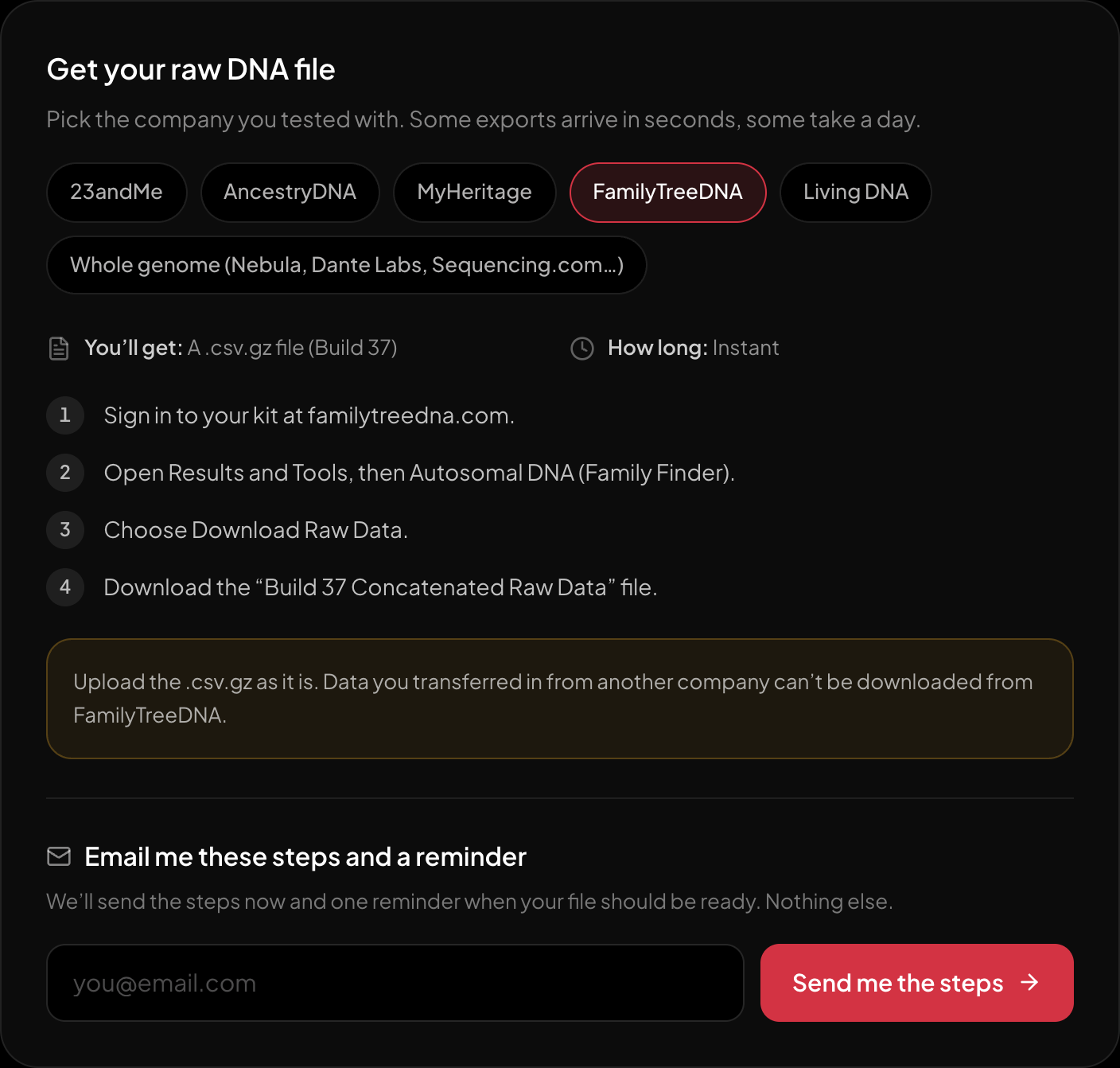
The download steps for FamilyTreeDNA, on the page itself.
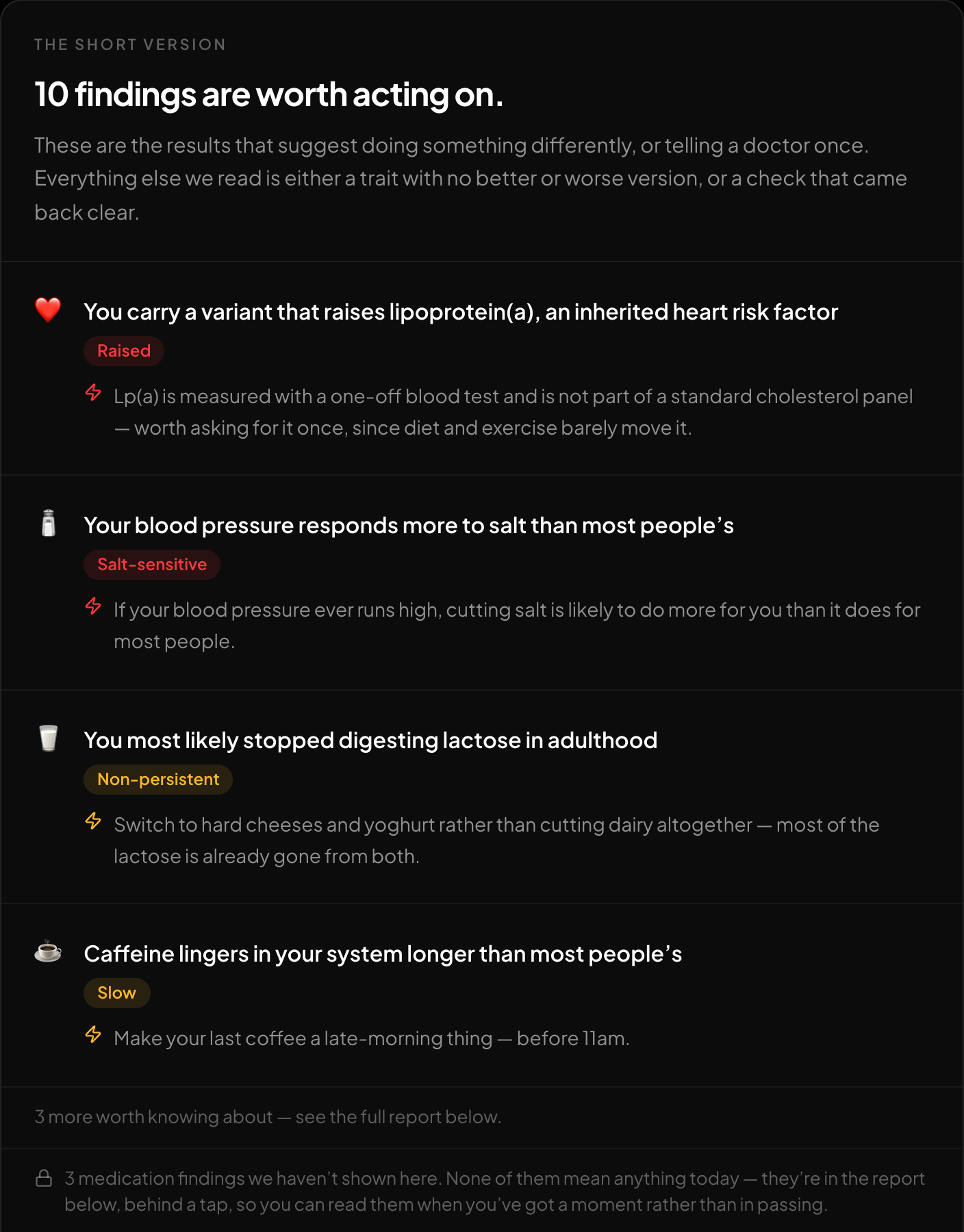
The short version: what is worth acting on, first.
If you have a raw autosomal file from 23andMe, AncestryDNA, MyHeritage, FamilyTreeDNA or a whole-genome VCF, the free DNA tool at HealthOSX reads it in the browser and reports traits, medication response and carrier-relevant findings, with optional genetic ancestry. It has no relative-matching database, so it will not fill a Y-DNA match list. But it can show what else is in the same file while you wait for your rare branch to find its next match.
New to raw DNA files? Start with the full guide: 23andMe Raw Data Interpretation Free in Your Browser
Written by
HealthOSX Research