Why Do My MyHeritage DNA Matches Show All Over Europe Instead of Mostly in My Own Country
Your MyHeritage match list is shaped by shared deep ancestry and who else tested, not by modern borders. Small segments make Europe look bigger than your recorded family tree.
If your MyHeritage DNA match list shows people scattered from Portugal to Poland, the main reason is not that your documented ancestry is wrong. It is that autosomal matching catches many small shared segments that predate national borders. MyHeritage shows you people in its database who share enough DNA with you, and across Europe you share many tiny pieces with people who are not recent relatives.
A match list is shaped by who else tested and how much DNA you share, not by your country's borders.
Why do I have DNA matches all over Europe instead of mostly in my own country?
Autosomal DNA comes in chunks called segments, measured in centimorgans (cM). You inherit large segments from close ancestors and shorter segments from older ancestors. MyHeritage reports a match when shared segments pass its detection threshold. That means matches in the single-digit cM range, often around 8 cM total or one segment near that size, can appear in your list.
At 8 cM, a match may share a common ancestor 10 or more generations back. Or the segment may be identical by state: common in the population, not evidence of a unique recent ancestor. Europe is small and densely connected, so a person from one country can share many of these tiny segments with people from other countries, even with no paper trail connecting them.
Your match list is not a census of your country
A match list is not a random sample of your ancestors. It is a sample of MyHeritage's database. If your own country has fewer testers, and nearby countries have more, the list will tilt toward the bigger testing populations.
Imagine four grandparents all born in a small country with 500,000 MyHeritage customers. A neighbouring country with 5 million customers can put far more low-level matches on your screen, even if your recent family tree is entirely from the first country. The matches are real in the narrow sense that the shared segments exist. They are not proof of recent ancestry from those places.
Deep ancestry and recent mobility blur the map
Europe's genetic map is not divided by modern borders. People moved for war, trade, work and religious persecution. The Roman Empire, medieval migrations, German speakers settling east, Scandinavian seafarers, Jewish diaspora communities, Huguenots and post-war border redrawing all left shared segments across the continent. A Dutch person can match many people in England, Germany and Scandinavia without a documented ancestor from any of those countries. The shared ancestry is older than the records.
Smaller countries and border regions show this pattern most
If your ancestry is from a small country, or from a border region that changed hands, expect more pan-European matches. Luxembourg, Belgium, Alsace, Silesia, the Baltics, the Balkans and similar areas spent centuries as transit zones. People crossed back and forth. Their descendants now carry segments that look like they come from everywhere.
What MyHeritage can and cannot infer from a match list
MyHeritage can infer that you share one or more autosomal segments above its threshold with another person in its database. It cannot infer that you have recent ancestry in that person's current country. A match whose tree says France does not mean you have a French ancestor. It means a person with some French paper trail shares a small segment with you.
The ethnicity estimate and Genetic Groups are separate from the match list. Ethnicity estimates use reference panels and broader regions. Match lists use direct segment sharing. They answer different questions.
What to look at instead of counting country flags
Ignore the country names until you check the amount of shared DNA. Look at total cM and the largest segment. A match with 40 cM total and a 15 cM largest segment is more likely to be traceable than one with 8 cM and one 8 cM segment. First cousins share roughly 850 cM, second cousins about 212, third cousins about 53, fourth cousins about 13, and fifth cousins about 3.
- Useful signs: 30 cM or more, longest segment 15 cM or more, multiple segments, shared matches that make sense with your tree.
- Noise signs: under 12 cM, one segment, no tree, no shared matches, and a country that contradicts your known records.
If most of your cross-European matches sit in the 8 to 12 cM range, treat them as deep background. Do not message a dozen 8 cM matches asking how you are related.
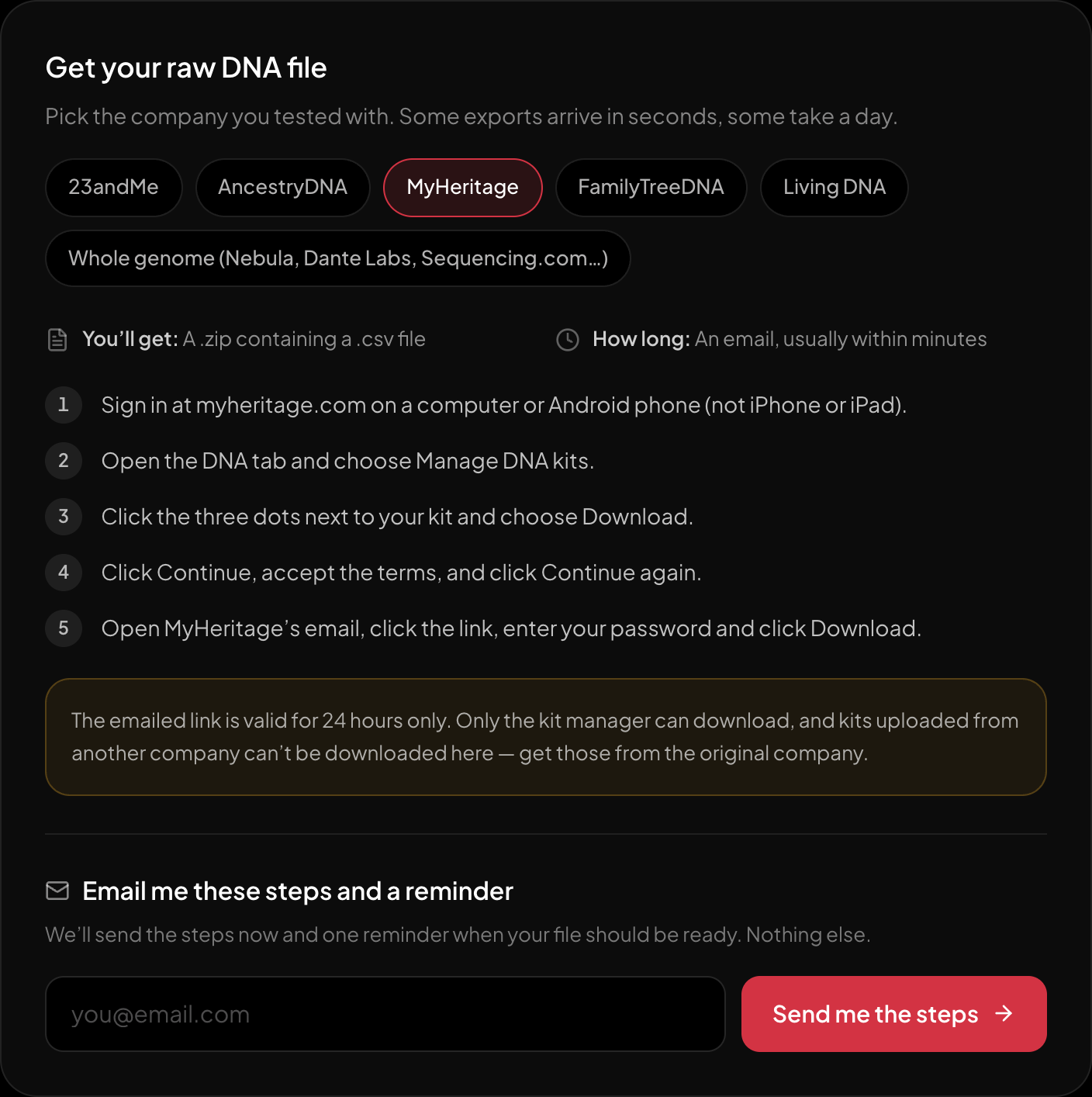
The download steps for MyHeritage, on the page itself.
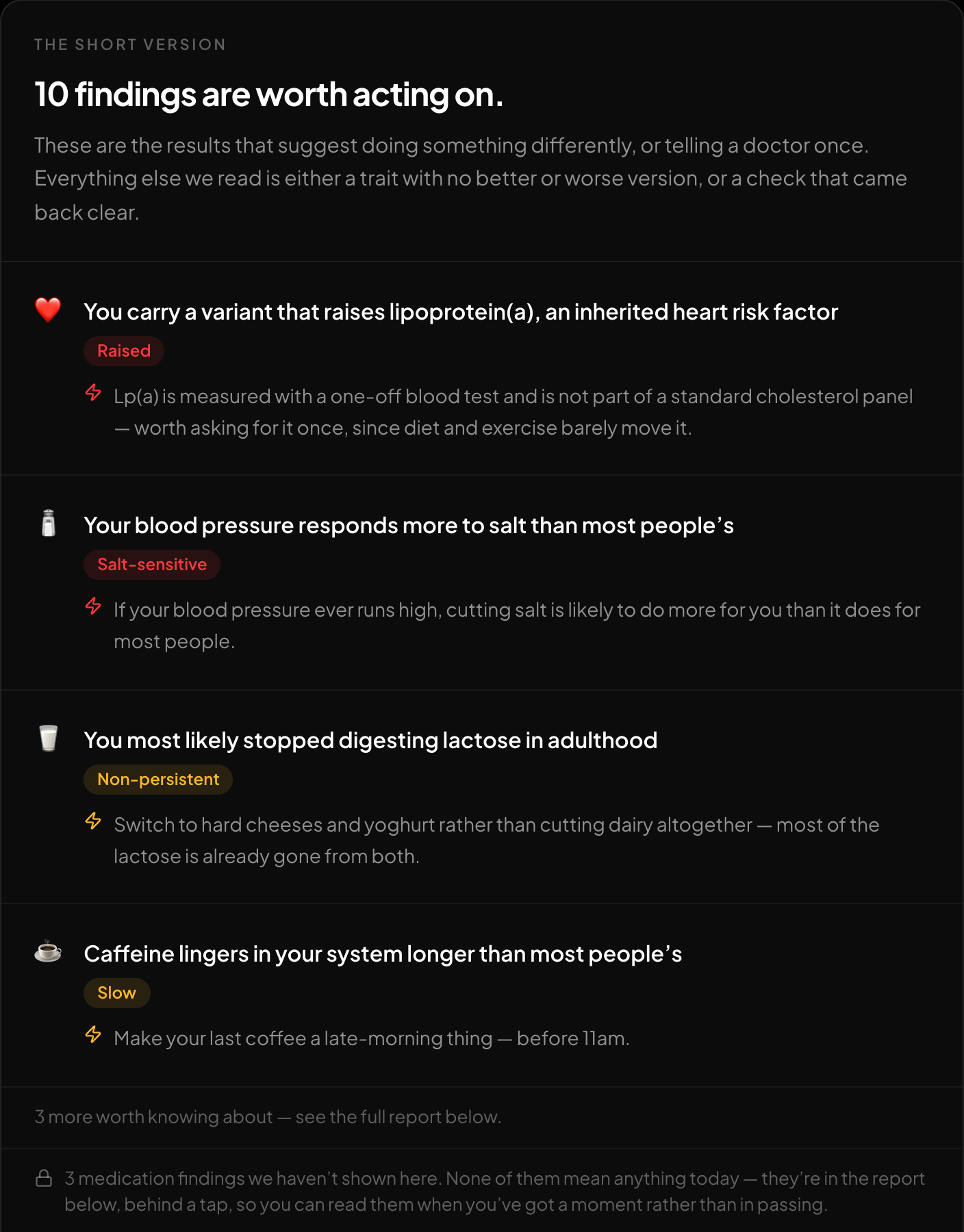
The short version: what is worth acting on, first.
If you already have a raw MyHeritage file, the free DNA tool reads it in the browser and reports traits, medication responses, carrier findings and ancestry. It is not a relative-matching database, so it will not find you more cousins. It lets you look at your own variants and ancestry panel instead of someone else's match list.
New to raw DNA files? Start with the full guide: How to Download & Analyze Your 23andMe Raw Data Free
Written by
HealthOS Research