What MC1R Means in Your 23andMe Raw Data
What MC1R markers in 23andMe raw data mean for red hair, carrier status and sun sensitivity.
MC1R in your 23andMe raw data means markers in a pigment gene that are mainly used to infer red-hair tendency, fair skin, and sun sensitivity. In 23andMe raw files, MC1R appears only through rsIDs, because the gene name is not a column. The gene helps switch melanocyte pigment production toward eumelanin or pheomelanin. One common reduced-function MC1R variant is mainly a carrier signal; freckling or burning may be increased, but red hair is not expected from one variant alone. Two reduced-function MC1R alleles increase the likelihood of red hair, but phase, ancestry, and other genes can change the phenotype.
What does MC1R mean in my 23andMe raw data?
Your downloaded 23andMe raw file has no gene name column. Search for rsids, not "MC1R". Each line shows an rsid, chromosome, position, and genotype. For MC1R, the rsids to look for sit on chromosome 16, but chromosome positions depend on genome build and chip. The strongest red hair markers are rs1805007 (R151C), rs1805008 (R160W), rs1805009 (D294H), rs1805006 (D84E) and rs11547464 (R142H). Weaker markers include rs2228479 (V92M) and rs885479 (R163Q). The exact set depends on your chip version. At each marker, two non-effect alleles mean that marker is negative. The reference allele can be the effect allele, so do not call reference or variant from the allele letters alone. One or more effect alleles fit the patterns below. Allele letters, strand orientation, and chip version vary; the effect allele must be known, or use a tool or report that handles allele orientation and effect where markers are supported.
One MC1R variant is a hint, not a verdict. Two reduced-function MC1R alleles increase the likelihood of red hair, but phase, ancestry, and other genes can change the phenotype.
How MC1R actually changes hair colour
MC1R is a G protein-coupled receptor on melanocytes. When alpha-MSH binds, the receptor sends a signal that pushes the cell toward eumelanin, the dark brown-black pigment. Reduced-function variants weaken that signal, so the cell settles toward pheomelanin, the red-yellow pigment. The same shift affects skin and freckles, not just hair. That is why a heterozygous carrier may have no red hair but may burn faster than someone with two fully working copies.
What your genotype pattern says
Most raw files fall into a few broad patterns. The table is the practical reading for the common MC1R markers, not a rare variant search. High-impact means the known red hair alleles: R151C, R160W, D294H, D84E and R142H. Weak variants V92M and R163Q are common but produce less shift. Two reduced-function MC1R alleles, such as two separate high-impact heterozygous markers or one homozygous high-impact marker, increase the likelihood of red hair, but phase, ancestry, and other genes can change the phenotype. If one high-impact marker is heterozygous, that is a carrier signal. Two weak variants may nudge hair toward auburn without full red.
| Pattern | What it means in practice |
|---|---|
| Two high-impact variants | Red hair becomes more likely, but is not guaranteed. Fair skin and freckling are common. Rare MC1R variants and non-MC1R genes can modify the result. |
| One high-impact variant | Carrier signal. Red hair is not expected unless two reduced-function alleles are present, but freckling or burning may be increased. |
| One or two weak variants | Possible auburn shift. Less predictive than high-impact markers. |
| No common variants | No common red hair marker found. Rare MC1R variants or other genes are still possible. |
Common MC1R marker patterns. Rare variants and non-MC1R genes can modify the result.
The obvious follow-up: does this change my skin cancer risk?
MC1R variants are linked to melanoma and keratinocyte cancers through fair skin, and through some signals that appear independent of hair colour. The risk is strongest when the phenotype is present: red hair, heavy freckling, and skin that burns before it tans. A single variant without red hair adds a smaller and harder-to-quantify increase. Raw MC1R markers are not a risk score and should not by themselves prescribe surveillance. Phenotype, ancestry, and clinical context matter. If you have red hair, heavy freckling, or skin that burns before it tans, discuss skin checks and mole changes with a clinician. The MC1R data is strongest in European ancestry populations. In people with naturally darker eumelanin, the same variant may have a much less visible effect.
What one variant does not prove
- One variant is not a red hair diagnosis. It is a carrier signal for a hidden red-hair variant.
- It does not mean your child will have red hair. The other parent's MC1R status matters just as much, and the variant still has to pass on.
- It does not rule out rare MC1R variants that are not on the chip.
- It does not give you a fixed skin cancer number. The visible phenotype is the stronger risk cue.
A no-common-variant result is also not a clean negative. It means the common red hair route is absent from the data you have; rare MC1R changes still exist but are not covered by most direct-to-consumer chips.
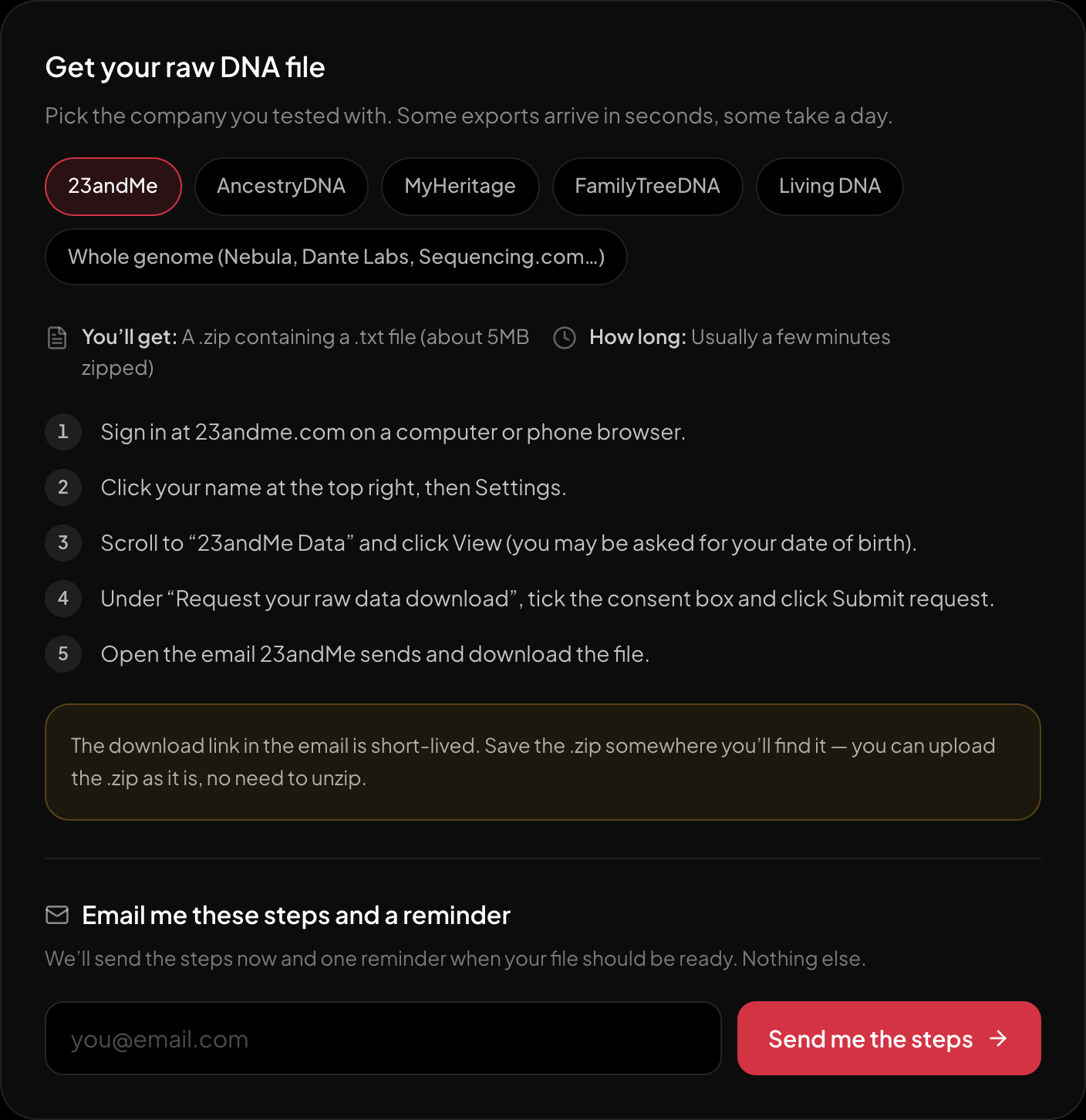
The download steps for 23andMe, on the page itself.
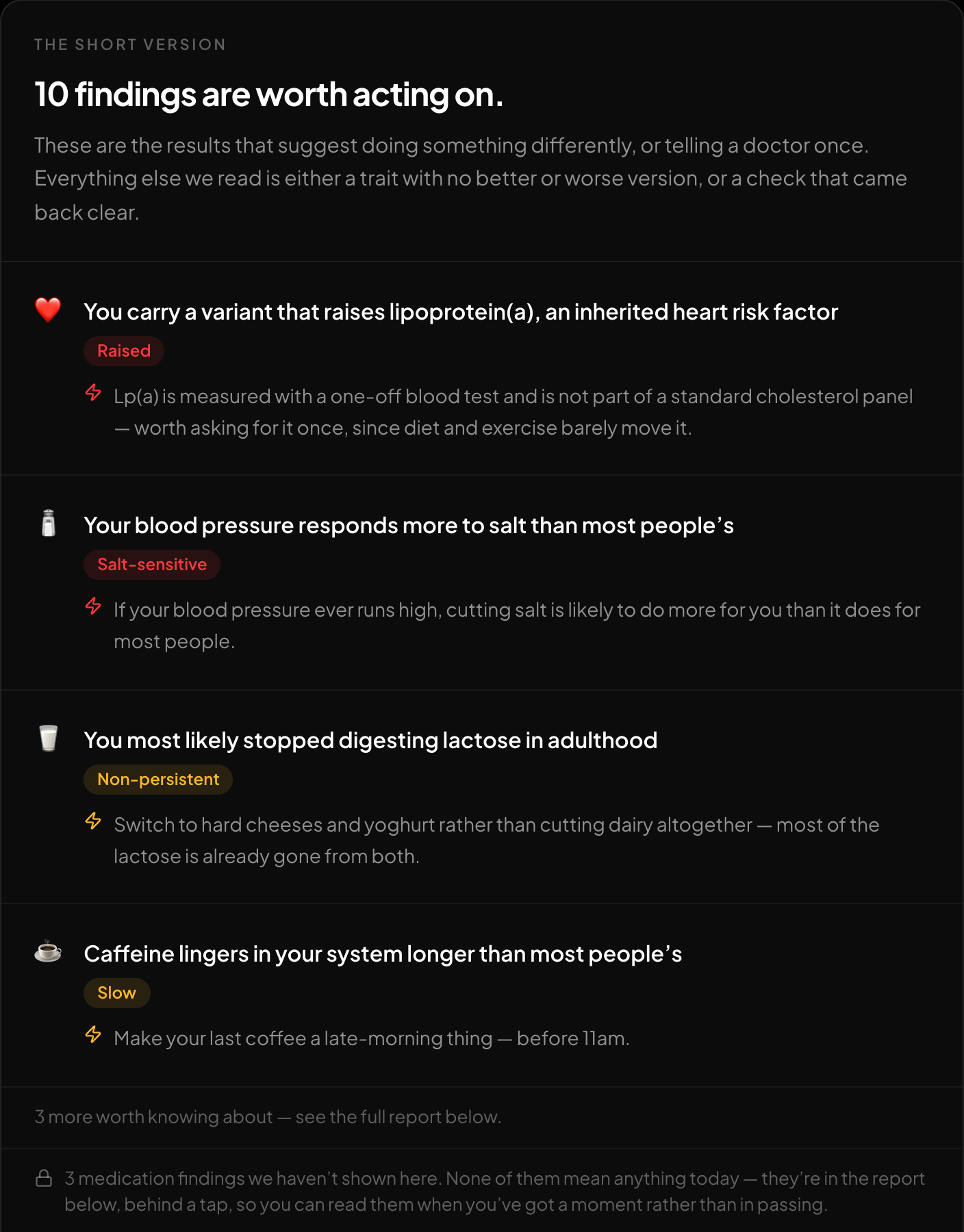
The short version: what is worth acting on, first.
Want to see your own MC1R pattern without reading rsids by hand? The free tool at HealthOS DNA includes MC1R in the free report as 'Your hair colour, and whether red runs in you', along with other trait and health findings in the free report. The file does not leave your device for the trait report. VCF files without rsIDs get ancestry only; the trait report needs rsIDs.
New to raw DNA files? Start with the full guide: How to Download & Analyze Your 23andMe Raw Data Free
Written by
HealthOS Research