Levels, Signos and Nutrisense: What a CGM App Actually Adds
The sensor is the same. What you pay a CGM app for is interpretation, and that is worth understanding before you subscribe.
Every consumer CGM app puts the same hardware on your arm. Abbott and Dexcom make the sensors; Levels, Signos, Nutrisense, Lingo and Veri are software sitting on top of them. So the sensor is not the thing you are choosing between.
What you are choosing is what happens to the curve after it arrives.
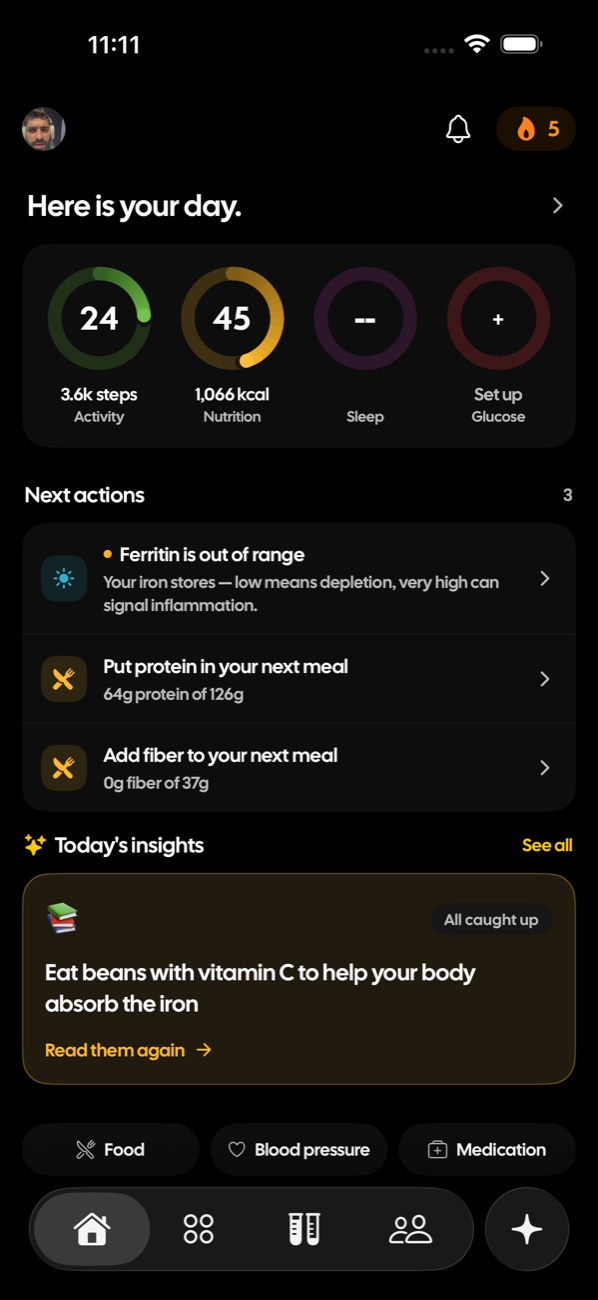
Your whole day on one screen
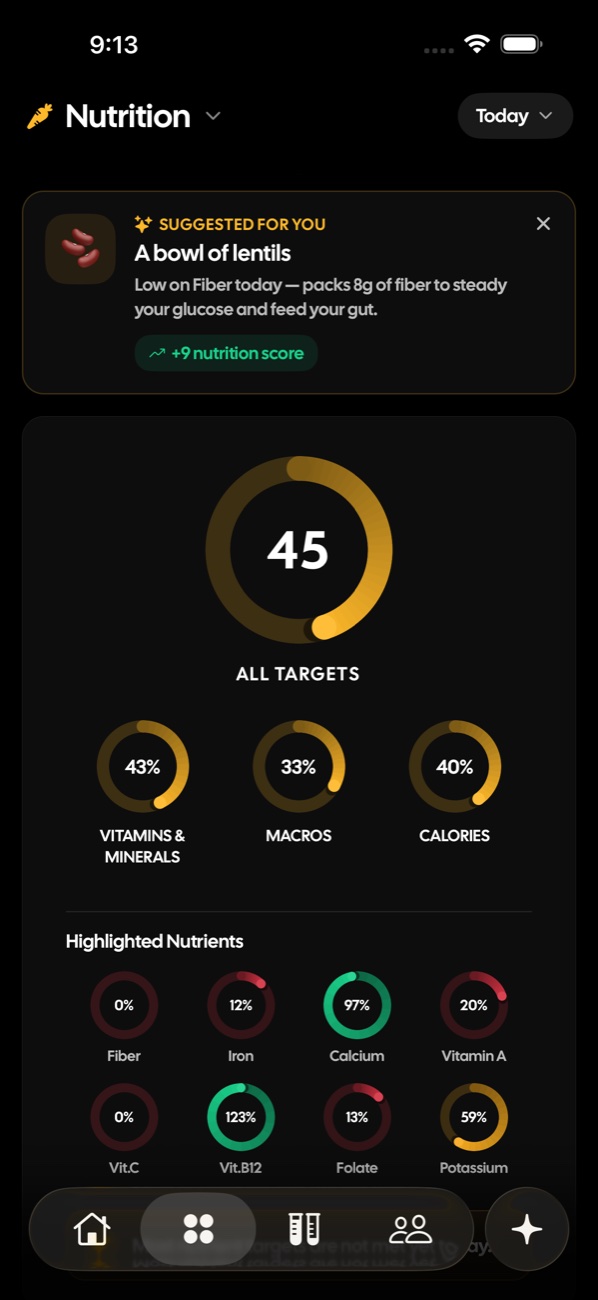
What your food really gives you
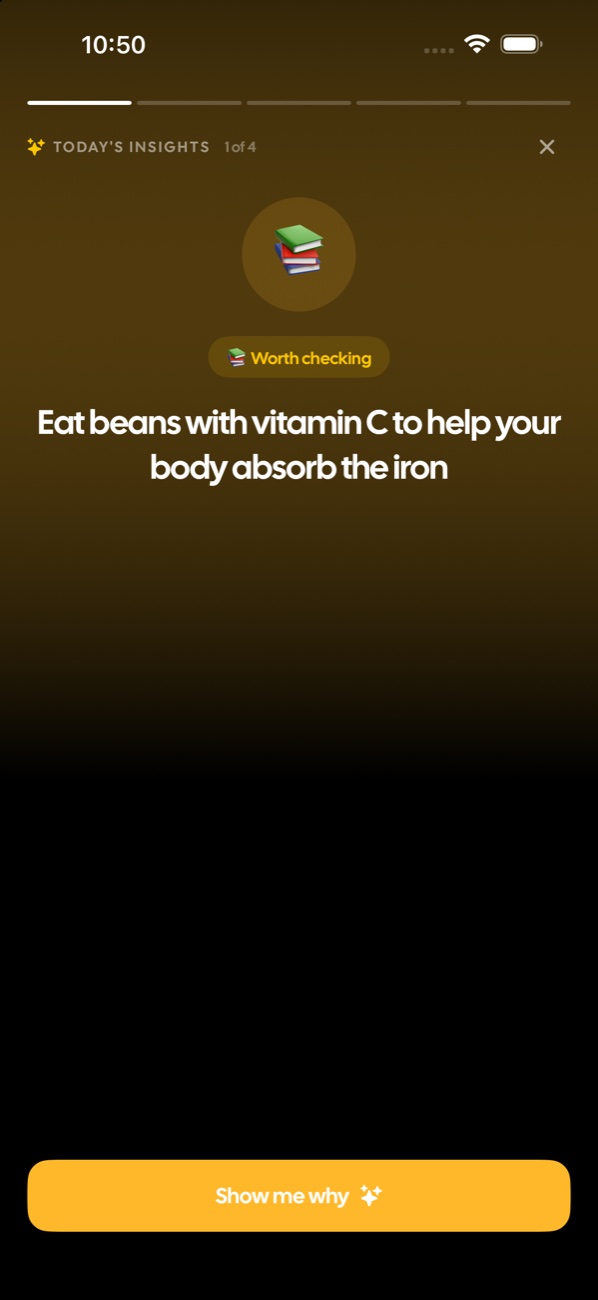
Patterns you would never spot yourself
The HealthOS app. The curve, the meal, and the training load on one timeline rather than in three apps.
The part that is identical
A sensor reads interstitial fluid every few minutes and reports a number. That number trails a finger stick by roughly five to fifteen minutes, is least reliable in the first day, and can read falsely low if you sleep on it. None of that changes between apps, and any app claiming better accuracy from the same sensor is describing its smoothing, not its measurement.
Two sensors worn at once by the same person routinely differ by ten to fifteen percent. Chasing agreement between apps is chasing that noise.
The part you are actually paying for
Four things differ, and they matter in this order.
- Whether the app connects a spike to a cause. A curve with no meal attached is a squiggle. The whole value is knowing that this rise came from that lunch, eaten at that time, after that night's sleep.
- How much logging it demands. Photo logging, barcodes and voice all beat typing. An app that needs careful manual entry gets abandoned in week two, and an abandoned app has no data to interpret.
- What else it can see. Glucose next to training load and sleep tells you something glucose alone cannot: the same meal after a bad night is a different meal.
- Whether it tells you what to do. A score is not an instruction.
The sensor is a commodity. Everything you are paying for happens after the number arrives.
Where the dedicated apps are genuinely better
Say this plainly. A specialist CGM app has spent years on the glucose problem alone, and it shows.
- They ship the sensor to you as part of the subscription, which removes a real logistical barrier. Getting a sensor without a prescription is the hardest part for most people.
- Their food databases and glucose-response scoring are mature and heavily tuned.
- Signos in particular is built around weight, and if that is your goal a tool aimed at it will beat a general one.
- Their onboarding assumes you know nothing, which is the correct assumption and not every product makes it.
If you want a sensor in the post next week and an app that does one thing well, buy one of those. That is a good outcome.
Where a broader picture wins
The limit of a glucose-only app is that glucose alone cannot answer most of the questions it raises.
Your curve flattened this month. Was that the diet change, the extra sleep, the training block, or the fact that your ferritin came back up? A glucose app cannot know, because it cannot see the other three. This is not a criticism of those apps. It is what happens when a product is scoped to one signal.
HealthOS is built the other way round: glucose, blood work, DNA, training and heart rate on one timeline. The app is pre-launch, and the honest thing to say is that a shipping product you can buy today beats a better idea you cannot.
What you can use right now is free and needs no sensor: the DNA reader tells you how you are wired for carbohydrate and caffeine, and the blood reader explains a panel you already have. Both are the context a glucose curve needs, and both work before you spend anything on hardware.
How to choose
- You want a sensor and simple feedback: a dedicated CGM app. Check current pricing and whether the sensor is included, since both change.
- Weight is the goal: an app built around weight.
- You already wear a sensor through your own supply: you are paying for software only, so pick on interpretation rather than logistics.
- You want the curve explained by everything else going on: that is the whole-picture case, and it is why HealthOS exists.
The mistake worth avoiding is subscribing to find out whether you care. Read your existing blood work first, for free. If nothing in it surprises you, a sensor probably will not either.
See what HealthOS is building. healthosx.com/start
Written by
HealthOS Research