Is Car Sickness Genetic and Can My Raw DNA Show Why I Get It
Car sickness clusters in families and a large genome study linked it to common variants. Here is what a raw 23andMe or AncestryDNA file can and cannot tell you, including the 6p24 region HealthOSX reads.
Partly, yes. Motion sickness clusters in families, and a large genome study has linked it to common DNA variants. The free HealthOSX report gives a plain-language finding for a region on chromosome 6p24 from a 23andMe, AncestryDNA or similar raw file, under the headline "6p24 region: Why car journeys are worse for you than for the driver". Your raw file can show a small genetic nudge, but it cannot explain why you in particular get sick. Age, whether you are driving and what you are looking at usually matter more.
Is car sickness genetic, and can my 23andMe raw data show why I get motion sick
Motion sickness runs in families: if a parent gets sick in the back seat, the children often do. Twin studies suggest genes account for roughly half of the difference between people. One often-cited twin study of adult women (Reavley and colleagues, 2006) put the figure near 57 percent. Nobody has pinned down a single exact number, and it varies with who is studied and how the question is asked.
Then came the genome-wide studies. A 2015 analysis by Hromatka and colleagues in Human Molecular Genetics used about 80,000 23andMe customers who reported how easily they got motion sick. It found 35 independent genetic signals (loci), meaning separate spots in the genome where common variants were associated with the trait. No single variant explained much on its own. That is general evidence that common variants play a role. It does not mean they combine into a predictor you can use on yourself.
Why the back seat makes you sick
Your brain builds a picture of movement from three sources: the semicircular canals and otolith organs in the inner ear (rotation, acceleration, gravity), your eyes, and the position sensors in your muscles and joints. Normally they agree. In a car they often do not. Read a phone in the back and your eyes report a still page, while your inner ear reports braking, accelerating and cornering.
There is a second ingredient: prediction. The brain expects the sensory feedback of movements it has caused. A driver steers into the bend and knows it is coming, so the signals match what was expected. A passenger gets the same forces with no warning. That is why the same road, at the same speed, can be fine from the driver's seat and miserable from the back seat.
Why a mismatch ends in nausea is still argued. One popular idea is that the brain reads it as a sign of poisoning and triggers vomiting as a precaution. This remains a hypothesis.
What the 6p24 result can and cannot say
This post cannot say what the 6p24 variant does or how much it contributes to car sickness. The Hromatka study is the general evidence for common variants and car sickness, not a verified source for this specific finding. So the finding is context, not a forecast. Here is what it cannot tell you:
- Whether you will be sick on any given journey, or at all.
- The cause. An array reads a marker that sits near the relevant DNA, not necessarily the variant doing the work.
- Certainty across ancestries. Most large studies of this kind drew heavily on people of European ancestry, so the effect may differ elsewhere.
- Anything about VR, boats or flights specifically. The mechanism is shared, but whether the same variants matter equally is not settled.
Chip versions also differ in which positions they read, so raw files from different companies or years are not identical.
Age, control and what you look at usually win
Common variants individually have small effects, and no measured comparison sets them against driving or screen use, so the table below is illustrative only.
| Size of the effect | Can you change it? | |
|---|---|---|
| Being the driver | Large (general-research judgment): drivers are rarely sick on the road that sickens passengers | Yes |
| Screen or book vs horizon | Large for many people (general-research judgment) | Yes |
| Age | Large (general-research judgment): low in toddlers, high in childhood, fades in adulthood | No |
| Migraine history | Moderate association | Partly |
| Common variants, one at a time | Small each | No |
Scroll the table sideways for the rest →
Illustrative, qualitative ranking from general research, not a measured head-to-head comparison. Rows run from larger to smaller expected effect, and the "Large" labels are general-research judgment, not measurements. Takeaway: what you can change from the car seat tends to outweigh any single common variant.
Susceptibility is low in toddlers, climbs through childhood, and for most people fades in adulthood. A history of migraine goes with it, which hints at shared wiring in how the brain handles sensory input.
A common variant nudges the odds. Who is driving and where you are looking decide the journey.
Your result won't match your history
Your DNA result and your own experience can disagree, and that does not mean the test is wrong. Much of the variation between people is not captured by any known common variant, and one region is only a sliver of the picture. Some people with a result suggesting higher susceptibility never get sick, and some with the opposite get sick often. Read the wording in your own report as context, not a verdict.
Your own history beats your DNA result every time. If you have been reliably sick in cars since you were eight, the DNA result adds almost nothing.
What actually helps
These are the levers with decent reasoning behind them, all of which work by cutting the mismatch or restoring prediction:
- Drive, if you can. Control gives you the prediction that passengers lack.
- Sit in the front and look at the horizon or the road ahead, not the side window.
- Skip the phone, the book and the laptop, especially in stop-start traffic.
- Get air moving and keep the cabin cool.
- Expose yourself in short, repeated trips. The brain can adapt with repeated exposure, much as it does when people get sea legs, but how fast varies from person to person and the sea timescale does not transfer cleanly to short car trips.
Medication for motion sickness exists and works for some people, but which one suits you, and for how long, is a question for a pharmacist or doctor. Testing your DNA won't change which treatment works. See a doctor if your motion sickness is severe, starts suddenly in adulthood, or comes with headache, vertigo or hearing changes.
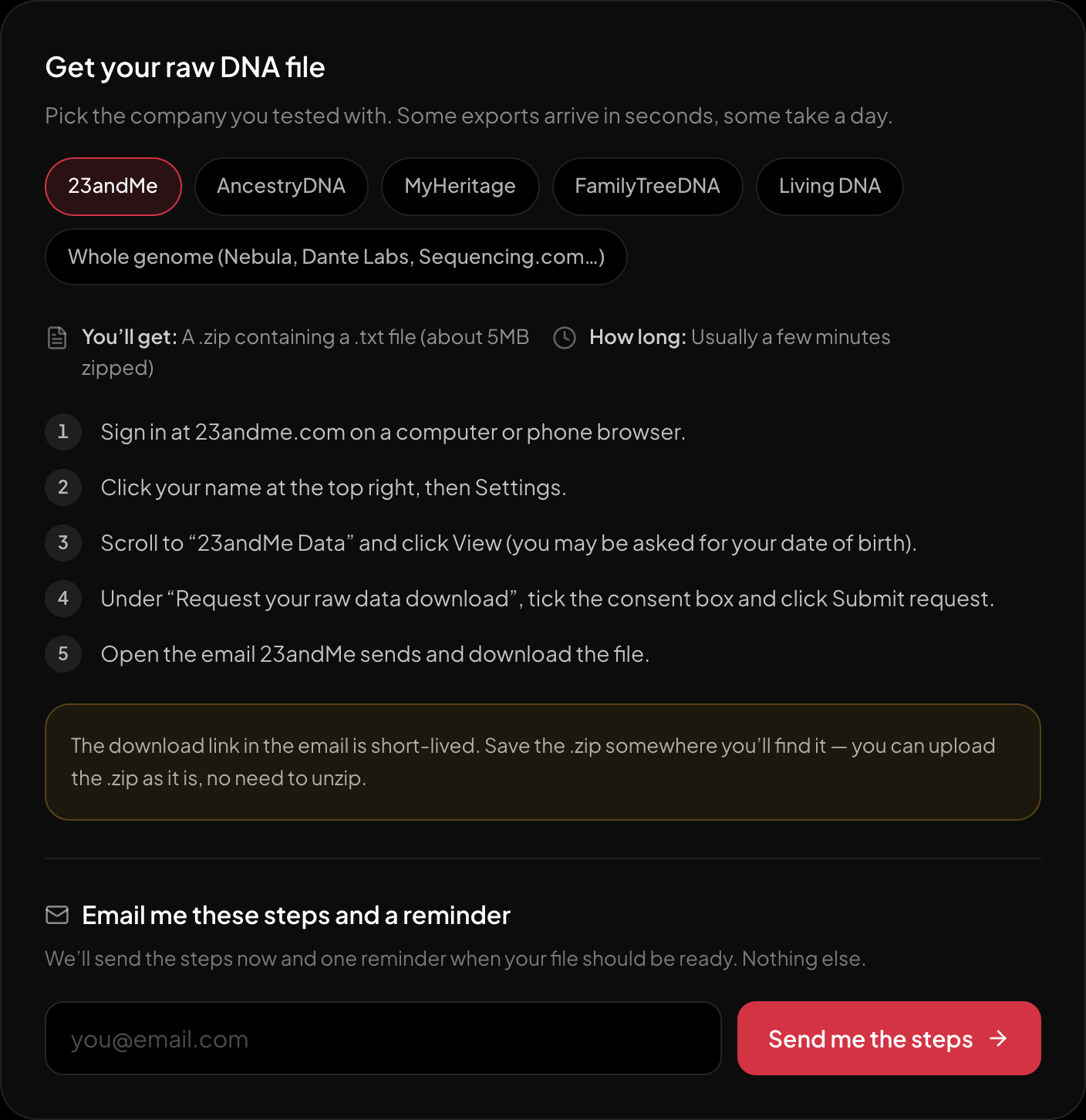
The download steps for 23andMe, on the page itself.

The short version: what is worth acting on, first.
If you want to see the 6p24 finding along with everything else that can be read from the same file, the free DNA tool at healthosx.com/dna reads a 23andMe, AncestryDNA, MyHeritage or whole-genome VCF file in your browser. The trait and health story appears in your browser with nothing asked, and the full report is free after a one-time email code. Read the result as context, then go and sit in the front.
New to raw DNA files? Start with the full guide: 23andMe Raw Data Interpretation Free in Your Browser
Written by
HealthOSX Research