Can I Impute My 23andMe or AncestryDNA Raw Data to a Whole Genome and Is It as Good as Sequencing
Imputation can stretch a 23andMe or AncestryDNA file to tens of millions of extra variant sites, but those are predictions. Common variants hold up. Rare ones often do not.
Yes, you can impute a 23andMe or AncestryDNA raw data file to tens of millions of extra variant sites, using free servers such as the Michigan or TOPMed imputation servers. But the output is a statistical prediction and not a measurement, so it is not as good as sequencing: it holds up for common variants and fails for many of the rare ones that cause inherited disease.
Yes, to tens of millions of known variant sites, not 3 billion letters
The caveat is on the words whole genome. A genome is around 3 billion letters, and any one person differs from the reference at roughly 4 to 5 million of them. Your file contains roughly 600,000 to 700,000 positions that the chip actually read, a small, fixed menu chosen because the positions are informative, not because they are the ones that matter for you. Imputation predicts your genotype at many more positions, but only at variant sites listed in a reference panel. These are known places where people differ. Most of the 3 billion positions are identical in everyone, so they are not guessed at. Anything outside the panel is not predicted at all.
In practice, the output depends on the panel. After filtering, you can expect tens of millions of sites. The HRC panel holds about 39 million sites. TOPMed holds hundreds of millions of sites before filtering, and the 1000 Genomes panel sits in between.
How imputation works, and why quality scores matter
The method relies on how DNA is inherited. Variants that sit close together tend to travel in long blocks called haplotypes, so if you carry one version at a nearby position you often carry a matching version at the next. A reference panel is a set of people who were fully sequenced, so their complete haplotypes are known. The software slides along your chromosomes and matches each stretch of your chip genotypes to stretches in the panel. If your stretch looks like panel haplotypes that all carry a T at some untested position, it concludes you probably carry a T there too.
That is why every imputed genotype comes with a confidence. It arrives as a probability or dosage, something like 0.93 instead of a clean 0 or 1 or 2, plus a per-variant quality score called R2 or INFO. Common variants score near 1. Rare ones score low, because the panel has few examples to copy from. Filtering on R2 is how you separate predictions you can lean on from noise, which is why step 6 below matters.
How to do it, step by step
- 1.Convert the file. Take the raw 23andMe or AncestryDNA .txt and convert it to VCF on build GRCh37, which is the build both companies use. Both already report on the plus strand. The reference FASTA is needed to assign REF and ALT alleles, so use the matching GRCh37 file: bcftools convert --tsv2vcf raw.txt -f human_g1k_v37.fasta -s mysample -Oz -o mysample.vcf.gz
- 2.Run QC. Remove positions with no call, drop indels and mitochondrial or Y positions, check strand and allele agreement against the reference, and remove duplicates. Then sort, compress with bgzip and index the VCF, and split by chromosome if the server asks for it.
- 3.Choose a server and panel. The Michigan Imputation Server offers the HRC panel (about 32,000 people) and the 1000 Genomes panel. The TOPMed Imputation Server uses the much larger TOPMed panel (over 100,000 genomes). Both need a free registration, and the TOPMed server and Michigan's panels require you to agree to research-use terms, so read them before uploading. TOPMed lifts your data to GRCh38, so the results come back on that build.
- 4.Upload and run. Submit the VCF, pick the panel and the population for the QC check, and wait. Jobs can take from minutes to many hours depending on the queue.
- 5.Download the results. They arrive as encrypted archives, and the password is sent to you separately by email.
- 6.Filter by R2. Keep variants above a threshold, commonly 0.3 for general use and higher, such as 0.8, if you care about individual calls, and check the rare end by hand.
Privacy note: Michigan and TOPMed are third-party servers. You upload your genotypes there, and the servers keep the files for a limited time, about 7 days, before deleting them.
Common variants impute well, rare ones do not
A common variant shows up on many haplotypes in the panel. The software has plenty of examples to match against, and the neighbouring chip positions tag it cleanly.
A rare variant is carried by a handful of panel people, or by none. The neighbours say little about it, so the software has nothing reliable to copy. A mutation that arose in your own family cannot be imputed at all, because no reference haplotype has ever contained it.
The sourced result is from the TOPMed paper (Taliun et al., Nature 2021). It compared imputation accuracy by allele frequency bin in European samples, using the TOPMed panel against HRC and 1000 Genomes. TOPMed's advantage over the older panels was largest for the rarer bins, where a bigger panel supplies more matching haplotypes. The Michigan server paper (Das et al., Nature Genetics 2016) describes the server and the Minimac method, not accuracy bands by panel.
The following cut-offs are typical rules of thumb, not figures from either paper. Imputation r2 is usually above 0.9 for variants with an allele frequency over 5 percent. It drops steadily between about 1 percent and 0.1 percent, and it is poor below about 0.1 percent. Panel size moves these lines:
- 1000 Genomes (2,504 people): the smallest of the three, so accuracy falls off earliest as variants get rarer.
- HRC (about 32,000 people): clearly better for low-frequency variants, but mostly European.
- TOPMed (about 97,000 genomes in r2 to about 133,000 in r3, more diverse): the largest, and it holds usable accuracy to lower frequencies than the others.
Even the best panel does not rescue variants that are very rare. The finished file looks complete while its rare end is thin or noise.
There is a second problem on the measured side. Weedon et al., BMJ 2021, compared array genotype calls with sequencing. The main dataset was UK Biobank's Axiom arrays, with consumer 23andMe files as a second check. For variants rarer than 1 in 100,000 in UK Biobank, only about 16 percent of the array calls were confirmed by sequencing, so most were false positives. So a scary rare result from a raw file needs a clinical lab before anyone acts on it.
Millions of rows is not millions of measurements.
Accuracy drops if your ancestry is poorly represented
Imputation only works if your haplotypes, or close relatives of them, are in the panel. The 1000 Genomes panel contains no Middle Eastern or North African population at all, and HRC is mostly European. Chips were also designed largely around variation common in Europeans, so they tag less well elsewhere.
For a reader from the Levant, Arabia, Iran or North Africa, that means stretches of your genome may have no close match. The software then borrows the nearest wrong relative, errors rise, and the first casualties are variants common in your region but rare in the panel. Exactly how much worse it gets depends on the panel and the person, and that is still being measured.
What imputation cannot reach at all
- Large deletions, duplications and other structural changes
- Repeat expansions, where a stretch of DNA is copied too many times
- New mutations, and anything private to you or your family
Short-read sequencing at 30x calls most single-letter changes and small insertions and deletions, including rare ones. It still misses some hard-to-map regions, many structural variants and some repeat expansions. A chip plus panel starts from a much weaker position on all of these.
| Positions | Common variants | Rare variants | Structural variants and repeat expansions | |
|---|---|---|---|---|
| Raw chip file | About 600,000 to 700,000, measured | Only if on the chip | Few, many false positives | Not detected |
| Imputed file | Tens of millions of panel variant sites, inferred | Mostly reliable | Unreliable | Cannot be reached |
| 30x whole genome | Most of the genome, measured; some hard regions missed | Yes, outside hard-to-map regions | Mostly | Some found, many missed |
Scroll the table sideways for the rest →
What each file type gives you for common variants, rare variants, and structural changes.
When sequencing is the only honest answer
- A family history points at a specific gene and you need to know whether you carry a rare variant in it.
- A result could feed into a medical decision. Imputed data should not start that conversation; sequencing or a clinical test should, and a clinical lab confirms either way.
- Your ancestry is poorly represented in reference panels and the variants you care about are regional.
Is it worth doing?
It is worth it for GWAS-style analyses, for polygenic scores that add up thousands of small effects, where a few wrong calls wash out, and for matching rsIDs that another tool needs. It is not worth it if what you want is a clinical answer about one rare variant. The common mistake is treating an imputed file as a sequenced genome.
Where to go from here
The free DNA tool at https://healthosx.com/dna reads a raw 23andMe, AncestryDNA or MyHeritage file, or a whole-genome VCF. The trait, medication response and carrier-relevant findings run in your browser. The optional ancestry breakdown is different: it runs on our server, only with your explicit consent, and sends just the markers it needs.
The tool does not hand back an imputed file. Its Ask your DNA chat, for people who choose to store their file, completes a chip file by imputation against 1000 Genomes in about ten minutes, and that imputation only feeds the answers the chat gives. If you want a downloadable imputed VCF, use the Michigan or TOPMed server as described above.
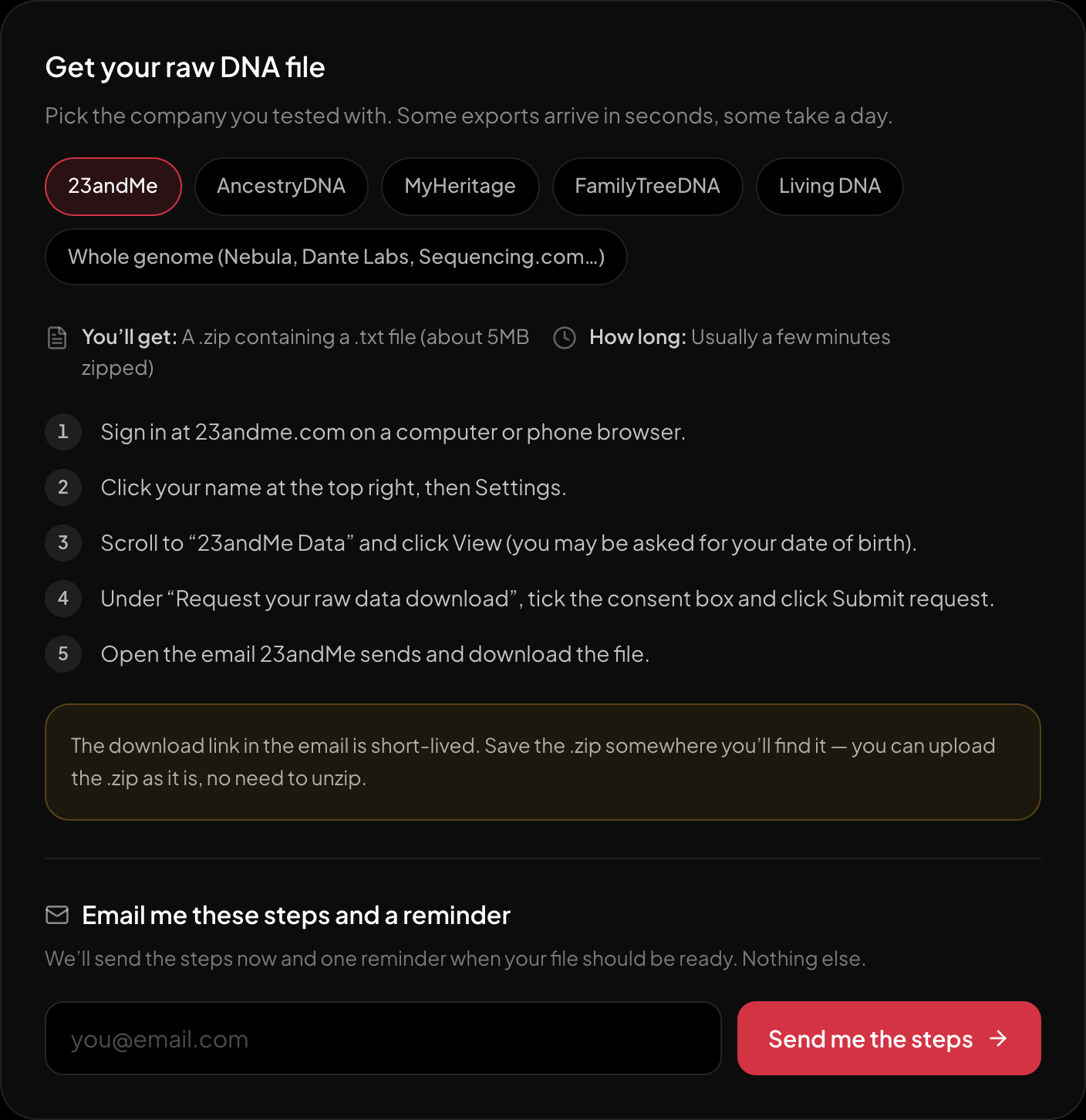
The download steps for 23andMe, on the page itself.
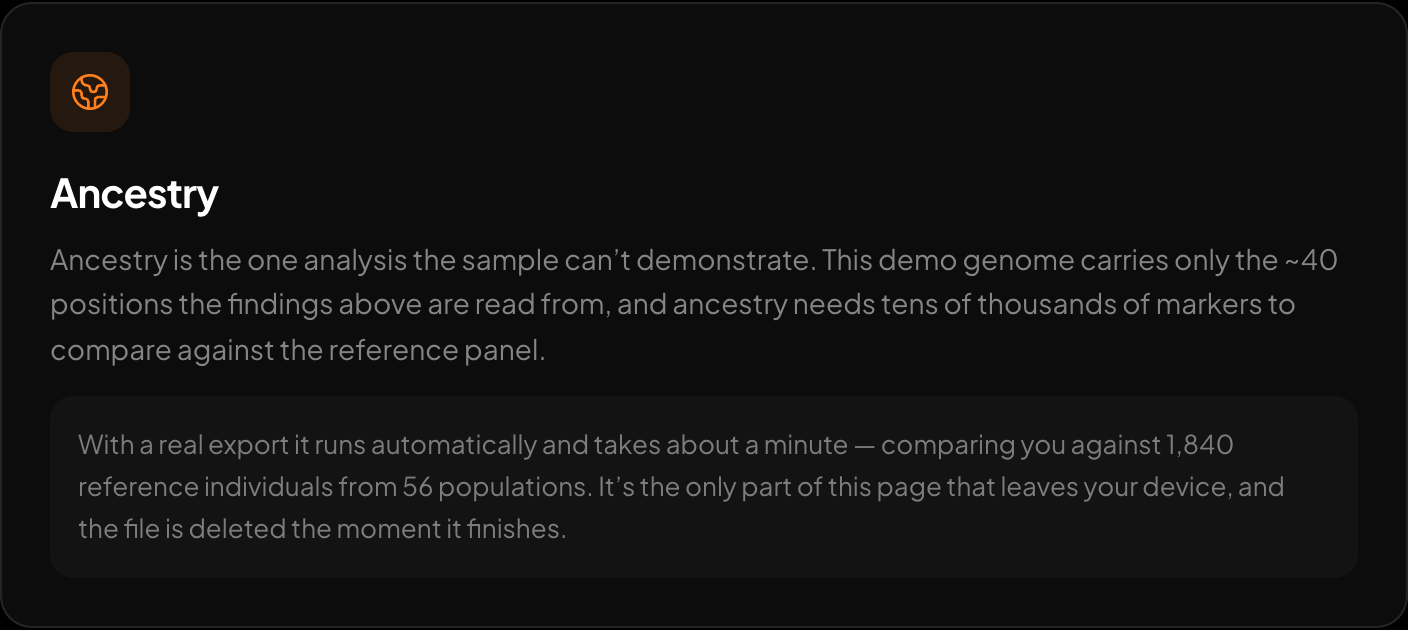
Ancestry across 15 regions and 157 reference populations.
That panel has 2,504 people and contains no Middle Eastern or North African population at all, so by the logic above it is weaker for rare and regional variants than TOPMed. Its polygenic results are placed relative to those 2,504 people, never as a prediction. If a rare result matters to you, that is a sequencing question.
New to raw DNA files? Start with the full guide: 23andMe Raw Data Interpretation Free in Your Browser
Written by
HealthOSX Research