How Many Variants Should a Normal Whole-Genome VCF Have and Is Mine Too Small
A typical 30x human whole-genome VCF holds about 4 to 5 million variant sites. Here is how to tell small-but-normal from truncated, exome-only, gVCF-style or all-sites files.
A normal 30x whole-genome VCF from a human has roughly 4 to 5 million records where the person differs from the reference genome: about 3.5 to 4.3 million single-nucleotide variants (SNVs) plus about 0.5 to 0.8 million short insertions and deletions (indels). If yours has a few hundred thousand, tens of thousands, or hundreds of millions of rows, the file is not what you assumed, and the count alone usually tells you which kind it is.
A normal 30x genome: about 4 to 5 million variant sites
The reference genome is one assembled sequence. Any individual differs from it at several million places, and a VCF lists those places, not the other 3 billion positions where you match it. A lot of confusing files are really a difference in what gets listed.
For a typical 30x genome, expect about 4 to 5 million variant sites. The 1000 Genomes Project Consortium (Nature, 2015) reported that a typical genome differs from the reference at 4.1 to 5.0 million sites. SNVs make up the bulk, at roughly 3.5 to 4.3 million (rounded). Short indels run to roughly 0.5 to 0.8 million; the 2015 data put a typical genome at about 0.55 to 0.63 million, and newer callers find somewhat more. With those numbers SNVs outnumber indels by roughly 4 to 9 times, about 6 to 1 at the midpoints. Two quick sanity checks: about two thirds of SNVs should be transitions (Ti/Tv near 2.0 to 2.1 genome-wide; exome-only files run higher, around 2.8 to 3.0), and heterozygous calls should outnumber homozygous-alt calls in most people.
Why people of African ancestry have more
Modern humans left Africa as a subset of a larger population, so non-African genomes descend from a narrower pool of ancestral variation. African genomes carry more heterozygous sites and more variants that differ from the reference, often by several hundred thousand. This is the main reason for the gap. A smaller part is the reference itself: GRCh38 is mostly one donor (RP11, who had mixed African and European ancestry) with stretches from a few other individuals, so it is a mosaic, and any one person's genome shows some extra differences from it. European and East Asian genomes land toward the lower end of the 4 to 5 million range, and African genomes toward the top of the range.
So a European genome in the lower part of the range and an African genome near the top can both be normal. Mixed ancestry falls in between.
Counting records the right way
Do not trust file size or the line count of a gzipped file you have not opened. Count the data rows and then count the ones that matter. With bcftools installed:
bcftools view -H file.vcf.gz | wc -lcounts every record.bcftools view -H -f PASS,. -i 'GT="alt"' file.vcf.gz | wc -lcounts passing records where you carry at least one non-reference allele.bcftools stats file.vcf.gzgives SNV, indel and transition/transversion counts in one go.
The second number is the one to compare with 4 to 5 million. The FILTER column matters because some pipelines leave failed calls in the file marked with something like LowQual instead of PASS. Hom-ref rows (genotype 0/0) and no-call rows (./.) are the other thing to look for: they are records, but they are not differences from the reference.
Two details move the count. A multi-allelic site (two or more alternate alleles at one position) counts as one row unless the file is split with bcftools norm -m-, so a split file has slightly more rows. And men carry one X chromosome, so they have far fewer heterozygous calls on chrX. That shifts the genome-wide het to hom ratio only slightly, but for a clean comparison either exclude chrX from both files or compare chrX only against people of the same sex.
When a small or huge file is not a complete genome
Each unusual count points at a different cause, and they look different in real data.
| Typical rows | Complete genome file? | |
|---|---|---|
| 30x whole genome, variants only | 4 to 5 million | Yes |
| Low-coverage genome | no fixed number; often below 4 million with a low het-to-hom ratio and many no-calls | Partial |
| One chromosome only (chr1) | about 400,000 | No |
| Exome only | tens of thousands | No |
| gVCF with reference blocks | tens of millions or more | Yes |
| All-sites VCF | hundreds of millions or more | Yes |
Scroll the table sideways for the rest →
Approximate. Exact numbers depend on the caller, the reference build and whether reference rows are kept.
- Truncated file. The count looks plausible for part of a genome, and the last line stops mid-record or
bcftoolscomplains about a missing EOF block. Runbgzip -t file.vcf.gzto test the compressed file, andzcat file.vcf.gz | tail -n 2to see whether the last line is whole and which chromosome it is on. - Chromosome subset. Chromosome 1 is about 8 percent of the genome, so a chr1-only file has around 400,000 records. List the contigs with
bcftools index -s file.vcf.gz(needs an index) or, without one,bcftools view -H file.vcf.gz | cut -f1 | uniq -c, which prints a row count per contig. - Low coverage. Fewer calls than expected, often below 4 million with a low het-to-hom ratio and more no-calls. The caller could not see the other allele, so heterozygous sites are missed first. How far the count falls depends on depth, so there is no fixed number, but that pattern is the cue to check.
- Exome only. Tens of thousands of records, clustered in genes. Real, but it is not a genome, and most of what a genome offers lives outside coding regions.
- gVCF-style. Tens of millions of rows or more, mostly hom-ref blocks with an END tag in INFO. Banded gVCFs vary widely by caller and GQ banding. Nothing is wrong. It just records "matches reference from here to here" as well, which is why it is huge.
- All-sites VCF. Some callers can emit every position, variant or not, so the file can approach one row per genomic position, hundreds of millions of rows or more. Again nothing is wrong; the variants are a small slice of it.
What the free DNA tool can do with each file
The free HealthOSX DNA tool parses the file in your browser, so a bad file costs you nothing to try. A normal whole-genome VCF gets the full read. A raw GATK or Sentieon file with "." in the ID column still works for ancestry, but cannot produce health findings, which need named positions (rsIDs). Files without rsIDs are matched on GRCh37 coordinates only, so a raw GRCh38 file without rsIDs may not work for ancestry. For that case, and to test any file before running the full analysis, use https://healthosx.com/dna/check.
The mistake people make
They compare a count to a number from a blog post and panic. The better question is whether the count fits the kind of file. A gVCF with 40 million rows, about 4.5 million of them non-reference, is a normal genome with its reference blocks listed. A 4.2 million row file that is all PASS and has a sensible Ti/Tv is fine. As a practical threshold, below about 3.5 million PASS non-reference sites in a 30x genome deserves a closer look. Above that, callers, reference builds (GRCh37 against GRCh38) and filtering choices move the total by several percent, which is normal.
Count the rows where you actually carry a non-reference allele, not the rows in the file.
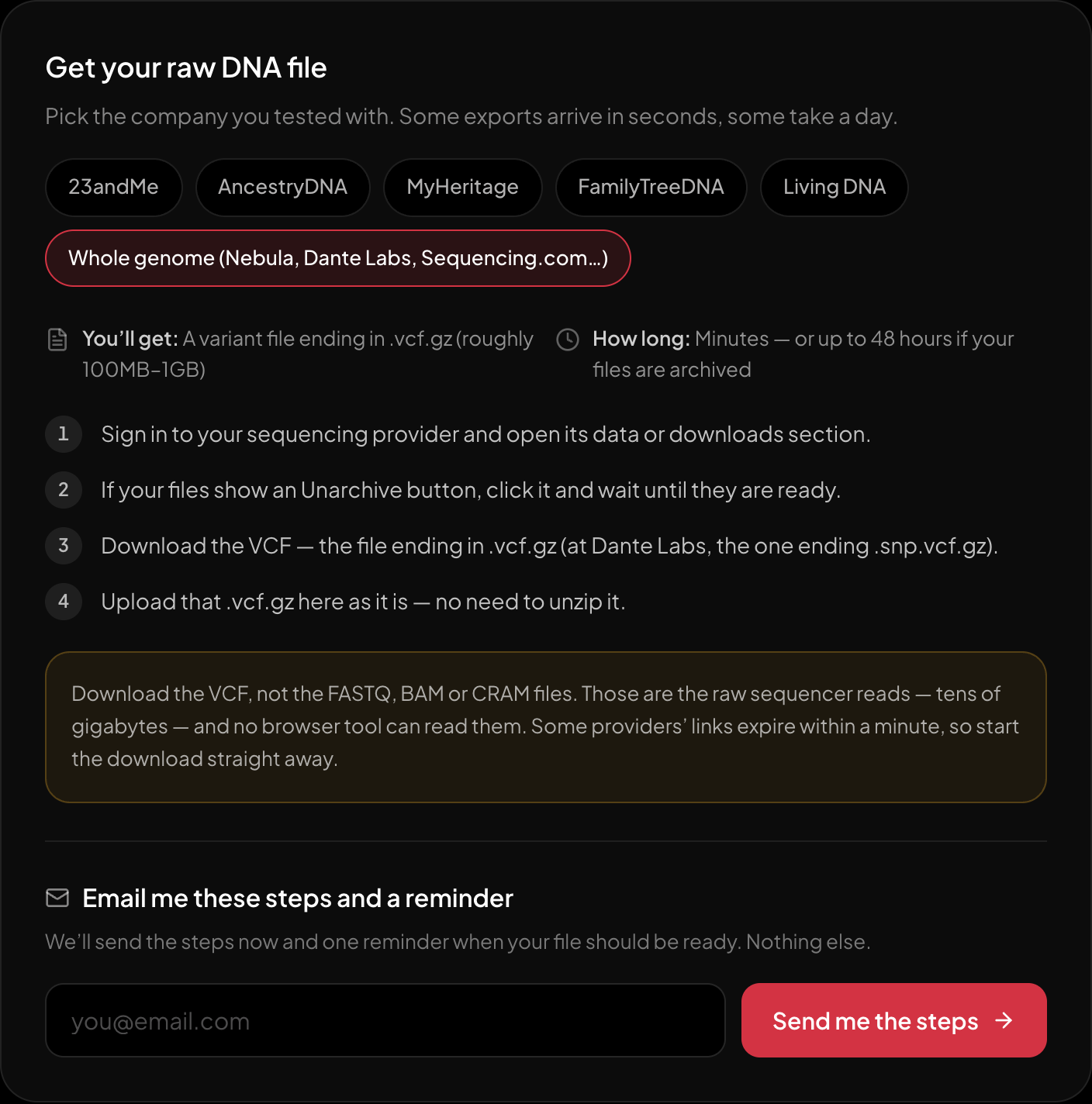
The download steps for whole-genome sequencing, on the page itself.
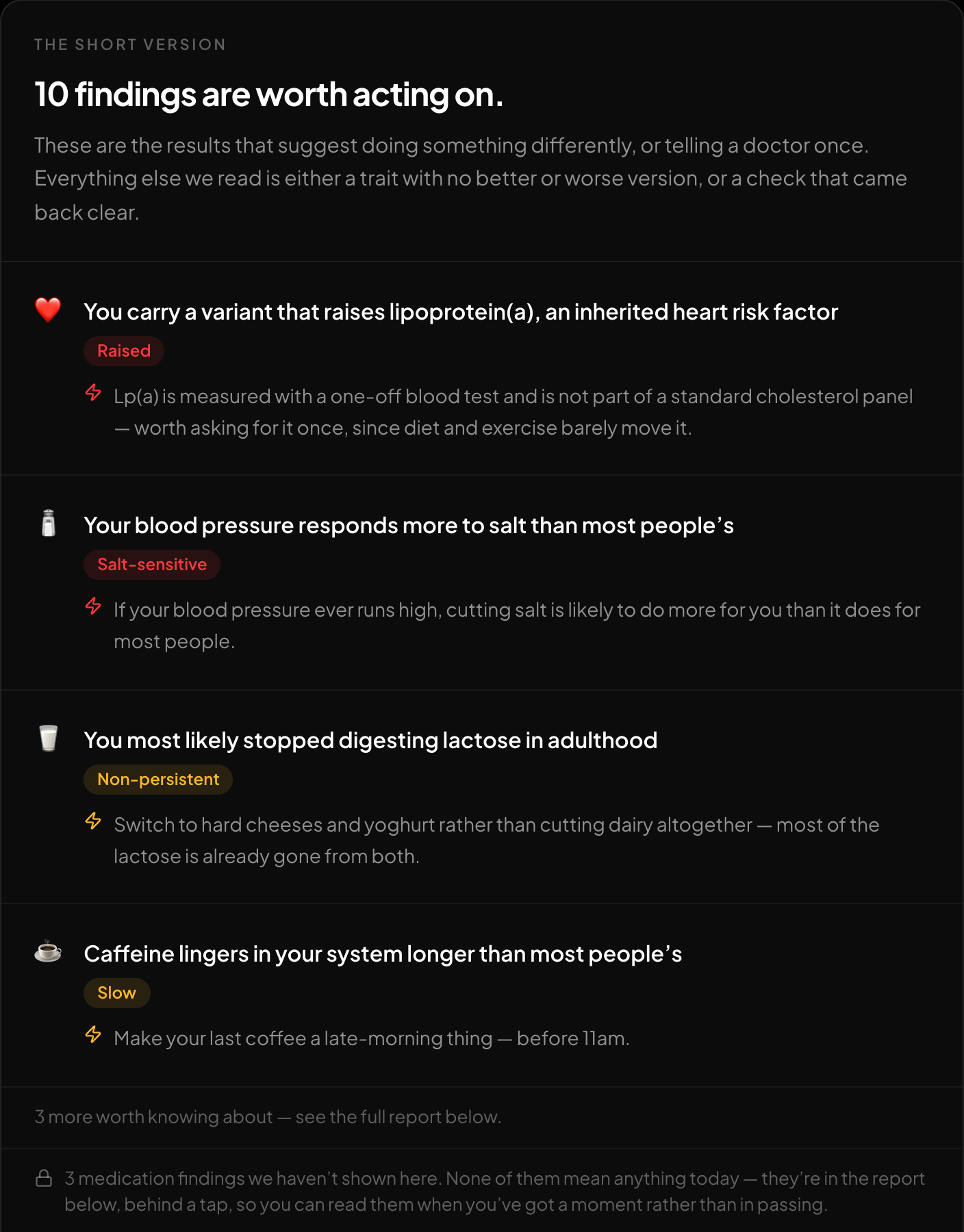
The short version: what is worth acting on, first.
If your file looks right and you want to see what is in it, the free DNA tool at https://healthosx.com/dna reads a whole-genome VCF in your browser and reports traits, medication response and carrier-relevant findings, with an optional ancestry breakdown. One limit to keep in mind: a clear panel is not a diagnostic all-clear. It only means no variant on the list was called in your file, which is a much weaker statement for a low-coverage or exome file than for a complete one.
New to raw DNA files? Start with the full guide: 23andMe Raw Data Interpretation Free in Your Browser
Written by
HealthOSX Research