What does HFE C282Y or H63D mean in my 23andMe raw data
C282Y and H63D are HFE iron-storage variants. C282Y matters much more than H63D, and raw letters must not be read literally. Ferritin and transferrin saturation are the usual first blood tests that help show whether iron may be high and need clinical follow-up.
Free gene check
Check it in your own file
Drop your raw DNA file here and see which row of this guide is yours. It is read in your browser and never uploaded.
Choose or drop your raw DNA file
.txt · .csv · .zip · .vcf · .vcf.gz
C282Y and H63D are HFE iron-storage variants. C282Y matters much more than H63D. In 23andMe raw data, they usually appear as letters at rs1800562 and rs1799945, and those raw letters must not be read literally. Two copies of C282Y are the DNA pattern most associated with HFE hemochromatosis risk, but DNA alone does not show current iron status. Ferritin and transferrin saturation are the usual first blood tests that help show whether iron may be high and need clinical follow-up.
What does HFE C282Y or H63D mean in my 23andMe raw data?
Your raw file is a table of marker names and letters. The two HFE markers that appear most often in consumer files are rs1800562, which maps to C282Y, and rs1799945, which maps to H63D. Raw 23andMe letters are strand-dependent and must be translated to C282Y or H63D before interpretation. The letters are not the variant names. They are the bases the chip read on both copies of chromosome 6. A report has to translate those bases into the protein change and account for strand orientation.
C282Y means the HFE protein has tyrosine instead of cysteine at position 282. H63D means aspartic acid instead of histidine at position 63. The first change is much more likely to affect iron handling. The second is common and usually mild.
HFE helps set the iron brake
HFE is part of the sensing system that tells the gut how much iron to absorb. When body iron rises, HFE helps trigger hepcidin, the hormone that closes the iron export gate on gut cells and macrophages. C282Y disrupts HFE folding and movement to the cell surface enough to blunt that signal. H63D changes the protein less, so the effect is smaller.
With weak hepcidin signaling, the gut keeps absorbing iron even when stores are already full. The extra iron can collect in liver, heart, pancreas and joints over years. Men and people after menopause are more likely to show loading than premenopausal women, because menstrual blood loss removes iron.
Which raw-data combinations earn a blood test
The pattern matters more than a single variant. HFE hemochromatosis is usually recessive, meaning both copies of HFE need to carry a relevant change before risk rises much.
| Pattern | What it tends to mean | Iron studies? |
|---|---|---|
| C282Y/C282Y | Main recessive pattern linked to hereditary hemochromatosis | Yes |
| C282Y/H63D | Possible mild iron loading, less than C282Y/C282Y | Often |
| H63D/H63D | Common pattern, usually not enough by itself | Only if labs suggest it |
| One C282Y only | One copy of C282Y, usually not iron loading by itself | Usually not for this alone; consider if symptoms, family history, or abnormal labs suggest a problem. |
| One H63D only | One copy of H63D, usually not iron loading by itself | Usually not for this alone; consider if symptoms, family history, or abnormal labs suggest a problem. |
Scroll the table sideways for the rest →
Common HFE patterns and what they usually mean. Illustrative interpretation.
A C282Y/C282Y result is the finding most worth taking to iron studies. Even then, penetrance is incomplete. Many people with the highest-risk pattern never develop clinically important iron overload. C282Y/H63D can raise iron modestly, but many people with this pattern stay in the normal range. H63D/H63D is common and usually not a clinical iron-overload genotype by itself. One copy of either variant is usually not enough to cause iron loading.
The obvious next step is iron studies
If a report says C282Y/C282Y, it is reasonable to ask a clinician for ferritin and transferrin saturation. If it says C282Y/H63D, iron studies are also sensible, especially with fatigue, joint pain, abnormal liver tests, a family history of hemochromatosis, or a high ferritin found elsewhere. If the only finding is H63D in one or two copies, DNA alone usually does not justify alarm.
The useful pair is:
- Ferritin: stored iron, but also inflammation
- Transferrin saturation: how saturated iron transport is
Transferrin saturation is serum iron divided by total iron-binding capacity, reported as a percentage. A value above 45% is a commonly used prompt for further evaluation, but it is not a universal cutoff. Its meaning varies by sex, lab, timing, and clinical context. Ferritin is reported in ng/mL and varies by lab, sex, age and inflammation. A high ferritin with normal transferrin saturation often points away from classic HFE overload and toward inflammation, liver fat, alcohol, recent illness or supplement use.
DNA can suggest that your iron thermostat is set to store more. Blood tests help show whether iron has actually accumulated.
If ferritin and transferrin saturation are normal, the DNA result still matters as background, but there is no current lab evidence of overload. Iron loading is slow. A normal result today does not prove lifetime safety, and a high result does not prove HFE is the cause. When treatment is needed, it is usually blood removal guided by ferritin and transferrin saturation, not a change inferred from raw data alone.
When the report would simply not cover the variant
A consumer report can only read what the file contains. The HFE result can be missing if rs1800562 or rs1799945 is absent, has no call, or if a VCF lacks rsIDs. A VCF without rsIDs gets ancestry only, and the trait report needs rsIDs. A negative result also does not rule out every form of hemochromatosis. Rare HFE changes and non-HFE iron genes are not covered by a typical two-variant screen.
This is where raw data stops being enough. The file can show common HFE markers. It cannot show liver iron or organ damage. It also cannot tell whether ferritin is from inflammation. Those answers come from blood tests and, in some cases, liver assessment, interpreted by a clinician.
A common mistake that makes this confusing
A common mistake is treating H63D as if it were C282Y, or treating one copy as a disease. Ferritin also gets more attention than it deserves when transferrin saturation is not considered. Ferritin is an acute-phase reactant. It rises with inflammation, infection, fatty liver, alcohol and many ordinary illnesses. In HFE hemochromatosis, transferrin saturation tends to be high early because transferrin becomes more saturated with iron. Ferritin rises later as stored iron accumulates.
That sequence is why a person can have a scary ferritin number and no HFE-driven iron overload. It is also why a person can carry C282Y and feel fine for decades while iron quietly accumulates.
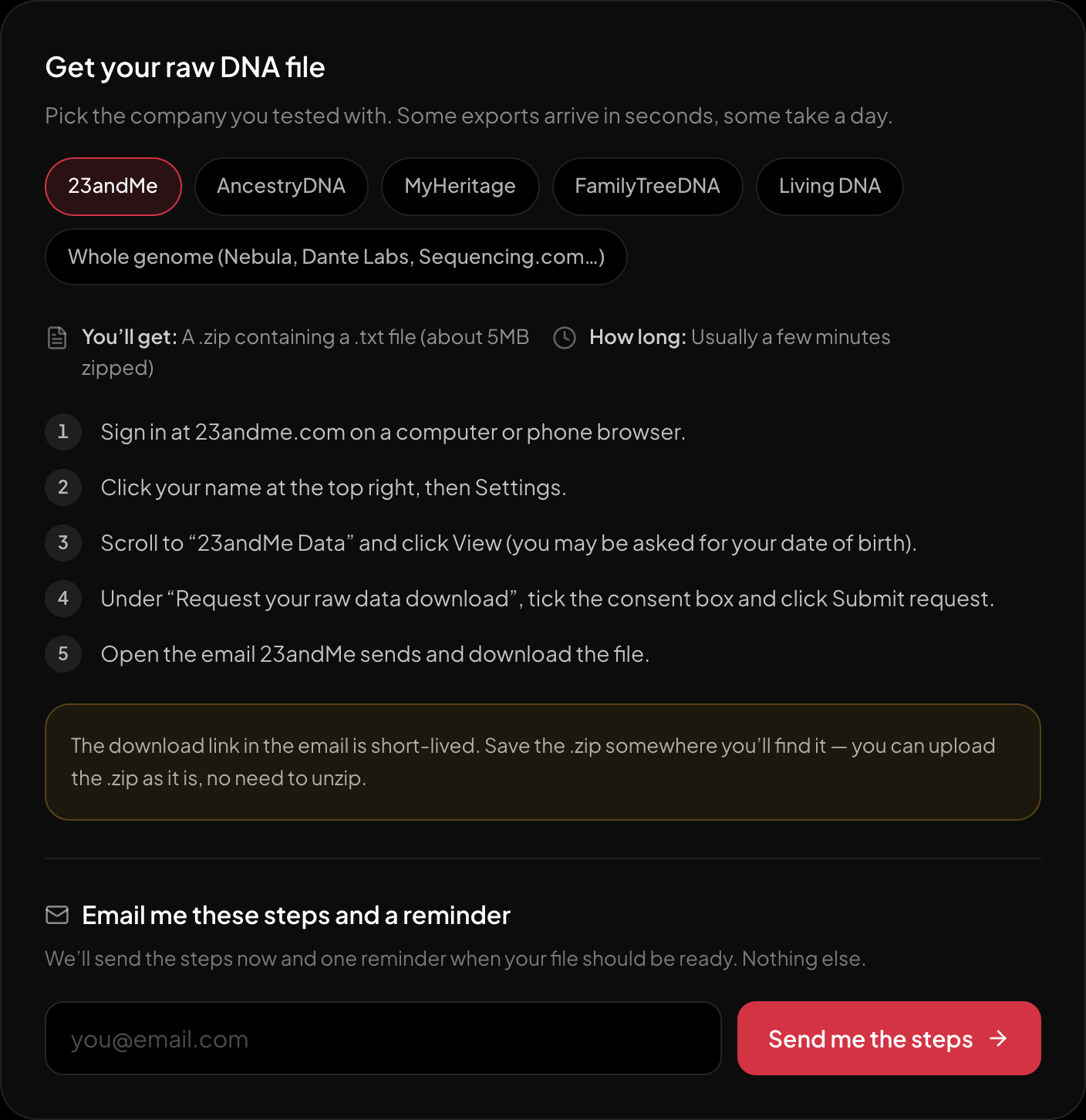
The download steps for 23andMe, on the page itself.

The short version: what is worth acting on, first.
If you want to see your own HFE result instead of guessing from raw letters, the free HealthOS DNA tool at https://healthosx.com/dna accepts supported 23andMe raw data files and VCF files, and its DNA story needs no account. The trait and health report is processed in the browser. Ancestry is optional. Only needed markers are sent, and they are kept with the result until the person deletes them. A VCF without rsIDs gets ancestry only, and the trait report needs rsIDs. The exact HFE report line is: "HFE: Whether you’re prone to storing too much iron."
New to raw DNA files? Start with the full guide: How to Download & Analyze Your 23andMe Raw Data Free
Written by
HealthOS Research