What HBB and HBA2 Mean in Your 23andMe Raw Data
A HealthOS report may include an HBB/HBA2 thalassemia-trait finding, but it is not a diagnosis or complete carrier screen and does not prove reduced globin production.
In a 23andMe raw data .txt export, HBB and HBA2 are genes that HealthOS uses to flag a possible thalassemia trait. A HealthOS report may include an HBB/HBA2 thalassemia-trait finding, but it is not a diagnosis or complete carrier screen. It does not necessarily mean beta-globin or alpha-globin production is reduced.
What does an HBB or HBA2 thalassemia result in my 23andMe raw data mean?
It may mean that the report includes an HBB or HBA2 thalassemia-trait finding, but it is not a diagnosis or complete carrier screen. Some such findings point to carrier status, but the raw result should be treated as a prompt for confirmation, not a label to apply to yourself or a future child. Carriers may have normal lives and smaller-than-average red cells, while some variants are mild, rare, or uncertain.
A DNA flag raises one question: could this person carry a thalassemia trait. It does not answer how severe it is, or whether a child will be affected.
In the raw file, the row itself is plain:
- rsID or coordinate
- chromosome and position
- genotype letters, such as AG or TT
The report turns that row into a gene name and a possible interpretation.
Hemoglobin needs two globin chains in balanced amounts
Adult hemoglobin is a four-part protein. Two chains come from alpha-globin genes, and two come from beta-globin genes. HBA2 is one of the alpha-globin genes; HBA1 is its close partner. HBB is the main beta-globin gene for adult life.
Thalassemia traits are usually discussed when one side of that balance is produced less efficiently. If beta-globin output is reduced, alpha chains can become relatively overrepresented in developing red cells. If alpha-globin output is reduced, the pattern is similar but the laboratory markers differ. A DNA flag does not measure that balance directly.
A flagged result is a starting point, not a full carrier screen
Consumer raw-data flags cannot establish phase, copy number, or full carrier status, especially for alpha-thalassemia deletions. If a beta-thalassemia-associated HBB variant is called, the usual starting interpretation may be beta-thalassemia trait, but laboratory confirmation is needed. If an HBA2 variant is called, the meaning can depend on HBA1, the alpha-globin copy number, and whether changes are on the same or opposite chromosomes. Consumer raw data cannot resolve alpha-globin copy number or common HBA1/HBA2 deletions, so a negative HBA2 result does not rule out alpha-thalassemia trait.
This is why the report should be read as a starting point. A variant can be mild, rare, uncertain, or absent from some databases. Some variants affect hemoglobin function rather than amount. The raw letters do not say whether you have symptoms, anemia, or a partner who carries a related trait.
A clear result is not the same as no trait
A consumer chip tests selected positions. It does not read every possible thalassemia change. Beta-thalassemia has many known HBB variants, and alpha-thalassemia often comes from deletions spanning HBA1 or HBA2. A genotyping array can miss those, especially if the change is private to a family or common in a population not well represented on the chip.
The common mistake is treating a clear panel as proof that no trait exists. A clear HBB or HBA2 panel means no called variant was found at the covered positions. It does not mean you cannot carry a thalassemia trait. This matters most if a blood test already shows low MCV or low MCH. It also matters if a close relative has thalassemia or if you are planning a pregnancy with someone who may carry a trait.
| Pattern | Possible meaning | Next check |
|---|---|---|
| Low MCV, low MCH, higher HbA2 | Beta-thalassemia trait is plausible | CBC and hemoglobin electrophoresis |
| Low MCV, low MCH, normal HbA2 | Alpha-thalassemia trait, iron deficiency, or some beta variants can look similar | Ferritin and alpha-globin DNA testing |
| No HBB or HBA2 variant called | The covered positions are clear | Not a full carrier screen |
Scroll the table sideways for the rest →
Illustrative. Patterns vary by variant, ancestry, iron status, and laboratory practice.
A normal blood count does not settle the carrier question
Some carriers have borderline or normal indices, especially silent alpha carriers. The blood picture from a single HBB variant can be subtle. If the DNA flag is strong and the blood count is normal, the DNA finding may still be worth confirming. If the DNA flag is weak or a variant of uncertain significance, the blood count may be more informative. Do not use one normal MCV to dismiss the raw file. Do not use one raw file flag to dismiss a normal blood count.
When blood work is more informative than the raw file
The right next step is often a blood test, because thalassemia trait can leave measurable marks. Laboratories often use typical flags such as MCV near or below 80 fL or MCH near or below 27 pg, but these are typical laboratory flags, not diagnostic rules. In beta-thalassemia trait workups, HbA2 may be above about 3.5 percent, yet HbA2 can be normal in alpha trait, iron deficiency, or some beta variants. Iron studies matter too, because iron deficiency can lower MCV and MCH and mimic trait.
Worth asking a doctor about:
- CBC with red cell indices and reticulocyte count
- Ferritin or iron studies before assuming thalassemia
- Hemoglobin electrophoresis or HPLC when beta-thalassemia is possible
- Alpha-globin deletion testing if alpha-thalassemia is suspected
If pregnancy is possible, partner testing matters. If both partners carry pathogenic or likely pathogenic HBB variants, each pregnancy can have a 1 in 4 chance of inheriting both variants, but the outcome depends on the specific variants and may range from mild to severe. Not all HBB traits produce major beta-thalassemia. Alpha risks depend on how many alpha genes are missing or altered, and whether the changes sit on the same chromosome or opposite chromosomes.
Put the variant beside the rest of your file
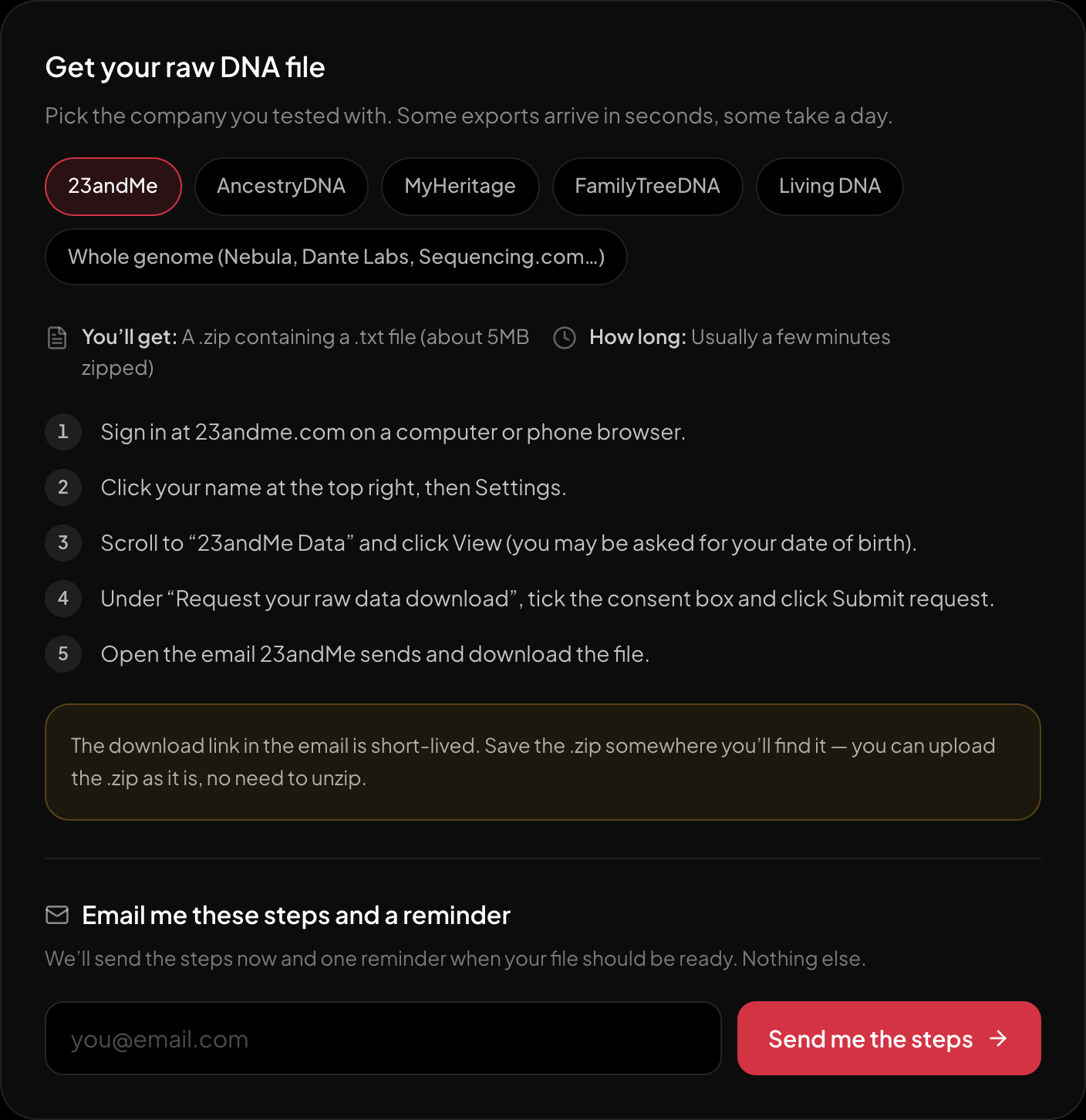
The download steps for 23andMe, on the page itself.
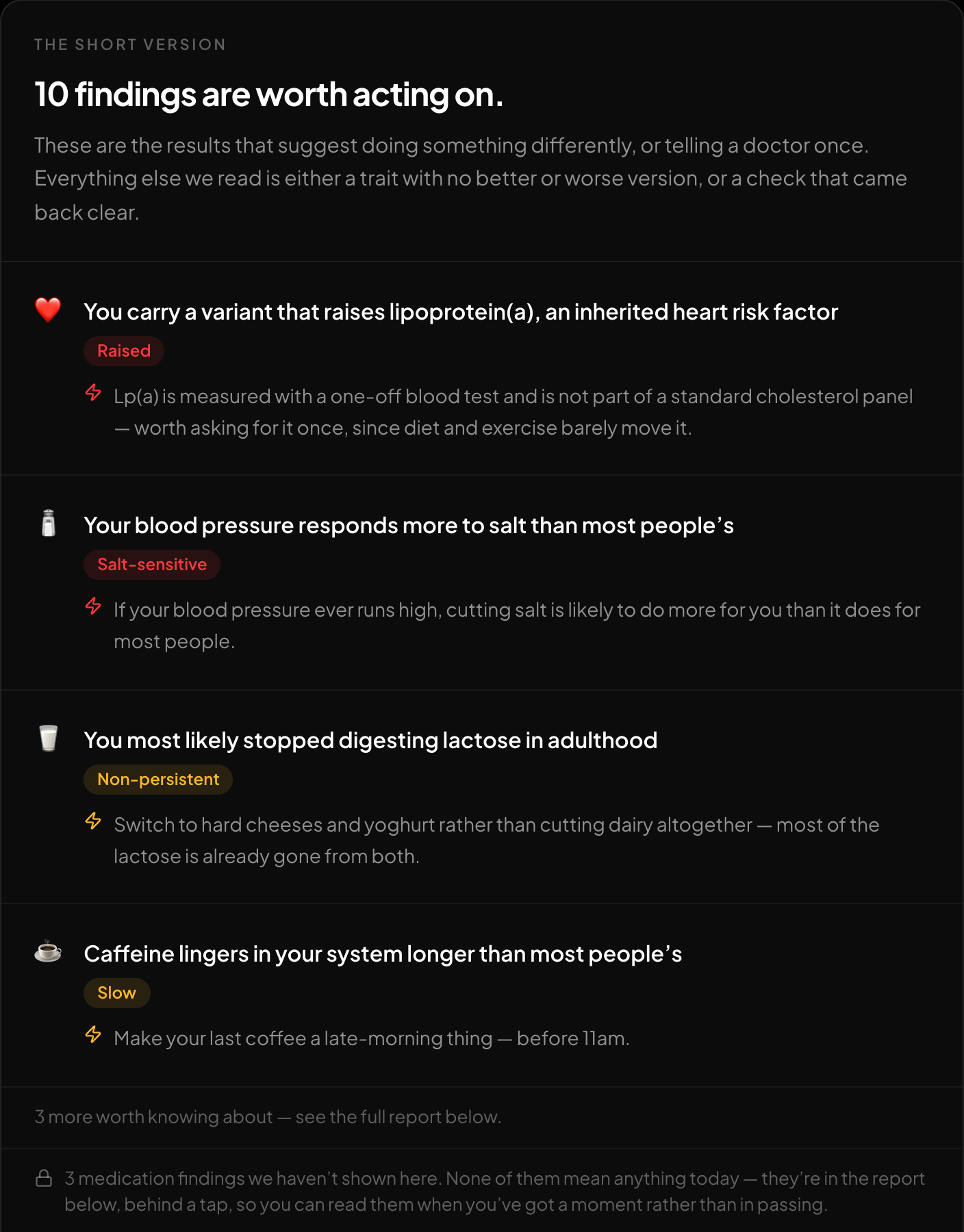
The short version: what is worth acting on, first.
If you want to see your own HBB and HBA2 lines beside related findings, upload your raw file to the free HealthOS DNA tool. The browser story is free and needs no account. The full report uses a one-time email code. Ancestry is optional and server-side with consent. Accepted formats are 23andMe (.txt/.zip), AncestryDNA (.txt/.zip), MyHeritage (.csv), WeGene (.txt), FamilyTreeDNA (.csv), LivingDNA (.txt), whole-genome VCF (.vcf/.vcf.gz), Nebula Genomics (.vcf.gz), Dante Labs (.vcf.gz), Sequencing.com (.vcf.gz), or check https://healthosx.com/dna/check. Whole-genome VCF files with '.' in the ID column can work for ancestry on GRCh37 coordinates but cannot produce health findings that need named positions.
New to raw DNA files? Start with the full guide: How to Download & Analyze Your 23andMe Raw Data Free
Written by
HealthOS Research