Why Didn't My FTDNA Y-DNA Haplogroup Update After the NGS Upgrade
An NGS upgrade refines the terminal Y-DNA branch, not the major haplogroup. If your result stayed the same, the STR prediction was already right or no new subclade was named yet.
An NGS upgrade from FamilyTreeDNA, usually Big Y-700, will not normally change your major Y-DNA haplogroup. It refines the terminal branch below that haplogroup. When your result looks unchanged, the usual reason is that the earlier STR prediction already pointed to the branch that is still terminal, or the NGS data found no new named subclade below it yet.
Why didn't my FTDNA Y-DNA haplogroup update after the NGS upgrade?
Your major haplogroup is a deep ancestral label like R, E, J or I. NGS does not reclassify that unless the original STR prediction was plainly wrong, which is uncommon. The part that should update is the terminal branch, the last named twig on your branch of the Y haplotree. It can stay the same for two very ordinary reasons.
- Your old STR prediction already pointed to the branch that is still terminal. STR prediction cannot identify a true private terminal branch, so if the predicted branch is still the deepest named branch, NGS confirms it rather than changing it.
- Your NGS data contains new private variants, but no other tester shares them yet. FTDNA names a new downstream branch only when there is enough matching data to place it. Until then your terminal branch stays at the current node.
This applies to the Y chromosome Big Y-700 upgrade, not to autosomal DNA or mtDNA.
NGS rarely rewrites your major haplogroup; it puts a longer surname on the branch you were already on.
| STR prediction | Big Y result | |
|---|---|---|
| Major haplogroup | Usually predicted | Confirmed |
| Terminal branch | Broad, often M269 level | Deep named branch; private variants may sit below it |
| Private variants | Not shown | Listed under branch |
| Tree revisions | No new Y-SNP data | Can refine later |
Scroll the table sideways for the rest →
What typically changes after a Big Y upgrade.
What an STR test actually predicted
An STR test like Y-37 or Y-111 counts short tandem repeats, which are lengths of repeating DNA, not the single-letter SNPs that define the haplotree. Those repeats change fairly quickly and can be used to predict a haplogroup by comparing your pattern to men of known branches. The prediction is a probability, not a definitive SNP call.
FTDNA's STR prediction is usually specific enough to get the major haplogroup and sometimes a large subclade. It is not designed to find your private terminal branch. That is why the upgrade exists.
What Big Y actually does to your haplogroup
Big Y-700 is the NGS upgrade. It reads a large portion of the Y chromosome, including known Y-SNPs and regions where new SNPs can be discovered, plus a larger set of STRs. It then matches the SNPs you carry against the Y haplotree and assigns the deepest branch where you have the defining derived markers.
That assignment can be identical to your STR prediction because both methods are looking at the same paternal line. If your father's line truly belongs to R-M269 and no named branch below R-M269 has been established, R-M269 is your terminal branch. NGS may list new private variants under that branch, but the terminal branch label does not move. If you upgraded from Big Y-500 to Big Y-700, the terminal branch often stays the same because the added coverage mostly increases STR count and private variant depth rather than changing known tree position.
One common mistake is to expect an upgrade to rewrite the major haplogroup. Big Y is not a replacement answer, it is a more precise address within the same branch.
When the result does change
A change is most visible when the STR prediction was broad or wrong.
- Broad prediction (illustrative example): Y-37 said R-M512, Big Y places you in R-YP445, a branch several steps down. Major haplogroup stays R, terminal branch lengthens.
- Wrong prediction (illustrative example): STR patterns can mislead, especially for less common branches. NGS can move someone from a predicted E-M35 to a confirmed J-M172, although this is rare and usually involves a low-resolution initial test.
- Tree revision: FTDNA periodically reorganises branches as new Big Y results arrive. A branch that was terminal in 2021 can become the parent of a newly named branch in 2024. Your terminal branch may update without any new test, or your own private variants may be promoted into a named branch.
Why your refined subclade may not appear after the upgrade
This is the common version of the question. You see the same haplogroup, and the deeper subclade you expected is not on the page. The reason is that a refined subclade needs evidence that the variant is shared and can be placed on the tree. Your own private variants are listed individually, but they do not become a named subclade until FTDNA has enough matching data to place them.
Check the FTDNA Big Y page under Haplotree & SNPs. If you see private variants listed beneath your current terminal branch, that is the data waiting to become a new branch. If no private variants are listed, no additional qualifying variants were called in the covered regions, so there is nothing to promote as a named branch.
Will it update later?
Yes, sometimes. FTDNA updates the Y haplotree as new testers submit Big Y data. A new branch can appear weeks or months later when a match appears. There is no fixed waiting period, and some branches stay unchanged for years because no close paternal-line tester has tested. You can make a new branch more likely by encouraging a known paternal-line cousin, ideally with a different surname, to take Big Y.
But if your terminal branch is already well sampled and your private variants are absent, later updates will not change it.
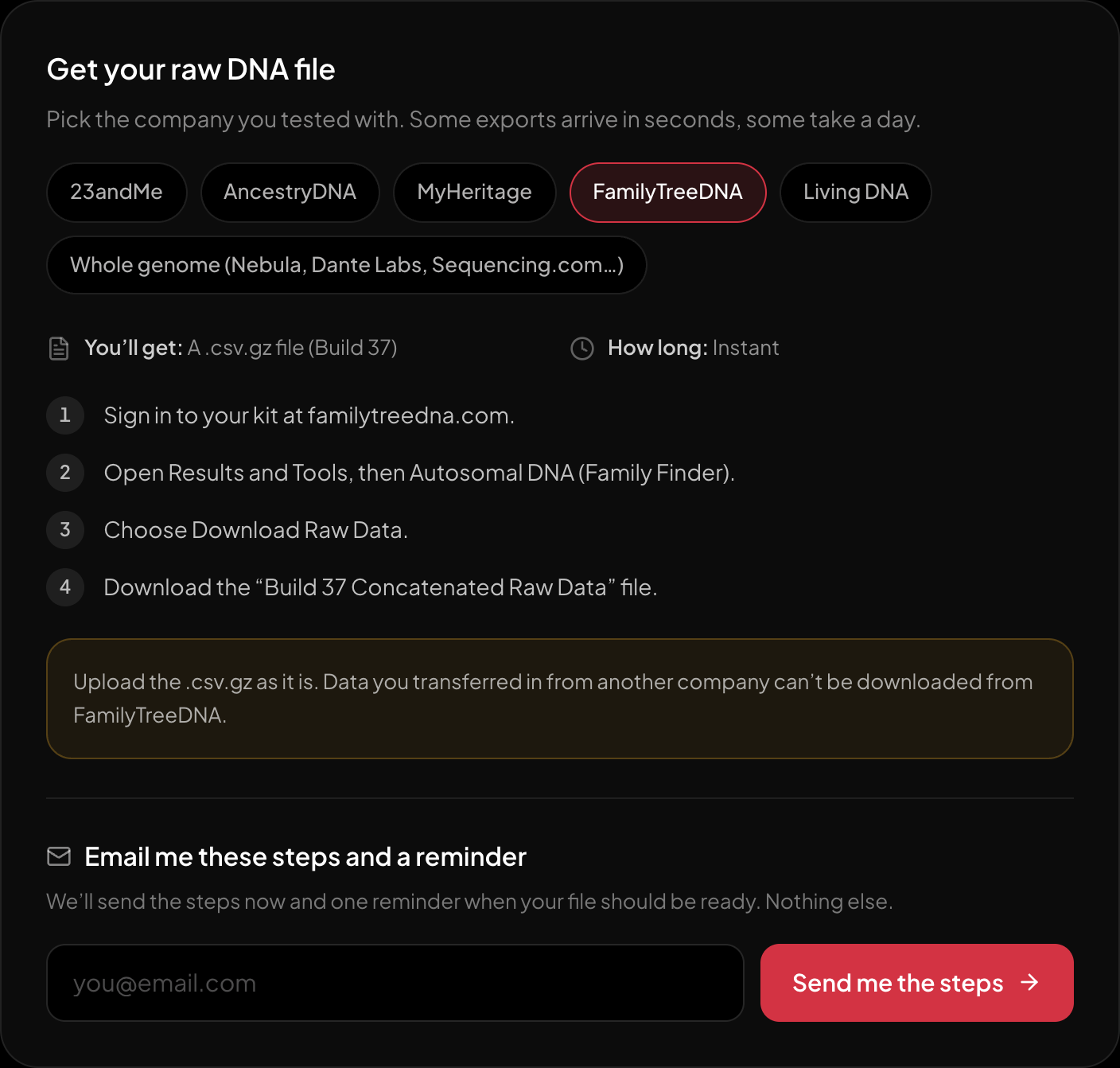
The download steps for FamilyTreeDNA, on the page itself.
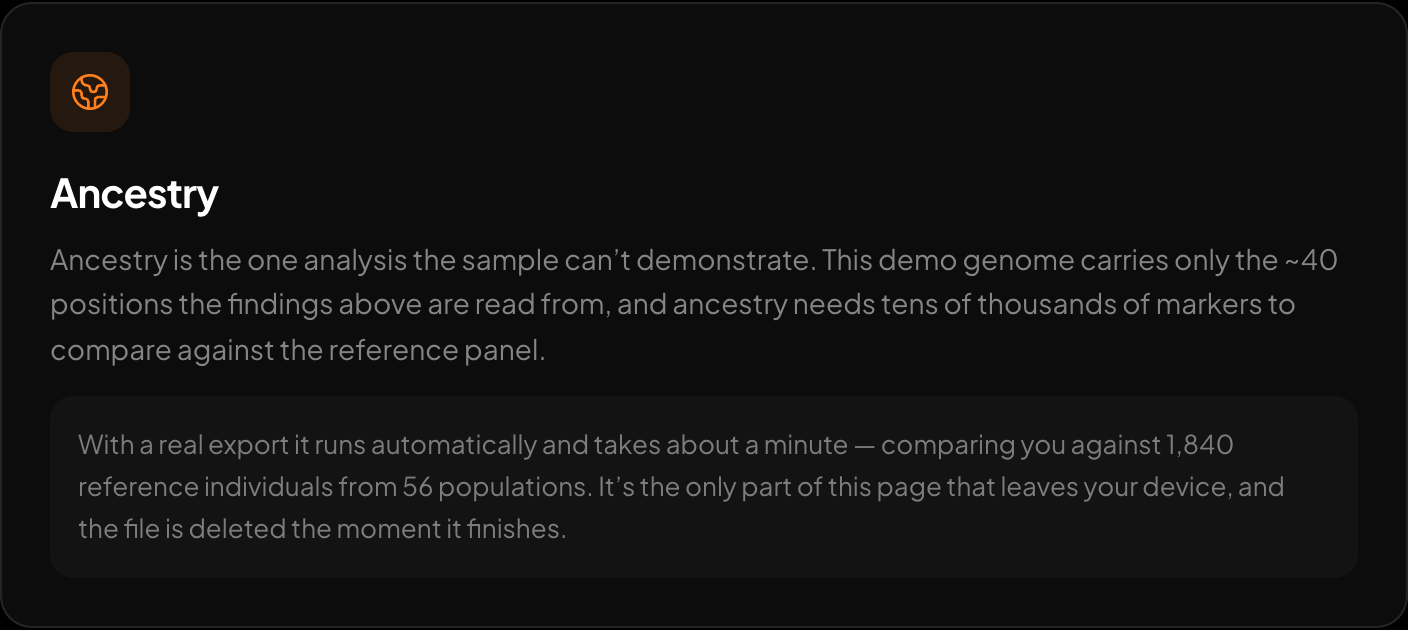
Ancestry across 15 regions and 157 reference populations.
If you want to see your own Y haplogroup in a browser, upload your FTDNA CSV to the free DNA tool at https://healthosx.com/dna. It reports the paternal line from the raw file on your device.
New to raw DNA files? Start with the full guide: How to Download & Analyze Your 23andMe Raw Data Free
Written by
HealthOS Research