What Factor V Leiden (F5 rs6025) Means in Your 23andMe Raw Data
Factor V Leiden at rs6025 is an inherited blood-clot risk. Here is how to read your 23andMe genotype and what it does not tell you.
Factor V Leiden is an inherited change in the F5 gene at marker rs6025. In the standard 23andMe orientation, the risk allele is A. If your raw data shows AG, you carry one copy; AA means two copies; GG is the usual low-risk form.
What does Factor V Leiden (rs6025) mean in my 23andMe raw data?
Open your 23andMe raw data text file and search for rs6025. You will see a line like this:
rs6025 1 169519049 AG
The last column is your genotype. What matters is how many A letters are there.
| Genotype | Risk alleles | What it means |
|---|---|---|
| GG | 0 | Usual F5 gene, no Factor V Leiden |
| AG | 1 | Factor V Leiden carrier |
| AA | 2 | Two copies, highest inherited risk |
Scroll the table sideways for the rest →
Using standard 23andMe orientation. The risk allele is A.
Count the A’s. GG has none, AG has one, AA has two. A no-call appears as --, meaning the chip did not read that marker. On most current 23andMe chips, this marker is directly genotyped, so a no-call is uncommon but possible. If a converted file reports C/T instead of A/G, it has been flipped to the opposite strand; in that orientation T is the risk allele and C is normal.
The mechanism: it removes an off switch
Factor V is a protein that helps blood clot. After clotting starts, a control system called activated protein C normally shuts factor V down by cutting it at arginine 506. That cut stops the process from running too far.
Factor V Leiden changes arginine 506 to glutamine, so activated protein C cannot make the cut. Factor V stays active longer, more thrombin is produced, and the balance tilts toward clot formation.
Labs sometimes call this activated protein C resistance.
How much does it raise blood clot risk?
Factor V Leiden is mainly about venous clots: deep vein thrombosis in the legs and pulmonary embolism in the lungs.
- About 5 in 100 people of European ancestry carry one copy. It is less common in African, East Asian and South Asian populations.
- One copy raises the risk of a first venous clot about 3 to 8 times.
- Two copies raise it much more, commonly cited as 50 to 80 times.
- The baseline is roughly 1 venous clot per 1,000 adults per year. A carrier might move to roughly 3 to 8 per 1,000 per year, with age and other triggers changing the number.
- Most people with Factor V Leiden never develop a venous clot.
The absolute number matters more than the relative one. A 5-fold increase from a very small baseline is still a small annual number for most younger adults. The gene matters most when another trigger arrives: major surgery, immobility, pregnancy, or estrogen-containing contraceptives. In a carrier using combined hormonal contraception, some reviews put the relative clot risk at around 30 to 50 times baseline.
What this result does not tell you
A positive rs6025 result is not a clot diagnosis. It does not mean you currently have a clot, and it does not mean you need anticoagulation by itself.
It also does not override the things that drive short-term risk more. Age, surgery, immobility, smoking, pregnancy and hormone therapy stack with this gene. A homozygous young carrier with no other triggers may have less short-term risk than an older heterozygous carrier who just had major surgery.
The common mistake is treating it as a verdict. It is a risk modifier. If you have one or two copies, it is worth mentioning before surgery, before pregnancy, or before starting an estrogen-containing contraceptive. Learning the symptoms of DVT and PE helps too: one-sided leg pain or swelling, and sudden unexplained shortness of breath or chest pain.
What it is not good at
Factor V Leiden does not strongly predict arterial events like heart attack or ischemic stroke. Its main effect is venous. A normal GG at rs6025 also does not rule out other inherited clotting risks, such as prothrombin G20210A in F2, protein C deficiency, protein S deficiency or antithrombin deficiency.
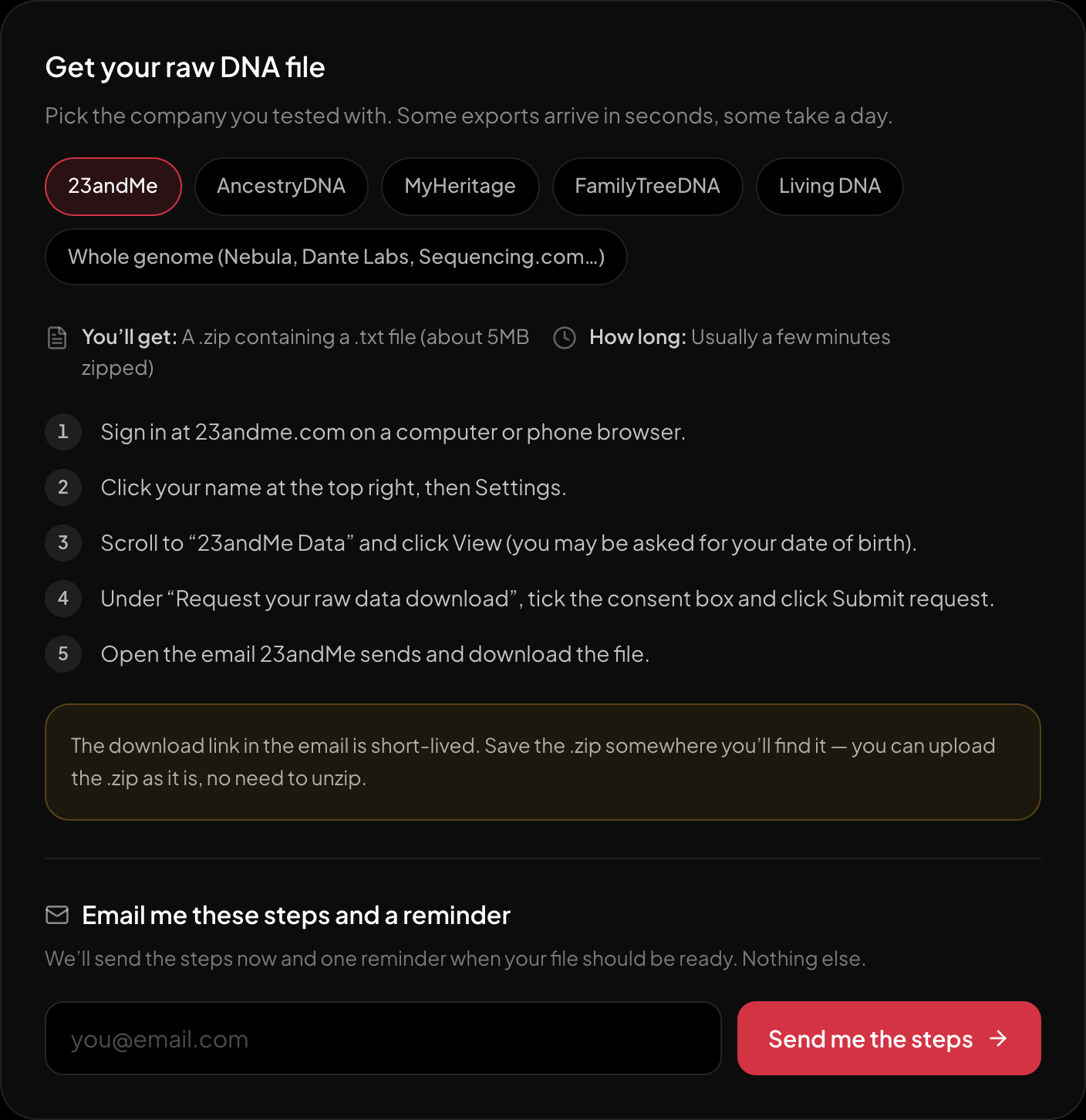
The download steps for 23andMe, on the page itself.
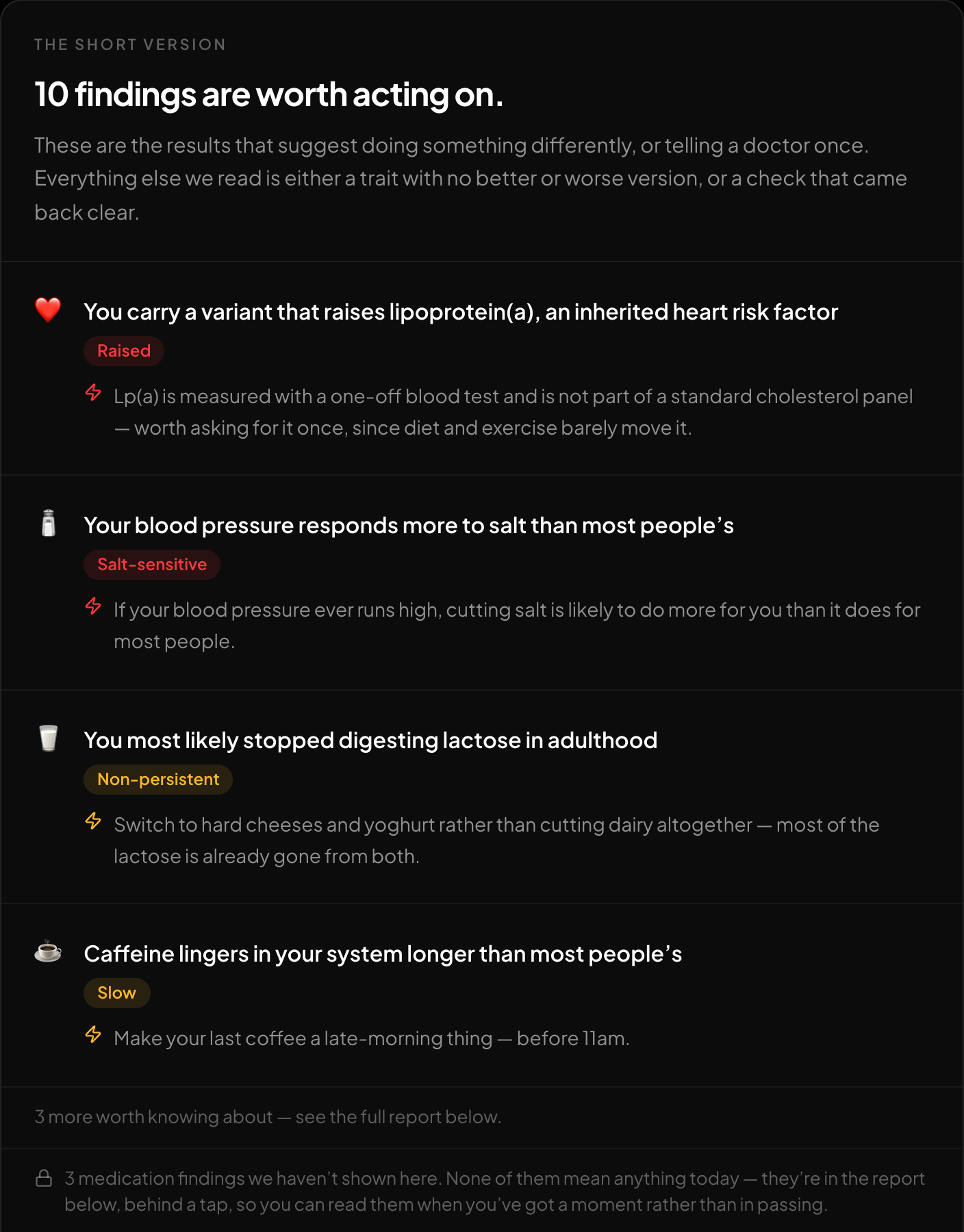
The short version: what is worth acting on, first.
The free HealthOS report does not classify this variant, so do not expect a call there. You can check rs6025 directly with the one-marker lookup at https://healthosx.com/dna/lookup. To read it alongside other traits, medication responses and carrier findings, use the free DNA tool at https://healthosx.com/dna.
New to raw DNA files? Start with the full guide: How to Download & Analyze Your 23andMe Raw Data Free
Written by
HealthOS Research