Does AncestryDNA Use My Family Tree to Calculate My Ethnicity Results
No. AncestryDNA calculates your ethnicity percentages from DNA markers compared with a reference panel, not from your linked family tree.
Does AncestryDNA use my family tree for ethnicity results?
No. AncestryDNA calculates your ethnicity percentages from autosomal DNA markers compared with a reference panel of people whose family roots trace back to one place. Your linked family tree is not an input to the ethnicity estimate and should not directly change the percentages.
The estimate is a DNA marker comparison
Your raw DNA file contains hundreds of thousands of autosomal SNP markers. The ethnicity algorithm takes those markers and looks for statistical patterns in the reference panel. That panel is built from living people whose ancestors all came from a particular region over several generations. So the reference panel represents what DNA looks like in people with deep roots in, say, Ireland or the Levant.
The algorithm does not read names, dates, birthplaces, or attached records. It cannot see your tree. So when you correct a grandparent's birthplace, there is no mechanism by which that correction could flow into the estimate. On the screen, each region shows a point estimate and a range. The range exists because assigning a short DNA segment to one region is probabilistic, not a read of a census record. That uncertainty has nothing to do with whether your tree is complete.
A linked tree can change other parts of AncestryDNA, but not this one.
What your family tree actually powers
Your tree powers the genealogy side of AncestryDNA. That mostly means:
- ThruLines, which suggests how you might connect to DNA matches through a shared ancestor.
- Shared ancestor hints on DNA match pages.
- Tree-based member searches and records hints.
- Some community features may draw on DNA match networks and tree data.
None of these are the ethnicity estimate.
Why editing a tree changes nothing
The ethnicity estimate is based on autosomal DNA markers and reference populations, not on the user's tree. The input is your genotype. The output is a set of regional proportions. The tree just sits in a different product area.
That is why deleting your entire tree today should not change your ethnicity percentages because of that tree edit. A later update may still appear, but that would come from a reference panel or algorithm change, not from your tree edit.
| Action | Changes the estimate? | What it affects |
|---|---|---|
| Editing or deleting tree entries | No | Tree-linked features such as ThruLines and shared ancestor hints may update |
| Linking or unlinking your tree to DNA results | No | Tree-linked features may update, including some community context |
| AncestryDNA updating its reference panel | Yes | Percentages and ranges can shift |
| Algorithm changes | Yes | Regional estimates recalculated |
| AncestryDNA updates or regenerates its genotype data | Yes | Underlying genotype data can change |
Scroll the table sideways for the rest →
Family tree edits do not touch the ethnicity model.
Does a linked tree ever affect ethnicity features?
It affects some features that look related, which is where the confusion usually starts. Linking or unlinking a tree may affect tree-linked features such as ThruLines, shared ancestor hints, and some community context. Those changes are separate from your regional percentage bars and their ranges.
People get this wrong because the dashboard shows ethnicity and communities on the same screen. It looks like one thing. Underneath, it is two different models.
Your ethnicity percentages come from DNA markers compared with a reference panel. Your family tree powers matches and ThruLines, not the percentages.
When percentages do change
Your ethnicity estimate can change for a few reasons:
- AncestryDNA adds more people to its reference panel.
- The algorithm changes.
- AncestryDNA re-runs the ethnicity model on your same file after an update.
Your tree document is not on that list. The underlying genotype data can change only with a new AncestryDNA test or if AncestryDNA updates or regenerates its genotype data. A change seen after a tree edit is likely due to a reference-panel or algorithm update, not the tree edit.
See what your raw DNA says elsewhere
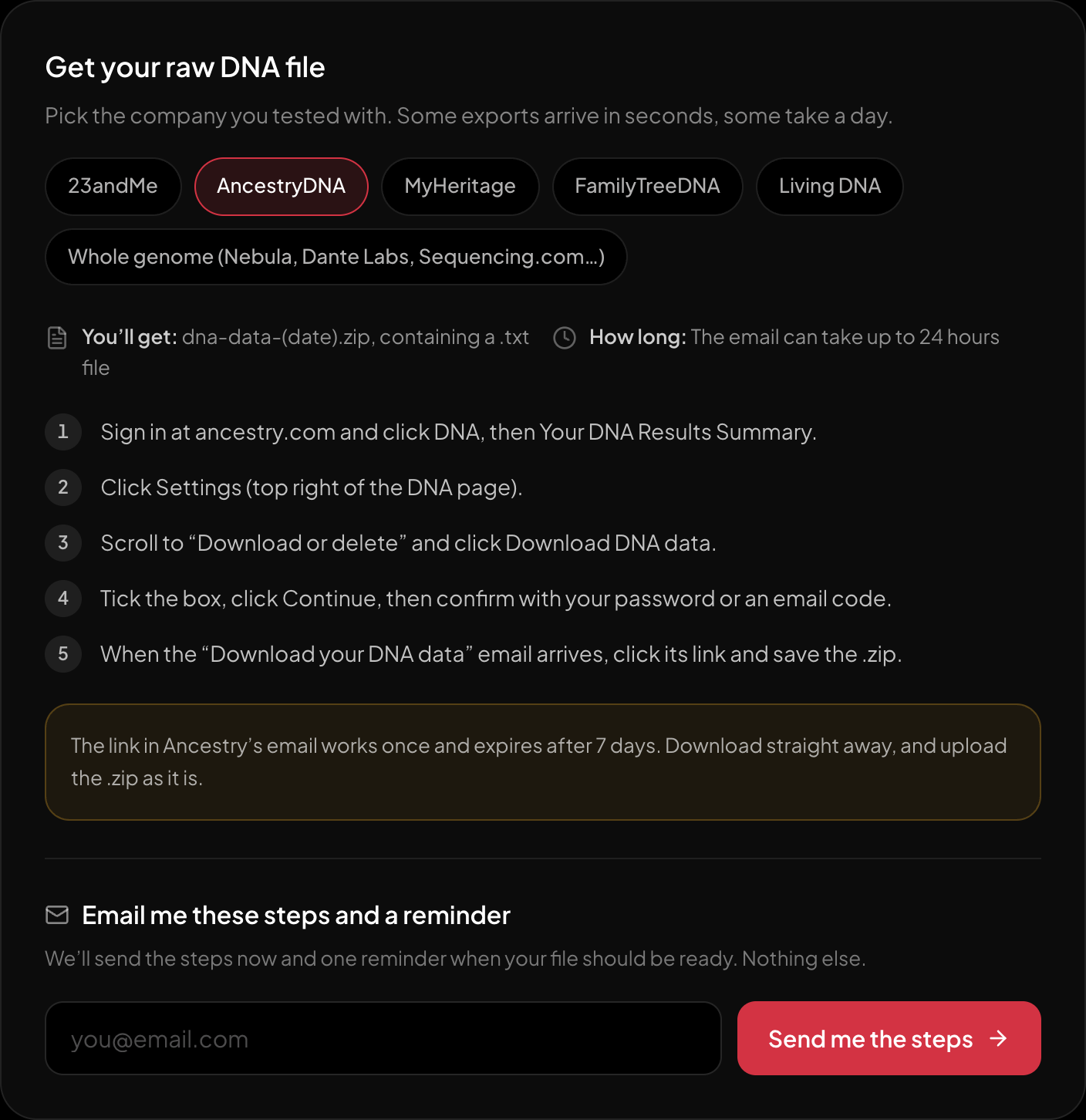
The download steps for AncestryDNA, on the page itself.
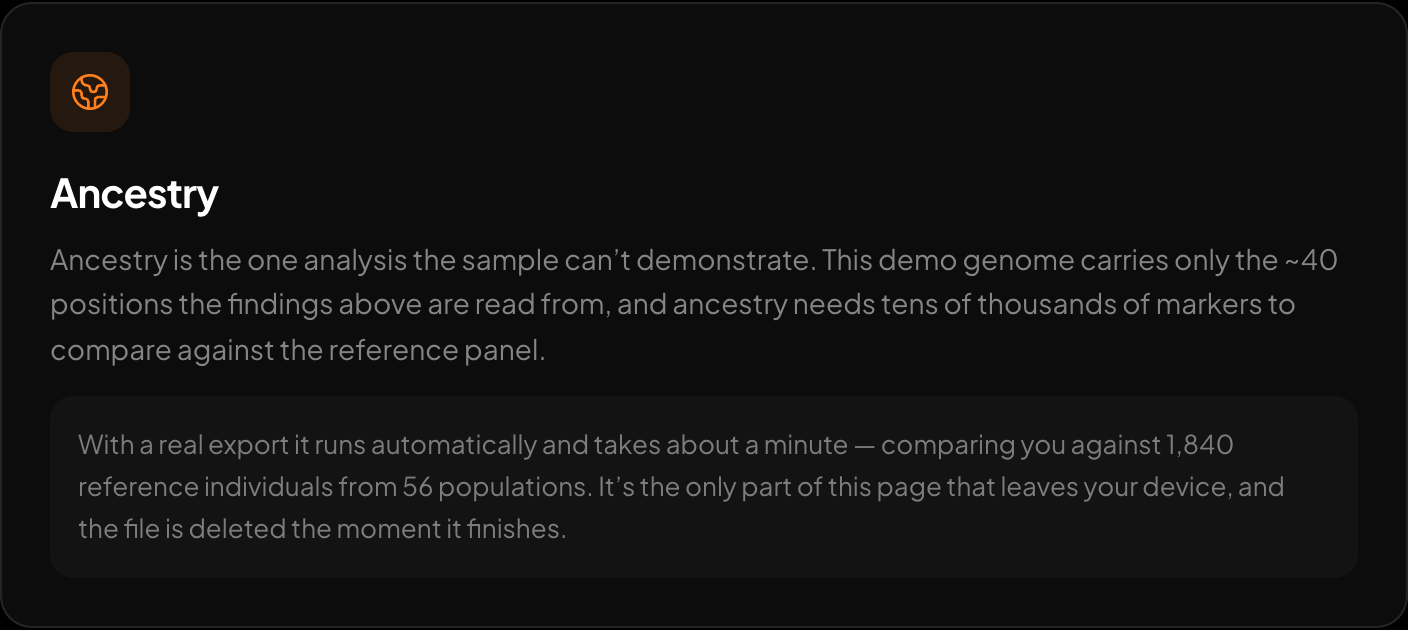
Ancestry across 15 regions and 157 reference populations.
If you have already downloaded your AncestryDNA raw file, you can get a second view without re-testing. The free HealthOS DNA tool at https://healthosx.com/dna reads raw exports from AncestryDNA, 23andMe, MyHeritage and whole-genome VCF files in the browser. The trait and health story appears in the browser before the one-time email code. Whole-genome VCF files without rsID annotations can still be used for ancestry, but they cannot produce the named health findings. An optional genetic ancestry breakdown requires explicit consent, runs on the server, uses selected markers, and opens after a one-time email code. No payment is required. That is a different pipeline from AncestryDNA's estimate, so the exact percentages and regions will not be identical.
New to raw DNA files? Start with the full guide: How to Download & Analyze Your 23andMe Raw Data Free
Written by
HealthOS Research