What CRP rs1205 Means in Your 23andMe Raw Data
CRP rs1205 is a single-letter DNA variant in or near the CRP gene. It has been associated with baseline CRP, but a 23andMe genotype alone cannot tell your CRP level.
CRP rs1205 is a single-letter DNA variant in or near the CRP gene. It has been associated with baseline CRP in some studies, but a 23andMe genotype alone cannot tell you your CRP level. It is an inherited marker, not a diagnosis, and everyday drivers like infection, obesity or smoking usually matter more.
If rs1205 shifts the idle level, the effect is small, not the acute spike, and it never overrides an infection.
What does CRP rs1205 mean in my 23andMe raw data?
A 23andMe raw data line has rsid, chromosome, position, and two alleles. Do not assign high or low unless the report specifies the genome build, strand, and effect allele. When you search the raw file for rs1205, you see the marker rs1205 and two alleles from your file.
| Raw data field | Example | What it does not mean |
|---|---|---|
| rsid | rs1205 | A CRP lab value or diagnosis |
| chromosome | 1 | Effect direction |
| position | Position from your file | Effect direction |
| alleles | Two letters from your raw file, for example C/T | High or low CRP unless build, strand, and effect allele are specified |
Scroll the table sideways for the rest →
Raw data fields only. This table does not assign a high or low effect because build, strand, and effect allele must be specified.
To check rs1205 in your own file, use https://healthosx.com/dna/lookup for rs1205 or upload your raw file at https://healthosx.com/dna. The browser story needs no account. The full free report opens with a one-time email code.
What CRP actually does
CRP is an acute-phase protein made mainly by the liver. When tissue is damaged or infected, immune cells release signals such as IL-6, and the liver pushes CRP into the blood. CRP binds to damaged cells and helps the complement system clear them.
Baseline CRP is the level when you do not have an obvious infection. That idle level is partly inherited. rs1205 sits in the CRP gene, in a region that may affect how much CRP protein gets made. It may not be the causal switch itself. It often travels with a nearby haplotype. The point is that it mainly tweaks the idle level, if it has an effect. An acute spike is driven much harder by cytokines from an actual insult.
How much difference does the genotype make?
The effect is modest and depends on the study, build, strand, and effect allele, so no single average difference is given here. A high-sensitivity CRP test is usually read as: - under 1.0 mg/L: low - 1.0 to 3.0 mg/L: average - above 3.0 mg/L: high
People with the same reported genotype overlap heavily on lab values because other factors dominate.
Why your lab result may not match your genotype
If your genotype effect and your CRP level do not line up, something other than rs1205 is doing the work. Common causes are:
- a recent infection or vaccination
- extra body fat, especially around the abdomen
- smoking
- poor sleep or high stress
- gum disease or another low-grade inflammatory source
- an autoimmune condition
An infection can push CRP very high within hours. The SNP does not stop that.
Illustrative relative magnitude only. It does not show exact mg/L shifts.
If a high-sensitivity CRP result is above 3.0 mg/L, repeat it when you are well. If it stays high, discuss the persistent elevation with a clinician rather than treating the number as a DNA result. CRP findings in HealthOS are not diagnostic, and a persistent high hs-CRP should be reviewed by a clinician.
The common mistake
People treat one genotype as a diagnosis and another as protection. Both are wrong. The variant may affect a small part of baseline CRP, not current inflammation and not acute response. Genetic CRP associations alone do not establish that lowering CRP will reduce heart attack risk, and they do not imply individual risk. That leaves CRP as a sign, not a proven target for heart attack prevention.
If a blood test shows a high-sensitivity CRP above 3.0 mg/L, the useful next step is to look at lifestyle and inflammatory sources with a clinician, not to recheck your DNA.
How to check your own raw data
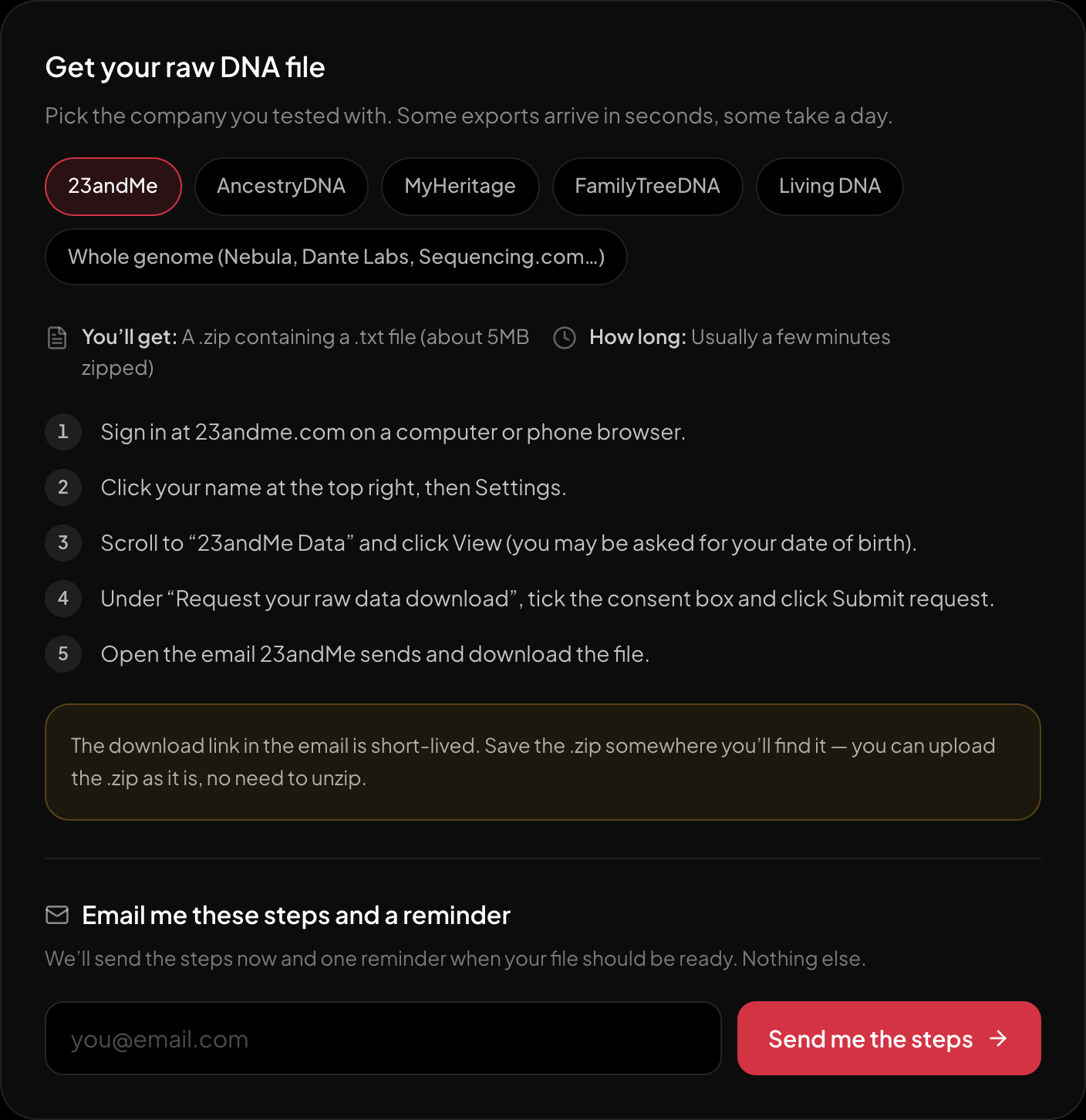
The download steps for 23andMe, on the page itself.

The short version: what is worth acting on, first.
The HealthOS free tool accepts 23andMe, AncestryDNA, MyHeritage and whole-genome VCF files. It shows traits and health findings in the browser. Ancestry needs explicit consent and server processing. The uploaded-file report is for information only and is not a diagnosis. The DNA kit is ancestry and traits only, with no health report.
New to raw DNA files? Start with the full guide: How to Download & Analyze Your 23andMe Raw Data Free
Written by
HealthOS Research