26 Chromosomes? Just a Label in AncestryDNA Raw Data
Humans have 46 chromosomes. In AncestryDNA raw data, 23 is X, 24 is Y, 25 is the region X and Y share, and 26 is mitochondrial DNA. Read your file free.
In an AncestryDNA raw data file, chromosome 23 is the X, 24 is the Y, 25 is the region X and Y share, and 26 is mitochondrial DNA. These are labels, not extra chromosomes. 23andMe and MyHeritage use letters for X, Y and MT instead, and how they write the shared region can differ, so check your own file.
The four labels, decoded
The chromosome column runs 1 to 22 for the autosomes, the numbered pairs that both sexes carry. Then it keeps counting for everything else. Humans have 46 chromosomes, 23 pairs, so "chromosome 26" can sound impossible. It is a label, not a 26th chromosome. Two of the four labels need a little more detail:
- 25 is the pseudoautosomal region (PAR): two stretches at the tips of X and Y, roughly 2.7 million bases at one end and about 0.3 million at the other, where the two chromosomes recombine in men and behave like autosomes. Everyone has two copies.
- 26 is mitochondrial DNA (mtDNA), a small circular genome of about 16,500 bases inside your mitochondria, separate from the 46 chromosomes.
| AncestryDNA | 23andMe | MyHeritage | |
|---|---|---|---|
| X chromosome | 23 | X | X |
| Y chromosome | 24 | Y | Y |
| Pseudoautosomal region | 25 | No separate PAR label; check your file | No separate PAR label; check your file |
| Mitochondrial DNA | 26 | MT | MT |
Scroll the table sideways for the rest →
Labels as they appear in the chromosome column of the raw data file. For the pseudoautosomal region, check how your own file writes those rows.
Numbers versus letters across companies
PLINK stores the chromosome as an integer and numbers X, Y, XY and MT as 23, 24, 25 and 26. AncestryDNA uses the same numbers for these four regions. 23andMe and MyHeritage use letters, which is also how many reference genomes name these regions.
The layouts differ in other ways too. An Ancestry file begins with lines starting #, which include a note on the reference build, then has five tab-separated columns: rsid, chromosome, position, allele1 and allele2. 23andMe has four columns, with the genotype fused into one field such as AG. MyHeritage is a comma-separated file with quoted values. The chromosome labels are one difference among several, alongside column count, delimiter and quoting.
What the sex and mtDNA rows should look like
Here is an illustrative Ancestry row. It is an example only, not from a real file, and the rsid is a placeholder:
rsid chromosome position allele1 allele2 rs0000000 26 7028 C C
Read it left to right: marker name, chromosome 26 (mtDNA), base position, then the two allele columns. A 0 in an allele column means no-call. mtDNA is a single maternal haplotype, so it has one allele, and a doubled C like this is formatting, not two matching alleles.
To check your own file, filter the chromosome column for 24 or 26 and count the rows where the alleles are not 0. On a command line, awk '$2==26 && $4!=0' yourfile.txt | wc -l does it for 26 (swap in 24 for the Y).
What you should see depends on the region:
- Chromosome 24 has real calls in a man. In a woman, who has no Y, the rows are typically no-calls.
- Chromosome 23 outside the PAR is one copy in a man and two in a woman.
- Chromosome 26 is a single maternal version in everybody, inherited from the mother.
If you are a woman and scroll to the chromosome 24 block, expect rows that look like this, with 0 in both allele columns all the way down (again an illustrative row with a placeholder rsid):
rs0000001 24 15000000 0 0
That is normal. It means the chip has Y positions on it and you have no Y to read there.
The common mistake is reading a doubled letter on 23, 24 or 26 as "homozygous". Where a file shows a single copy twice, that is formatting. Whether a company repeats the letter or pads the second column with a 0 varies by company and file version, so look at your own rows rather than assume.
Where the haplogroup rows are stored
They are not stored. No row in an AncestryDNA file says H or R1b. A haplogroup is a named branch of the family tree of mtDNA or Y variants, and software works it out by comparing your genotypes at specific positions on chromosome 26 (maternal line) and 24 (paternal line) against a published tree.
mtDNA passes from a mother to all her children, the Y from a father to sons only, so a woman's own file has no paternal haplogroup, only her mother's. And because a chip tests only a limited selection of positions on those chromosomes, expect a broad branch, not the finest subclade that whole-genome sequencing could place.
Why a tool or spreadsheet drops or misreads them
Most failures come from code that assumes the chromosome column looks like someone else's file.
- A filter such as "chromosome 1 to 22" removes 23 to 26 on purpose. That is fine for autosomal ancestry and fatal for haplogroups.
- Parsers expecting
X,YandMTskip numbers they do not recognise, or fail on the whole file. - Converters to 23andMe format must turn 23 into X, 24 into Y and 26 into MT. Chromosome 25 is the awkward one, because the target format may have no separate PAR label, so check what your converter did with those rows.
- A spreadsheet sorting the column as text puts 23 to 26 in the middle (1, 10, 11 ...). Sorted as numbers, they sit at the bottom.
- Mixed-up builds produce nonsense. Check the build named in each file's header comment before comparing positions across files.
The HealthOSX converter at healthosx.com/dna/convert converts between layouts including AncestryDNA, so check how it labelled rows 23 to 26 afterwards. For the maternal and paternal lines themselves, use the haplogroup page at healthosx.com/dna/haplogroup.
Do these rows matter beyond ancestry
Some do. G6PD, the gene behind sensitivity to fava beans and certain drugs, sits on the X, so in an Ancestry file it is a chromosome 23 row. Because a man has one X, a single variant copy can matter more than in a woman, who has two. Little on the Y is of health interest from a chip. The mtDNA rows on a chip cover a limited set of positions and are not a screen for mitochondrial disease, so an unremarkable chromosome 26 tells you nothing about that.
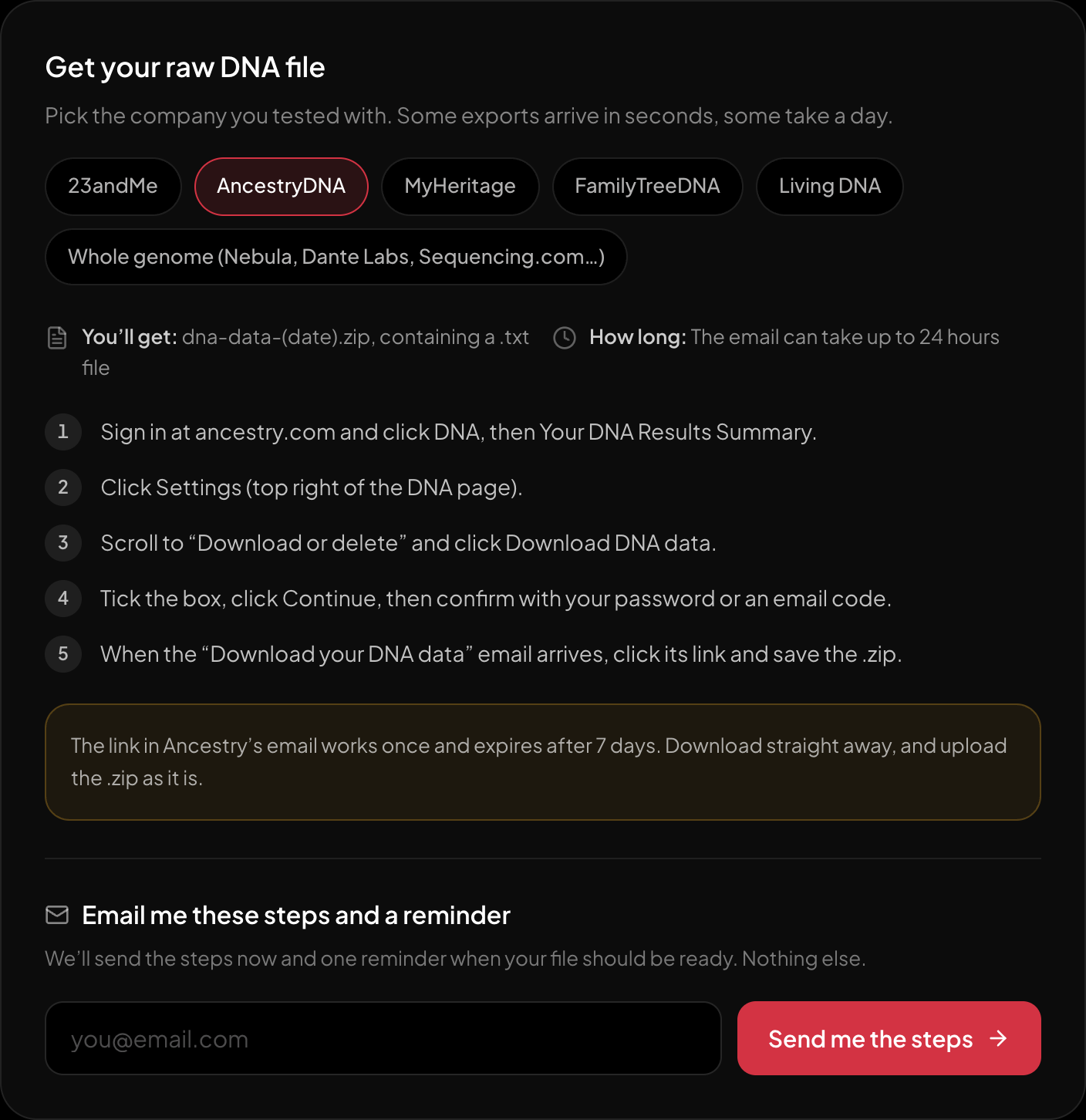
The download steps for AncestryDNA, on the page itself.
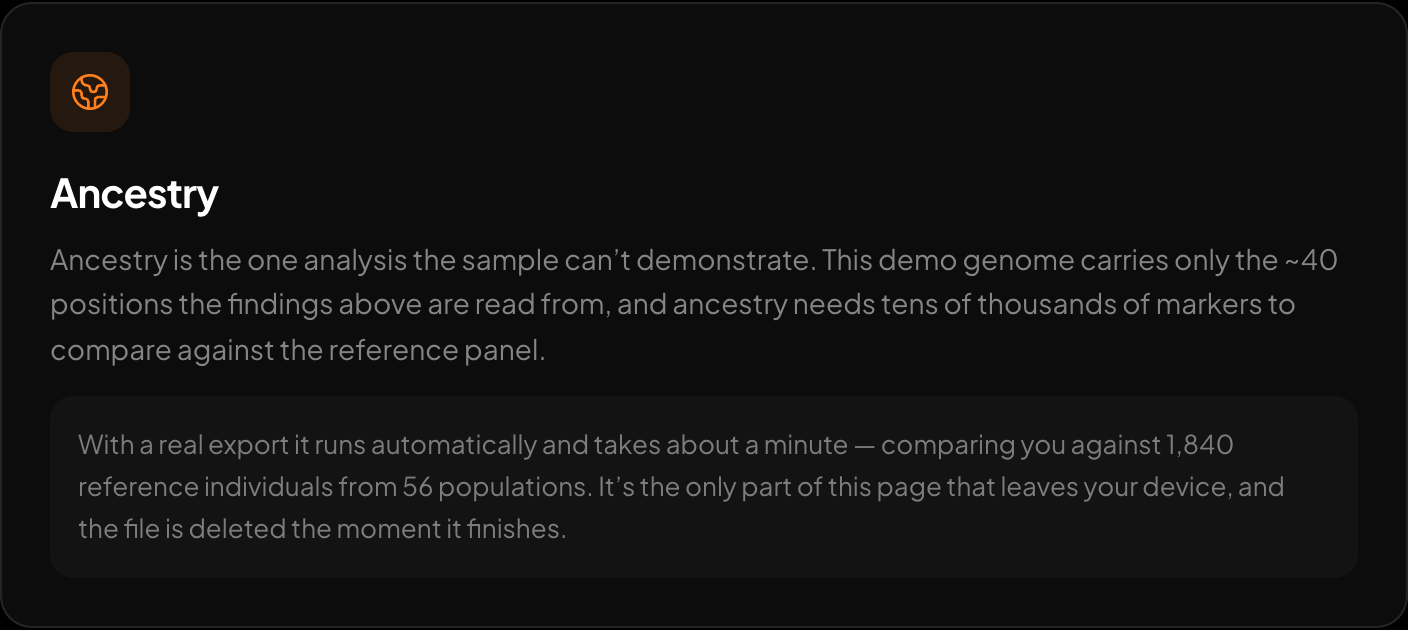
Ancestry across 15 regions and 157 reference populations.
If you would rather not wrangle the file, the free reader at healthosx.com/dna accepts an AncestryDNA .txt or .zip and parses it in your browser. The report covers traits, medication response and carrier-relevant findings, and it includes a G6PD finding, though whether your file has the needed X-chromosome position depends on the chip version. The ancestry breakdown is optional and runs on the server only with your consent. The full report opens after a one-time email code.
New to raw DNA files? Start with the full guide: 23andMe Raw Data Interpretation Free in Your Browser
Written by
HealthOSX Research