Can Life Insurance Companies See or Use My 23andMe or AncestryDNA Raw Data
Insurers can't look up your 23andMe or AncestryDNA file on their own, but in most of the US a life insurer may ask about genetic tests and use your answer, and a result in your medical records can reach them too.
Insurers can't look up your raw file. A result reaches them in two ways: you answer an application question about genetic tests, or the result is already in your medical records because you showed it to a doctor, and the insurer reads those records with your signed authorization. In most US states a life insurer may ask and use the answer, because the federal genetic privacy law (GINA) does not cover life insurance. It does not cover disability or long-term care insurance either.
Who can actually see a raw DNA file
The file lives in two places: with the company that ran your test, and wherever you put copies. Insurers are not a third holder by default. As of November 2026, 23andMe and AncestryDNA say they don't share individual results with insurers or employers without your consent. Those terms can change after a sale, and 23andMe's assets went to a new owner (TTAM Research Institute) after its 2025 bankruptcy sale, so treat the terms as a current policy, not a permanent promise.
Data can still move in a few ways: a legal order, a sale of the company, or your own consent. A company holding millions of genomes can also be breached (23andMe had a credential-stuffing breach in 2023). And every site you upload the file to for a second opinion becomes another holder with its own terms. That is where raw data usually leaks: not from the lab, from the reader.
What GINA covers in the US, and what it leaves out
The Genetic Information Nondiscrimination Act of 2008 has two halves. One bars health insurers from using genetic information to set eligibility or premiums. The other bars employers with 15 or more staff from using it in hiring, firing and pay. The ACA separately stops health insurers from pricing on pre-existing conditions.
| Covered by GINA? | |
|---|---|
| Group and individual health insurance | Yes |
| Employment (15+ employees) | Yes |
| Employers with fewer than 15 staff | No |
| Life insurance | No |
| Disability insurance | No |
| Long-term care insurance | No |
| Military coverage (TRICARE) | No |
US federal law, as passed in 2008. State laws may add protection. The ACA protection for health insurance is separate from GINA.
A life insurer is allowed, federally, to use genetic information in underwriting. Military health coverage (TRICARE) also sits outside GINA. A few states have added their own limits on life insurers; Florida is one. The rules differ and change, so check your own state before assuming either way.
Buy life, disability or long-term care cover before you test
If a variant like a BRCA1/2 or APOE result might make you want more cover, the time to buy is while you have nothing to report, because an application that asks about genetic tests must be answered truthfully. A result you know about can't be un-known once an application asks. Whether to test at all is your choice.
The medical-records route
If a 23andMe or AncestryDNA finding is discussed with a clinician or confirmed by a clinical test, it can sit in records the insurer gets through the authorization you sign on the application. That is the most common way a consumer result reaches an underwriter. The insurer never needs your raw file for this: the finding travels inside the chart.
What the application asks, and what you must disclose
Insurers don't need your raw file. They need your answers. An application asks about diagnoses, medications, family history of heart disease or cancer, and often about tests. They then check prescription databases and medical records.
In US states with no limit, a life, disability or long-term care application can ask directly whether you have had any genetic test. If it does and you know about a consumer result, answering no is misrepresentation. The policy can be contested, usually for the first two years, and a misrepresentation found after a death within that window can lead to a denied claim. Rules on fraud after that window differ by state. What you must disclose is what the application asks and what you know, whether or not a clinician confirmed it.
How the UK, Germany, Canada and other countries differ
| Protected for ordinary life cover? | Exception | |
|---|---|---|
| US federal | No | Insurers may ask and use results |
| Some states (e.g. Florida, 2020) | Limits for life, disability and LTC insurers | Rules differ by state |
| UK | Yes, voluntary code | Huntington's, life cover above £500,000 |
| Germany | Yes, by law | Known results, cover above 300,000 euros or a pension above 30,000 euros a year |
| Canada | Yes, by law (2017) | Results usable only with written consent |
Scroll the table sideways for the rest →
Summary of the main rule in each place; details and thresholds can change.
The UK has a voluntary Code on Genetic Testing and Insurance between the government and the insurance association. Insurers agree not to ask for or use predictive genetic test results, with one long-standing exception: Huntington's disease on life cover above £500,000. It is a code, not a statute, so it binds members by agreement.
Germany has it in law. The Gendiagnostikgesetz stops insurers from requiring a genetic test or using results, but lets them ask about results you already know when the cover is large: life, disability or care insurance above 300,000 euros, or a pension above 30,000 euros a year. The common thread: strong protection for ordinary policies, and a threshold above which your knowledge counts.
Canada has had a Genetic Non-Discrimination Act since 2017, upheld by the Supreme Court of Canada in 2020. No one may require a genetic test or disclosure of results as a condition of a contract, or use results without your written consent.
Does analysing the file in the browser change any of this?
It changes where the copies are, but not to zero. When a file is parsed in your browser, the raw genotypes are read on your own device. The full report needs a one-time code sent to your email. The optional ancestry breakdown sends the markers it needs to the server only with your consent, and keeps them until you delete them. Storing the whole file is opt-in. None of this alters what an insurer may ask.
Before and after you test, a short list is worth keeping:
- Check your state's rules on life, disability and long-term care before buying cover.
- Don't paste results into apps or forums tied to your real name.
- If you share a consumer result with your doctor, know it may enter your record.
- Read the testing company's terms on research use, sale and law enforcement requests, and opt out of what you can.
- Download your raw file, then delete the account data if you no longer want it held there.
- Upload the file only to tools that say plainly what leaves your device and what they keep.
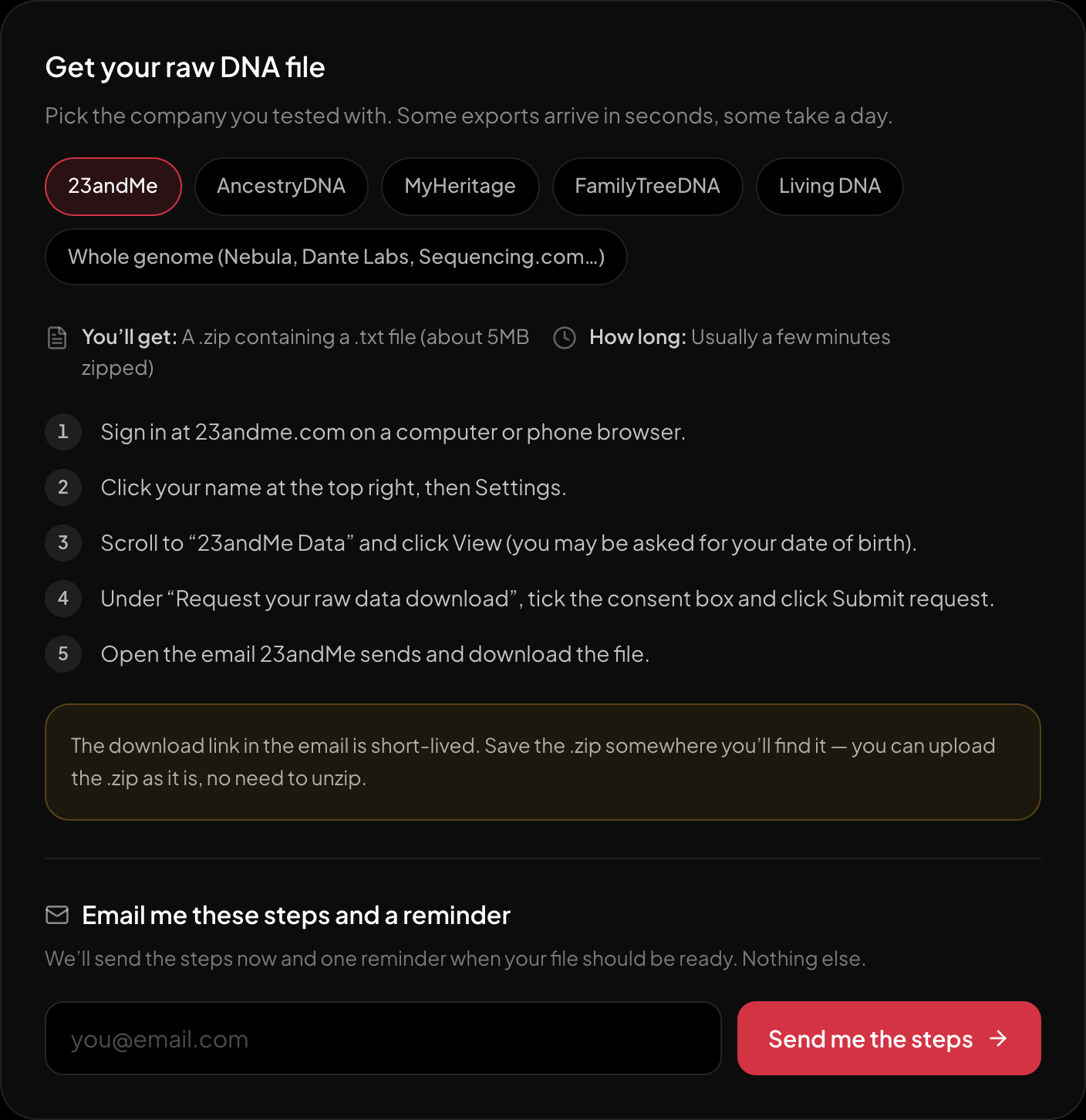
The download steps for 23andMe, on the page itself.
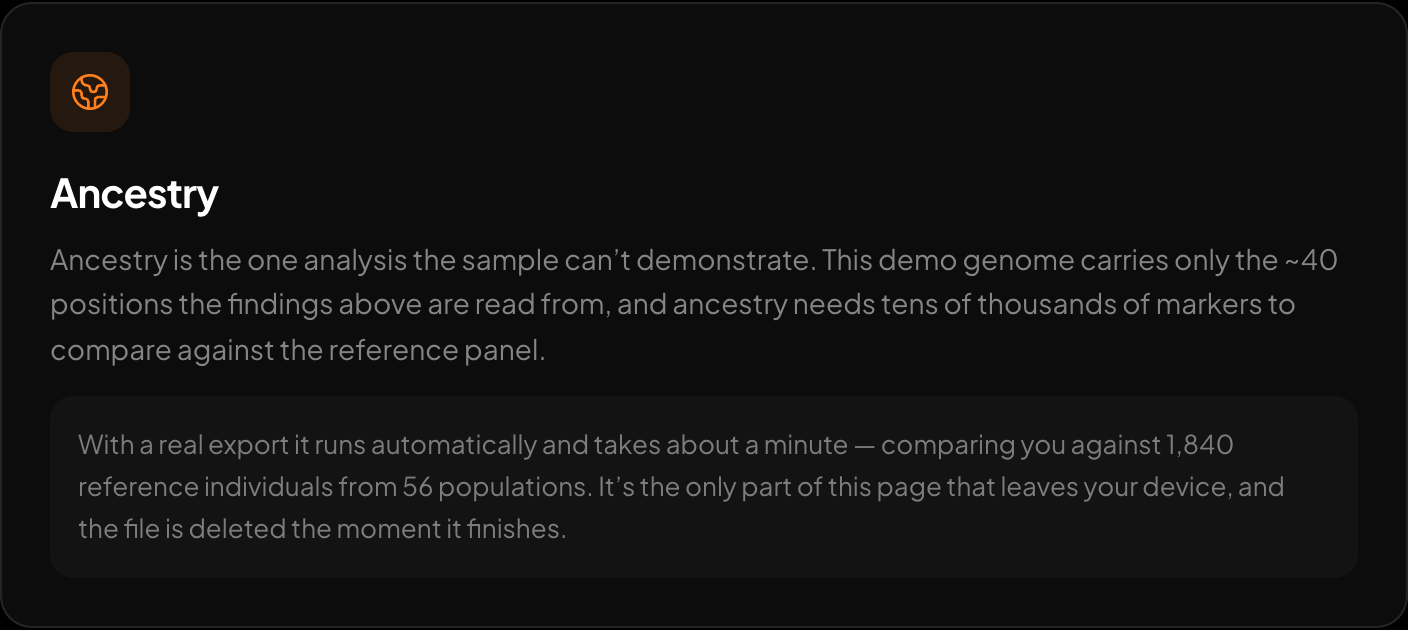
Ancestry across 15 regions and 157 reference populations.
Laws here are moving, and US state rules on life insurers are the part most likely to have changed since you last read about them. If you want to see what your own file contains, the free tool at healthosx.com/dna reads a 23andMe, AncestryDNA or MyHeritage file in your browser and reports single-variant health findings, medication response and carrier status. The report runs on a genotyping chip file and is not a clinical test, which is exactly why its findings shouldn't be read as a diagnosis but may still be something an application asks about. An ancestry breakdown only runs if you consent. If you are buying cover, read the US section above first.
New to raw DNA files? Start with the full guide: 23andMe Raw Data Interpretation Free in Your Browser
Written by
HealthOSX Research