Can I Find My Blood Type From My 23andMe Raw Data
Yes, your 23andMe raw data can show your likely ABO blood group: A, B, AB or O, but it is a DNA-based ABO result only, not a clinical blood type, and Rh is not included.
Yes. You can find your likely ABO blood group from your 23andMe raw data if it is a supported raw file. 23andMe is a supported source. The free trait report is read in your browser, the DNA story needs no account, and it includes an ABO blood-group result when the required ABO rsIDs are present. The result is based on ABO markers in your DNA file, not a clinical blood type, and it does not include Rh factor.
The line worth remembering: a DNA file can tell you your likely ABO group, but it is not a substitute for a laboratory blood type if you need one for donation, surgery, pregnancy, or transfusion.
Can I find my blood type from my 23andMe raw data?
For ABO, yes. 23andMe is a supported raw data source. The free trait report is read in your browser, the DNA story needs no account, and the file does not leave your device for that report. Trait reporting needs rsIDs, so a VCF without rsIDs gets ancestry-only results, and ABO cannot be promised for every whole-genome VCF. Ancestry reporting is optional and server-based.
The DNA result covers the ABO letter only. If a blood bank types you, it may report O positive or A negative. The DNA result stops at ABO and does not include Rh. It is not suitable for donation, surgery, pregnancy, or transfusion decisions.
What the ABO gene actually does
Blood group is about sugars on red cells. The ABO gene makes an enzyme that modifies a base sugar called the H antigen. The A allele adds N-acetylgalactosamine. The B allele adds galactose. The O allele has a small deletion that knocks out the enzyme, so the H antigen stays unchanged.
Your two copies of ABO decide the usual result:
| Alleles | Usual ABO result |
|---|---|
| A/A or A/O | A |
| B/B or B/O | B |
| A/B | AB |
| O/O | O |
Simplified inheritance from your two ABO alleles. This is not the exact report format.
A person with an A and a B allele gets both enzymes, so both sugars appear: type AB. A person with two O alleles has no working enzyme, so neither sugar appears: type O.
How accurate is the DNA ABO result?
If the required ABO rsIDs are present, the tool returns a likely ABO group from the common A, B, and O markers. Rare or weak ABO variants may make the DNA prediction uncertain or approximate. If a person carries one of those, the tool may report the nearest common result or an ambiguous result.
How often rare or weak ABO alleles get miscalled depends on the population, and that number is not well measured for every chip. A lab forward and reverse type also checks the serum antibodies, which DNA does not. For donation, surgery, pregnancy, or transfusion, the lab type is the one that matters.
What about Rh positive or negative?
Rh is not part of this result. Rh factor is controlled by a different gene, RHD, on a different chromosome. Clinical blood type is two things: ABO and RhD. A raw file may contain some Rh markers, but the DNA ABO result does not read them.
If you need to know whether you are Rh positive or negative for pregnancy, blood donation, surgery, or transfusion, get a standard blood type from a lab. The ABO result is not the whole blood type.
The common mistake: DNA result is not phenotype
A DNA result predicts your blood group from your ABO markers. Usually that matches the red cell antigens, but not always.
- A recent blood transfusion can temporarily introduce donor red cells into a blood sample and cause a mixed serology typing result. DNA typing from a raw file is not a substitute for blood bank testing.
- A bone marrow transplant replaces the blood-producing cells. Saliva DNA may still have your original ABO, while your blood cells may produce the donor's ABO.
- The rare Bombay phenotype stops the cell from making the H antigen that A and B enzymes need. A person can carry A or B alleles but test as O on routine blood grouping.
- Some weak A or B subgroups produce less antigen and can be mistyped by DNA or by lab methods.
For most people, the DNA ABO result and the clinical ABO group agree. The lab type is the one that matters for clinical decisions.
What should I do with this result?
Treat it as a self-check, not a medical type. If you already know your blood type, the DNA result should match the letter. If it does not, that is worth asking a doctor or blood bank about. The mismatch can be more informative than either result alone.
If you have a DNA file but no blood test that reported ABO, this fills in the letter, but not the Rh.
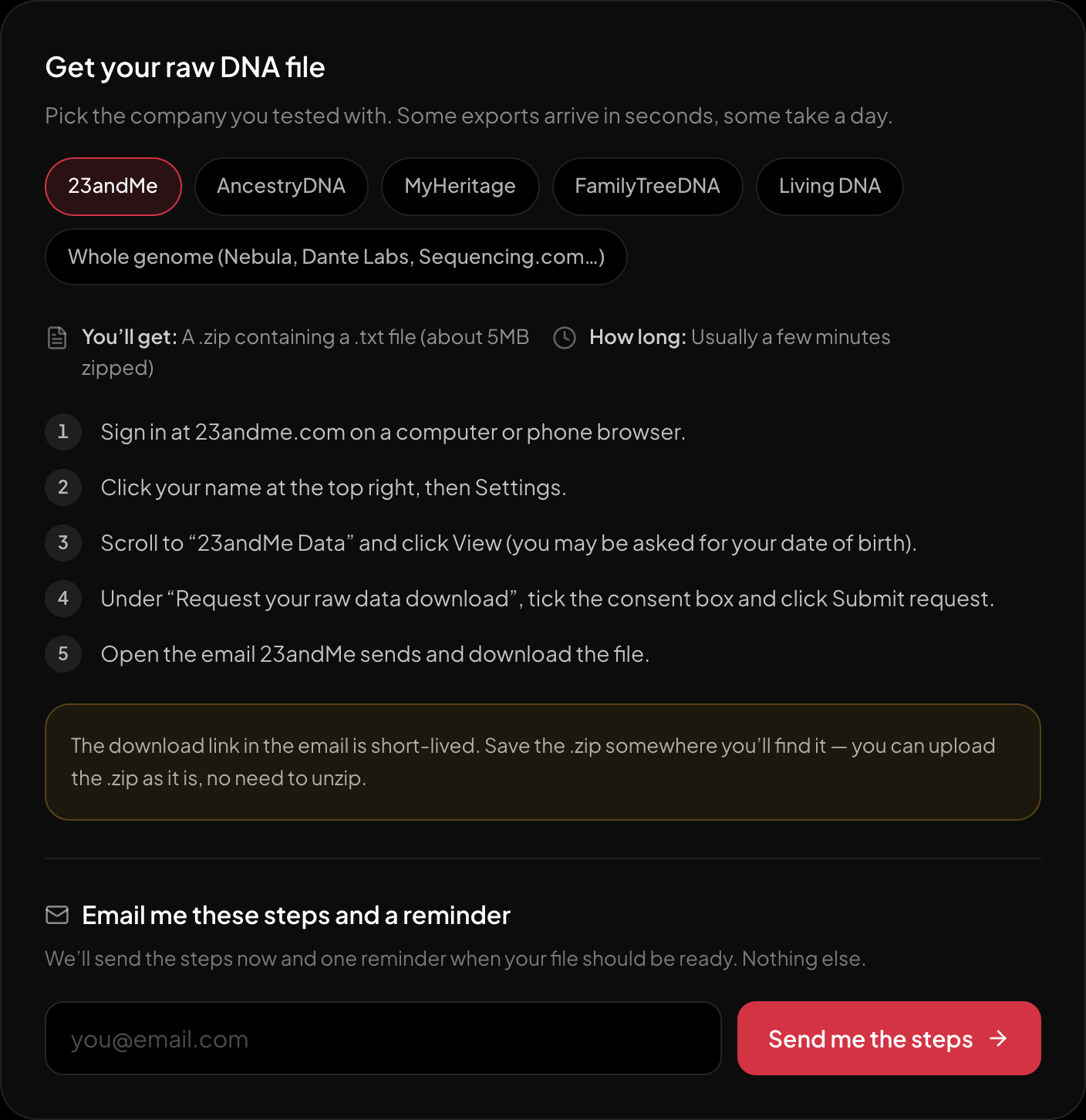
The download steps for 23andMe, on the page itself.
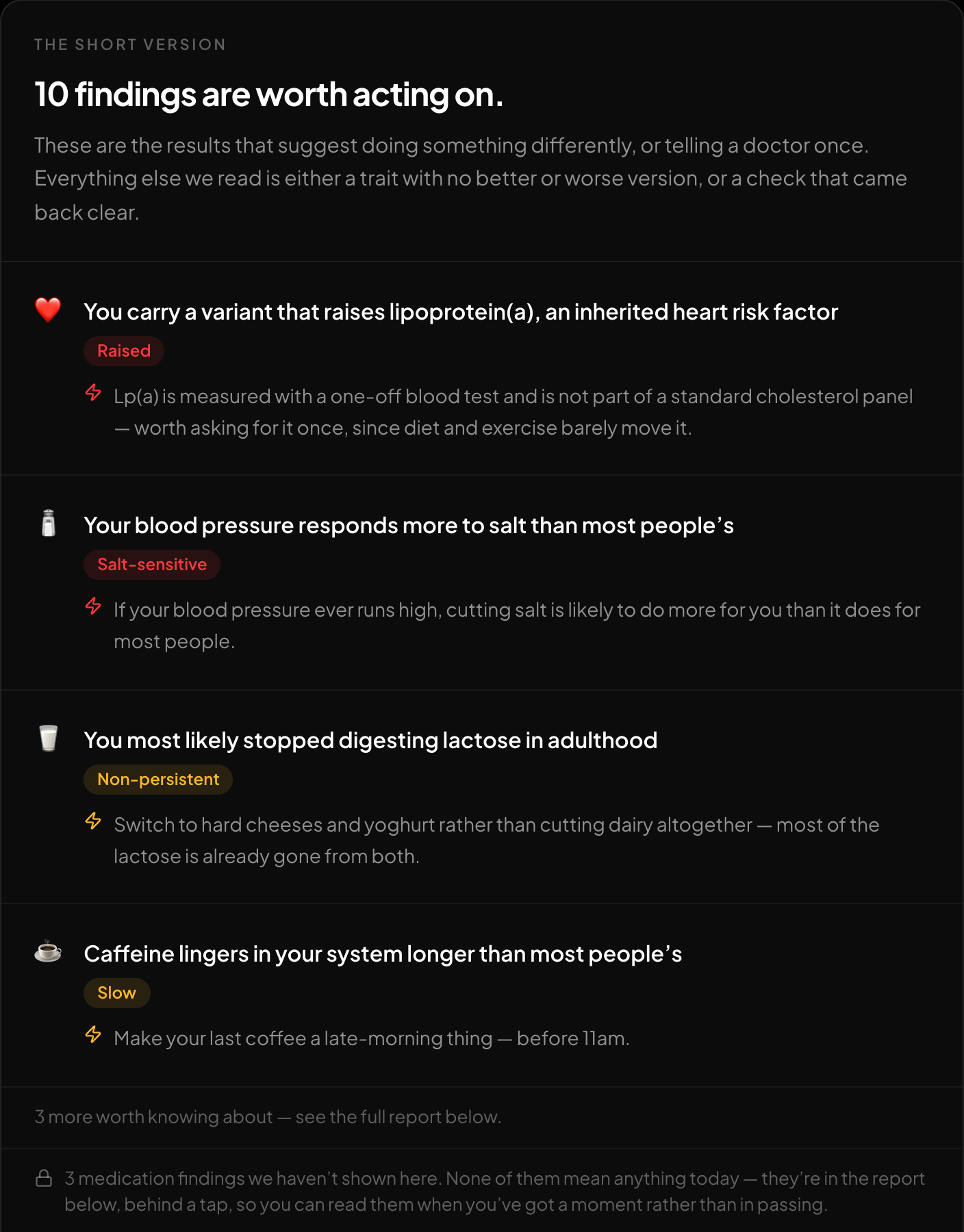
The short version: what is worth acting on, first.
If you have a supported raw file, the free HealthOS DNA tool will read it in your browser (the DNA story needs no account) and include an ABO blood-group result when the required ABO rsIDs are present. Trait reporting needs rsIDs, so a VCF without rsIDs gets ancestry-only results and cannot return ABO. Ancestry reporting is optional and server-based. Do not use this tool as a diagnostic or for clinical decisions. It is not suitable for donation, surgery, pregnancy, or transfusion decisions.
New to raw DNA files? Start with the full guide: How to Download & Analyze Your 23andMe Raw Data Free
Written by
HealthOS Research