Can a DNA test show if my parents are cousins, and what does a raw data file say about it
A raw DNA file can hold long runs where both copies match, a sign of related parents. Comparing both parents' files is stronger. It is a signal, not proof, and not a diagnosis.
Partly, yes. If your parents are cousins (or otherwise related), your own raw DNA file can contain long unbroken stretches where your two copies are identical, called runs of homozygosity, and their total length is a rough measure of how closely related your parents were. A child of first cousins is expected to have about 6% of the genome, roughly 180 Mb, in these long matching stretches. It is a signal and not proof, and the free HealthOSX report does not show runs of homozygosity.
The test reads you, not your parents
The test never looks at your parents. It looks at you. You inherit one copy of every chromosome from each parent, and those two copies normally differ at many positions. In a raw file that shows up as a mixed call such as AG.
If your parents share a recent ancestor, both may have inherited the same piece of that ancestor's chromosome. You can then receive that identical piece from both sides. Over that stretch every call reads AA or GG, with no mixed calls at all. Geneticists call this autozygosity: the two copies are the same because they came from the same place.
Why cousins leave long stretches
Chromosomes are passed on in big chunks, cut only a couple of times per chromosome each generation. A piece from a shared grandparent therefore survives for a few generations before it is chopped small. For first cousins there are six steps of inheritance around the loop from one parent's line back to the shared grandparent and down again. That gives shared stretches averaging roughly 17 centimorgans, on the order of 15 to 20 million bases.
The expected total follows from simple arithmetic. A child of first cousins is expected to have about 1 in 16 of the genome (6.25%) in these stretches. With roughly 2,900 Mb of autosomes, that is about 180 Mb of long runs. For a child of second cousins (about 1.6%) it is about 45 Mb. These are approximate expected averages. The real figure varies from child to child, because recombination is random.
Expected averages, with approximate Mb of about 2,900 Mb of autosomes; individual children vary widely.
Everyone has some short runs, because all humans share distant ancestors. What separates recent relatedness is the length. Long runs of several million bases and up point to a shared ancestor a few generations back, not thousands of years.
What it looks like in a raw file
A 23andMe or AncestryDNA file is a list of positions with a two-letter genotype for each. At the common variants these chips use, a person is mixed (AG, CT) at a sizeable share of positions, and the exact share varies by array and ancestry. But many array SNPs are rarely mixed, and neighbouring SNPs are linked, so on a chip a run of about 100 homozygous SNPs over about 1 Mb turns up in almost everyone. A count of consecutive calls therefore proves little. What stands out is the length in Mb: runs of several Mb and up.
Tools such as PLINK (its --homozyg option) scan for exactly this. Plotted along the chromosomes, an unrelated person shows a scatter of short blocks. A child of first cousins shows several long solid ones.
A chip with several hundred thousand positions can see runs of a few million bases. A whole-genome VCF holds far more, so in principle it sees finer detail. But a VCF that lists only the differences from the reference needs care: an absent position is not the same as a confirmed match.
If you can get the parents' files
If you can get a parent's raw file, or better both, compare the two parents' files directly for shared DNA. Related parents share long stretches with each other, and first cousins are expected to share about 12.5% of their genomes on average. Seeing that sharing between the two files is far stronger evidence than inferring it from the child's runs of homozygosity, because it measures the relationship itself rather than one possible consequence of it. Ask your DNA, for readers who store their file, can compute relatedness between two files uploaded with consent. It is still a measurement of how much DNA two people share, so a counsellor should interpret what the relationship is.
| Points to related parents | Proves it | |
|---|---|---|
| Both parents' files compared directly | Yes | Mostly |
| Several long runs adding to a few percent of the genome | Yes | Partly |
| One long run on one chromosome | Partly | No |
| A similar-looking ancestry estimate | No | No |
| Total of long runs near the background for your population | No | No |
Scroll the table sideways for the rest →
Judgement summary, not a diagnostic rule.
How to check a file yourself
- 1.Convert the 23andMe file with PLINK:
plink --23file genome.txt Family1 Me --make-bed --out me. For AncestryDNA, MyHeritage and other files, use the HealthOSX converter, which outputs PLINK layout. - 2.Run
plink --bfile me --homozyg --out me. The PLINK 1.9 defaults are runs of at least 1,000 kb and 100 SNPs. Check the current PLINK documentation, and add--homozyg-kbto set your own length cutoff. - 3.Sum the run lengths in
me.hom(the KB column) for runs over a cutoff you state, for example 5,000 kb, and convert to Mb. A higher cutoff drops short background runs, and also some real ones. Totals summed only over runs above 5,000 kb will therefore come in below the 180 Mb and 45 Mb expectations, because those expectations include shorter segments. - 4.Compare like with like. The expected averages above, about 180 Mb for first cousins and about 45 Mb for second cousins, include shorter segments, so a 120 Mb total over runs above 5,000 kb should not be read as 'less than cousins'. Remember too that individual children vary widely.
Alternatively, a third-party relatedness tool that asks whether your parents are related can do a similar job. Treat its output as a hint, not a verdict, and check what method and thresholds it uses.
Why a similar-looking ancestry estimate proves nothing
An ancestry estimate compares your markers with reference populations and reports proportions. Two parents from the same region will give you a tidy single-region result whether or not they are cousins. Parents from the same small community can be distantly related without being cousins, which is one more reason ancestry alone says little. Ancestry tells you where your DNA resembles, not how recently your parents shared a grandparent. The signal is in the run lengths, not the pie chart.
Where the simple answer breaks
- Small or long-isolated communities produce long runs with no recent cousin marriage, because everyone is a little related to everyone.
- Second cousins give about 1.6% on average, which can sit inside normal background in some populations.
- One long block on one chromosome can have other causes, such as both copies coming from one parent (uniparental disomy, rare) or a deleted region on a chip.
- The same total can come from different family trees. A file cannot tell you which relationship, or which parents.
- What counts as a run is still argued: length cutoffs differ between research papers.
What it does not tell you
It is not a diagnosis, and it says nothing about a particular person's health. Across populations, related parents raise the chance that a rare recessive variant is carried in two copies. Studies put the extra risk of a serious inherited condition for children of first cousins at a few percentage points above the baseline (Bennett et al. 2002, J Genet Couns, about 1.7 to 2.8 percentage points above baseline). Most of those children are healthy. For one individual only a specific variant found in their own file means anything, and that is a question for a genetic counsellor or doctor.
Long stretches where both copies match are the signature of related parents, but one file can only hint at it, never settle it.
Choosing a file. The report is read on your own device.
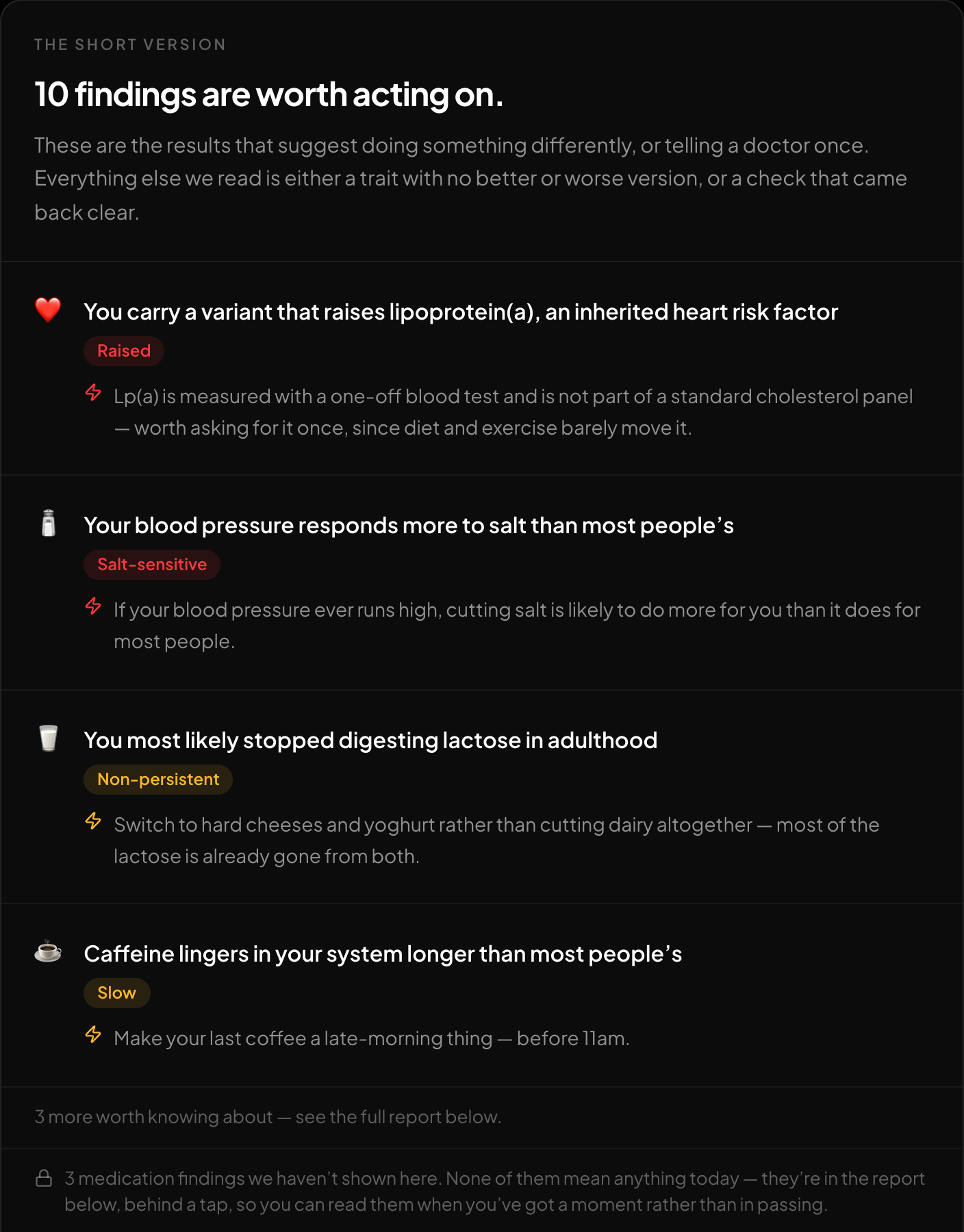
The short version: what is worth acting on, first.
The free DNA tool at HealthOSX reads a raw file in your browser for the trait story. The ancestry breakdown is different: it runs on the server, and only with your consent. The report does not show runs of homozygosity, and HealthOSX does not detect parental relatedness from a single file. For a runs-of-homozygosity check, use the PLINK steps above and ask a genetic counsellor to interpret the result.
New to raw DNA files? Start with the full guide: 23andMe Raw Data Interpretation Free in Your Browser
Written by
HealthOSX Research