What Does BDNF Val66Met rs6265 Mean in My 23andMe Raw Data
If your 23andMe file shows CT at rs6265 you carry one Met copy of BDNF Val66Met. Here is how to read your letters on either strand, and why the variant is common and a weak predictor.
If your 23andMe file shows CT at rs6265 you carry one Met copy (Val/Met); CC is Val/Val and TT is Met/Met. This is the BDNF Val66Met variant. The Met allele is common, the evidence tying it to memory, mood or exercise response is mixed, and your genotype says nothing diagnostic about you. A tool that reports from the gene's own strand shows the same three genotypes as GG, GA and AA.
How to find rs6265 in your raw data file
Open the file in a text editor, or in a spreadsheet if it is a CSV, and search for rs6265. In a 23andMe .txt file the line has the rsID, chromosome 11, a position, and the genotype as two letters. AncestryDNA splits the two letters into separate columns. A MyHeritage file is a CSV with the genotype quoted.
In a whole-genome VCF the row has REF and ALT columns, and your genotype is encoded as 0/0, 0/1 or 1/1. REF and ALT are on the forward strand, so for rs6265 REF=C and ALT=T. That makes 0/0 Val/Val, 0/1 Val/Met and 1/1 Met/Met, the same strand logic as the table below.
Labels differ between tools and papers: the same variant appears as Val66Met, rs6265, c.196G>A or G196A. They all point to one position.
Many chips omit rs6265. Then you will see one of these:
- a missing line for rs6265
--, which is a no-call- a VCF without the row
A blank result is about the array, not about you. It means the position was never measured. A sequencing file or a different array would carry it, and https://healthosx.com/dna/check tells you whether a file will work.
Why it says C/T in one file and G/A in another
DNA has two strands that read as complements: A pairs with T, and C pairs with G. rs6265 sits in a gene that is transcribed from the opposite strand to the one most references print. So the same base change is C to T on the forward strand and G to A in the gene's own coding sequence, where it is written c.196G>A. Nothing differs between people or files. Only the label does.
| Forward strand (23andMe, AncestryDNA) | Gene strand (c.196G>A) | |
|---|---|---|
| Val/Val | CC | GG |
| Val/Met | CT | GA |
| Met/Met | TT | AA |
Scroll the table sideways for the rest →
The same person gets different letters depending on the strand a tool reports. Val is the common allele, Met the less common one.
The quick check is to look at your two letters. If they are different, you are Val/Met whichever strand was used: CT and GA are the same genotype. If they are identical, the letter tells you the strand: CC or GG is Val/Val, TT or AA is Met/Met. If your two letters are C and/or T, the file is on the forward strand. If they are G and/or A, it is on the gene strand.
What does my BDNF Val66Met rs6265 genotype mean?
The variant swaps one amino acid, valine for methionine, at position 66 of the BDNF protein precursor. That position sits in the pro-region, which is trimmed off before the mature growth factor goes to work. The mature protein is the same in Val and Met carriers. What the swap seems to change is how the precursor is packaged and how much BDNF is released from neurons when they fire.
The finding of reduced activity-dependent secretion comes from cell studies and from the 2003 paper by Egan et al. in Cell, which also reported effects on human memory and hippocampal function. It is not established that this translates into reduced BDNF in a living person's brain, or into any trait you could notice.
The Met allele is common, and it varies by ancestry
The Met allele frequency is roughly 18 to 20% in people of European ancestry, 40 to 50% in East Asian populations and around 5% in African populations. These are approximate figures.
The carrier shares below are derived from those allele frequencies with the Hardy-Weinberg formula and are approximate. A 20% allele gives about 32% Val/Met plus 4% Met/Met, so about 36% carry at least one Met. A 45% allele gives about 70% carriers, and a 5% allele gives about 10%.
A variant carried by most people in some populations is not a defect. It is ordinary variation. It also means study results do not transfer cleanly: a finding in one population can reflect ancestry differences in the sample rather than the variant.
What the studies actually show
The claims attached to Met concern memory, risk of depression or anxiety, response to exercise and response to stress. Early small studies reported effects. Large replications have been mixed: some found nothing, and others found effects that depended on age, sex, stress exposure or which cohort was used. Whether it changes how much exercise lifts BDNF or cognition is still argued about, and the samples are small.
Things to avoid:
- Treating Met/Met as a "bad" genotype. The variant is common in healthy people, and the studies do not support it as a disease marker.
- Reading one SNP as the BDNF story. Mood and memory are shaped by thousands of variants, plus sleep, stress, illness and circumstance.
- Comparing your result to one study from a different ancestry.
- Using it to explain a low mood. A genotype cannot be a diagnosis, and a persistent low mood is worth raising with a doctor whatever your letters say.
Will it change anything I should do?
No established recommendation depends on rs6265. Sleep, exercise, and managing stress are worth doing at any genotype, and none of it is gated by this variant. If you want to see whether exercise or a change of routine moves your own memory, mood or sleep numbers, your own tracking tells you more than a Val or Met label can.
Where HealthOSX fits
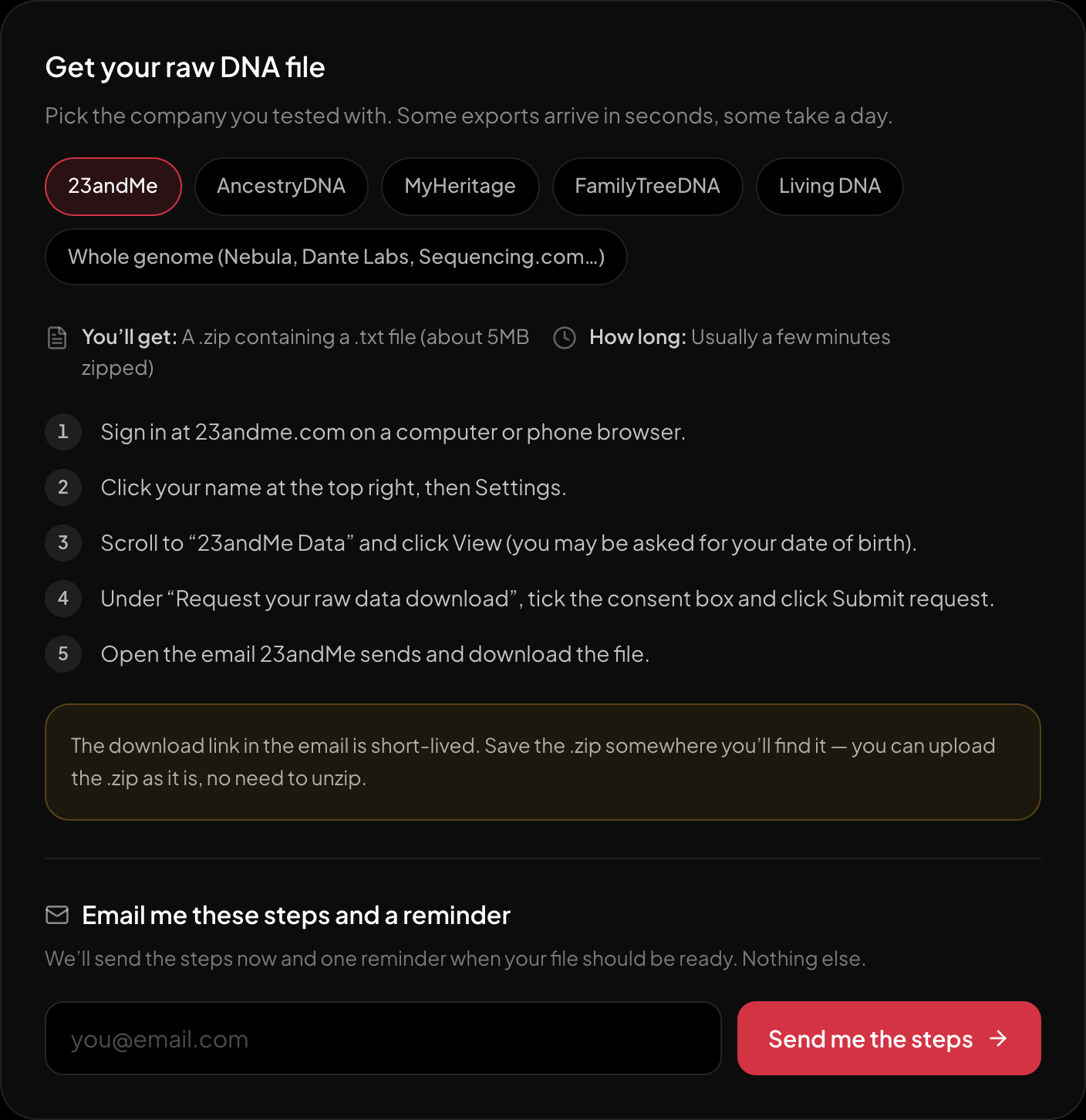
The download steps for 23andMe, on the page itself.
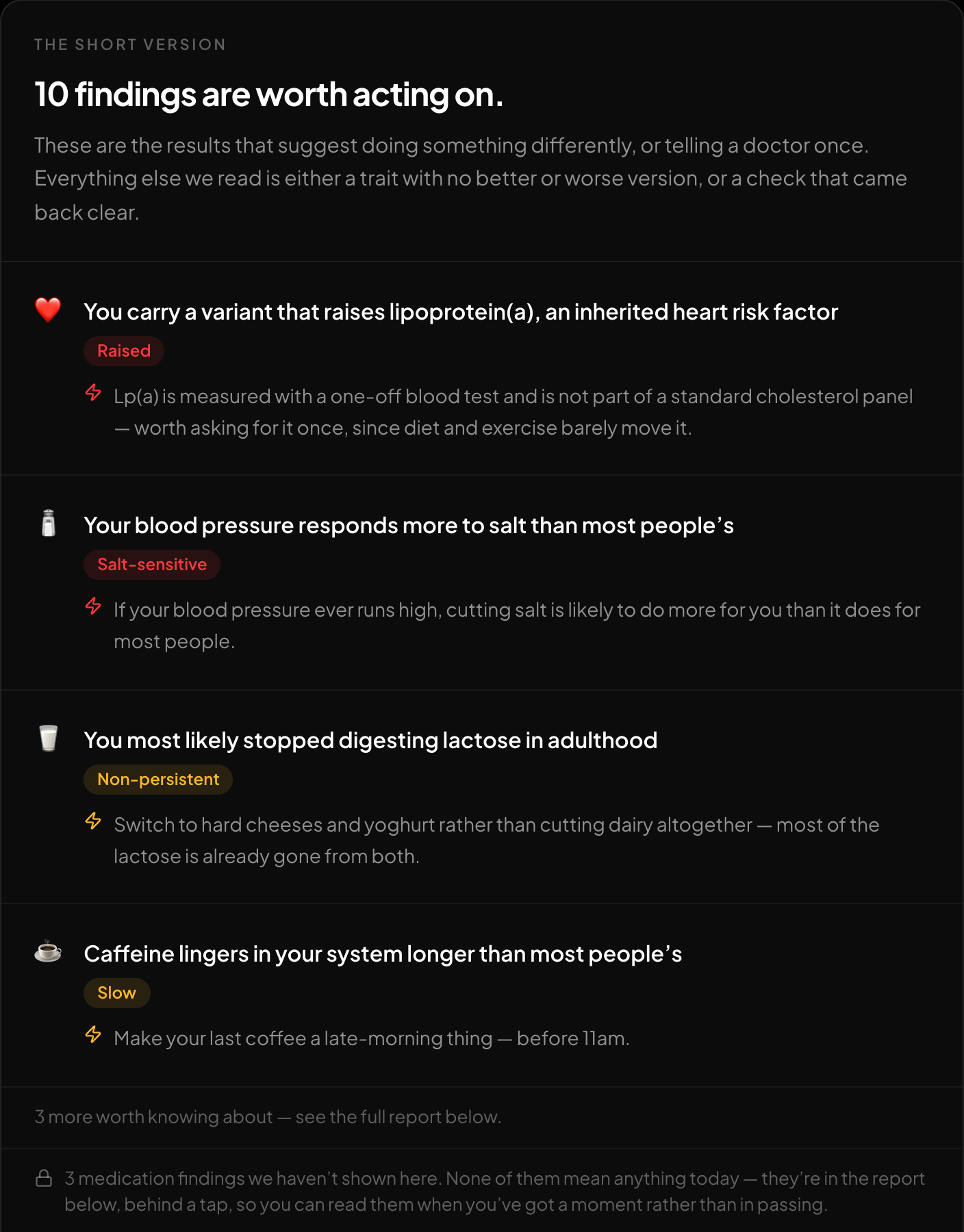
The short version: what is worth acting on, first.
The free HealthOSX DNA tool covers traits, medication response, carrier status and single-variant health findings. BDNF is not among its report findings, so do not expect a Val66Met headline there. For one variant at a time there is a single-rsID lookup (https://healthosx.com/dna/lookup). The chat "Ask your DNA" can look up any variant, but only for readers who have stored their file.
New to raw DNA files? Start with the full guide: 23andMe Raw Data Interpretation Free in Your Browser
Written by
HealthOSX Research