What ALDH2 rs671 Means in Your 23andMe Raw Data
What your 23andMe rs671 result says about alcohol flush, acetaldehyde, and drinking risk, including what AG, AA and GG actually mean.
ALDH2 in your 23andMe raw data is the rs671 result in the ALDH2 gene. The line will contain rs671 and two letters, such as AG, GG, or AA. If your result is AG or AA, you carry a change in ALDH2 that slows the second step of alcohol metabolism. That change is a common inherited reason for alcohol flush: a hot face, red skin, faster heart rate and sometimes nausea after a drink. At rs671, GG is the common active form; it does not rule out other rare ALDH2 variants or non-genetic causes of flushing.
What does ALDH2 mean in my 23andMe raw data?
ALDH2 is the gene for aldehyde dehydrogenase 2, the enzyme your liver uses to clear acetaldehyde after you drink. Raw DNA files report your genotype at the marker rs671. The variant at this spot is often called ALDH2*2. It swaps one amino acid in the enzyme and makes it far less effective.
Your 23andMe file should show one of three genotypes: - GG: two common active copies at rs671. - AG: one common active copy and one reduced-function copy. - AA: two reduced-function copies.
If your file is from another company or a whole-genome VCF, the letters may appear as C or T depending on the strand. Do not try to translate those to A or G yourself unless you know the orientation. The important distinction is whether you are homozygous for the common allele, heterozygous, or homozygous for the variant.
rs671 is a single marker, so the letters must be interpreted in the file's strand and genome build context. If a result is surprising or ambiguous, confirmed testing is the way to resolve it.
The reduced-function variant is most common in East Asian populations. ALDH2*2 carrier frequency varies widely across East Asian populations, and published estimates differ by country and sample. In many European, African and South Asian reference groups it is much rarer, often below a few percent. That is why alcohol flush is often described as an East Asian trait, though it is not exclusive to any region.
Your rs671 genotype maps to enzyme function like this:
| Genotype | ALDH2 enzyme | Facial flush after alcohol |
|---|---|---|
| GG | Common active form at rs671 | Minimal or none |
| AG | One reduced-function copy | Often flushes; severity varies |
| AA | Two reduced-function copies | Can flush strongly; severity varies |
Scroll the table sideways for the rest →
AG and AA are the genotypes most often linked to alcohol flush. Exact wording in a raw file can differ by company and strand. Flushing severity varies from person to person.
The two-step reason alcohol makes you flush
Alcohol itself does not cause the flush. Your body handles ethanol in two steps. First, alcohol dehydrogenase turns ethanol into acetaldehyde. Acetaldehyde is toxic and irritating. Then ALDH2 converts acetaldehyde into acetate, which is much less reactive and is eventually used for energy.
Two enzymes are involved, not one:
When ALDH2 is slow, acetaldehyde builds up. That is what dilates blood vessels in the face and makes you feel hot. Your heart rate rises. Nausea can follow. Many people with one reduced-function copy are more likely to flush after small amounts, but the response varies from person to person. People with two reduced-function copies often flush after small amounts as well, and some can flush strongly.
The flush is not an allergy to alcohol. It is a visible sign that acetaldehyde is sitting in your system longer than it should.
What this does and does not tell you about drinking risk
A reduced-function ALDH2 result is not a safe drinking limit and not a total ban for everyone. It tells you that your acetaldehyde exposure after alcohol is higher and lasts longer than in someone with GG. The most clearly documented long-term risk is oesophageal cancer, especially in people who drink regularly. That risk rises with the amount you drink.
What the result does not tell you: - It does not measure your current alcohol tolerance. - It does not tell you how much you drink now. - It is not a diagnosis of alcohol intolerance or any disease. - It does not say your liver, stomach, or brain are otherwise healthy.
People sometimes ask whether one variant copy is half as bad. In practice, one copy is often enough to cause flushing because the ALDH2 enzyme works in groups of four. One altered subunit can interfere with the whole group. Still, AG is not identical to AA. Enzyme function and flushing severity vary person to person, so an AG result should not be treated as the same as AA.
No flush does not mean no problem
The common mistake is to use flushing as the only signal. In some people with AG or AA, flushing may become less visible over time, or they may learn to drink through the discomfort. Tolerance, visibility, or behaviour can change while genotype and acetaldehyde exposure remain. That does not mean their ALDH2 has recovered.
This is why the genotype matters. It stays the same regardless of how you feel after a drink now. If you have a reduced-function variant and you drink heavily, your acetaldehyde exposure is still higher than in a GG heavy drinker. The absence of a red face is not a green light.
What you should actually do with this result
Start with the practical question: does alcohol make you flush, and do you drink enough for that to matter? If you drink rarely or not at all, this gene is mostly a piece of self-knowledge. If you drink regularly and you have AG or AA, the step most clearly supported by the evidence is to reduce total alcohol, especially heavy drinking episodes.
Worth asking a doctor about if: - You drink most days and have a reduced-function ALDH2 result. - You have heartburn, throat irritation, or difficulty swallowing after drinking. - You are from a population where ALDH2 variants are common and you want a fuller risk picture.
The limit of a raw DNA file
This single marker explains alcohol flush well, but it is not the whole story. Other genes affect how quickly alcohol is absorbed and how unpleasant it feels. ADH variants can speed up the first step and make acetaldehyde rise even faster. Histamine pathways and skin tone affect how visible the flush is. Raw data can also contain errors. If a result is surprising or the letters are ambiguous, clinical testing can confirm the genotype.
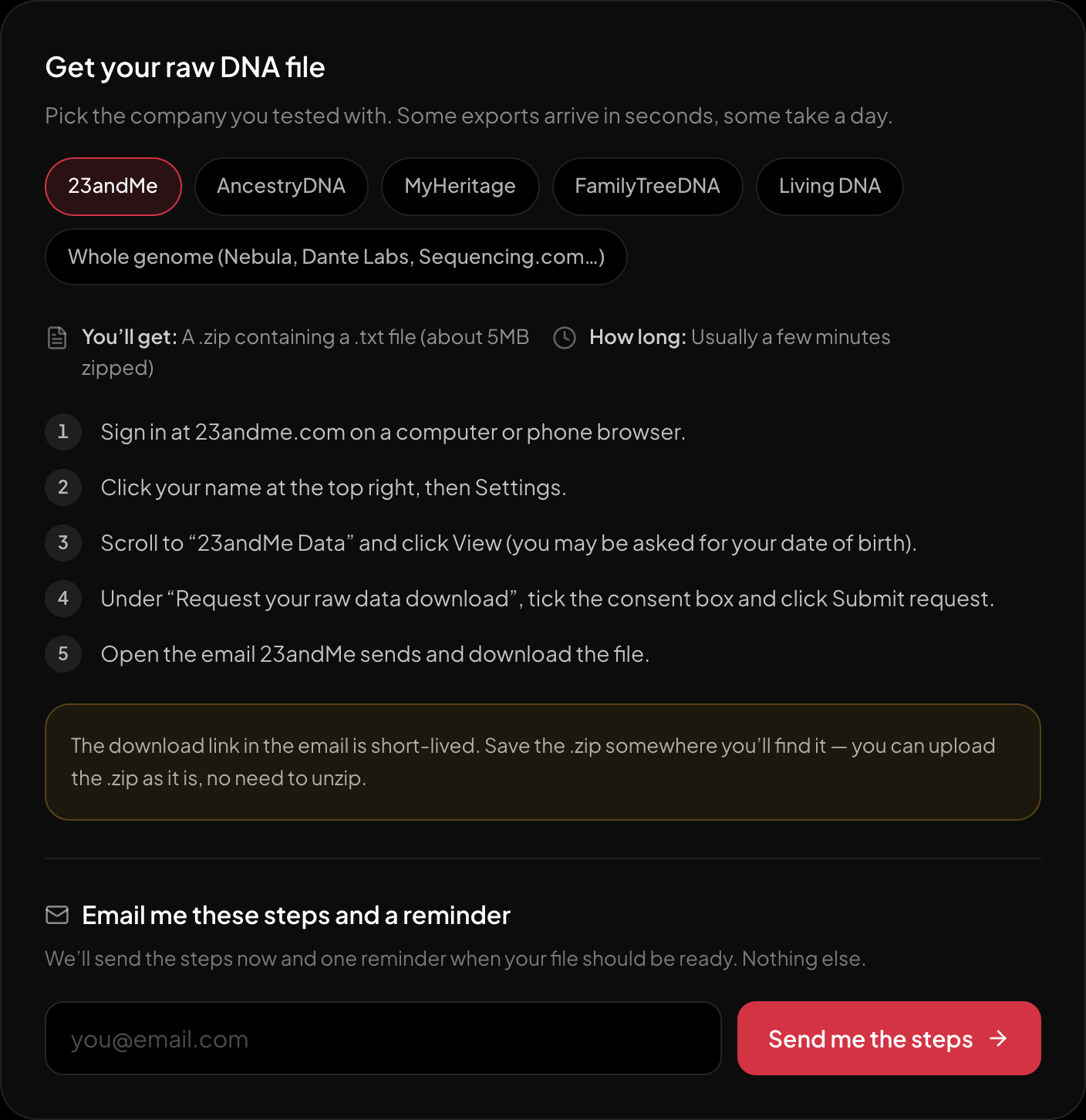
The download steps for 23andMe, on the page itself.
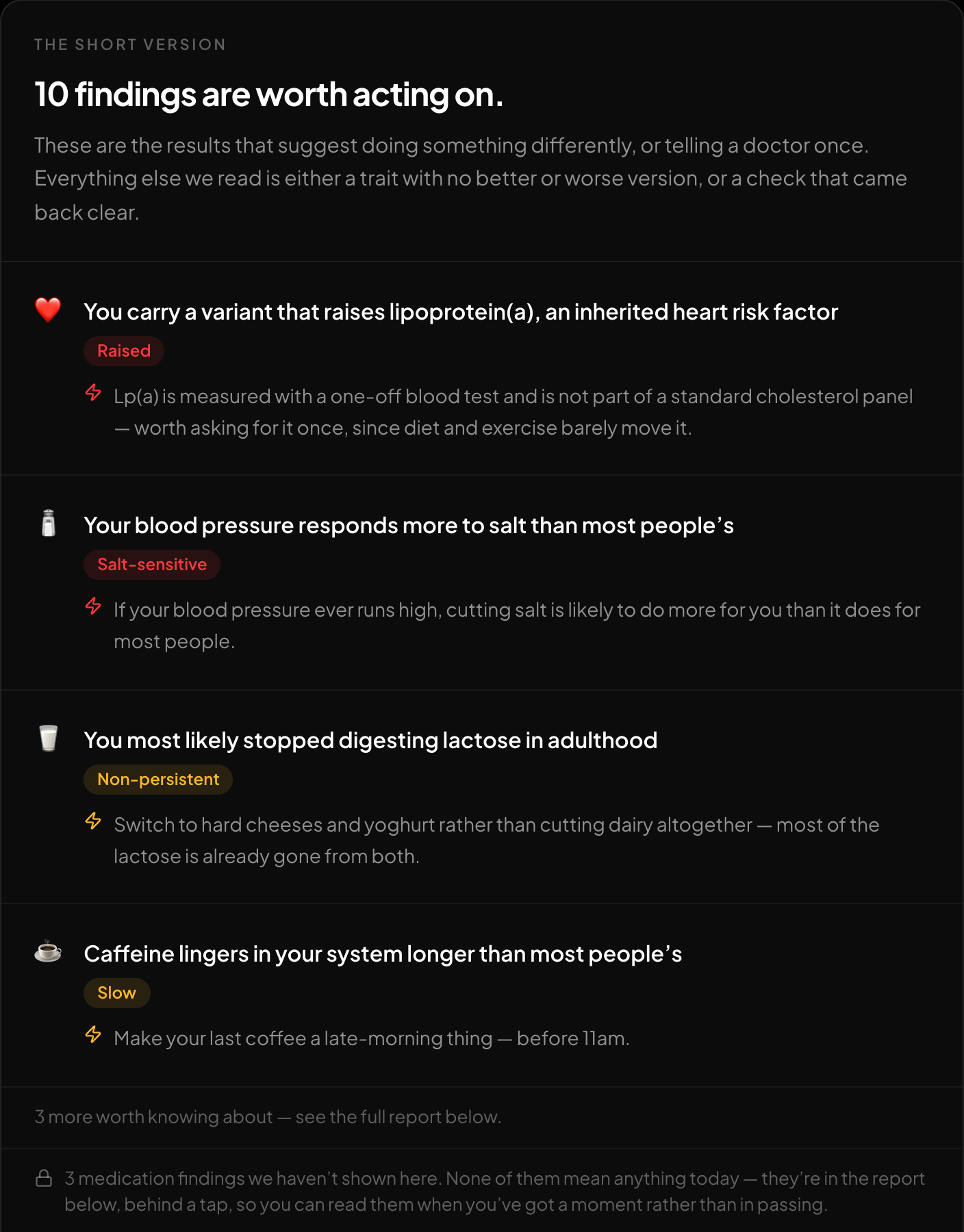
The short version: what is worth acting on, first.
If you want to see ALDH2 in your own raw file, the free DNA tool at HealthOS reads 23andMe, AncestryDNA, MyHeritage and other raw files. For the ALDH2 trait report, the file is read in the browser and does not leave your device. Ancestry is optional. If used, it needs a server, sends only needed markers, and deletes them afterwards unless the person chooses to keep the file. The ALDH2 trait report headline is 'Whether alcohol makes you flush'. VCF files without rsIDs receive ancestry-only results, not the ALDH2 trait report.
New to raw DNA files? Start with the full guide: How to Download & Analyze Your 23andMe Raw Data Free
Written by
HealthOS Research