Can My 23andMe or AncestryDNA Raw Data Show Familial Hypercholesterolemia and Why Is My LDL So High
A 23andMe or AncestryDNA raw file can occasionally flag a known familial hypercholesterolemia variant, which then needs clinical confirmation, and it can never rule FH out. Here is what settles it: an LDL measurement, family history and a clinical gene panel.
A 23andMe or AncestryDNA raw data file can occasionally flag a known familial hypercholesterolemia (FH) variant, which then needs clinical confirmation, and it can never rule FH out. A clear file does not mean your LDL is fine. A whole-genome sequence screened for pathogenic variants in LDLR, APOB and PCSK9 can find a cause, but the first test is still a lipid panel and your family history.
Why a chip file can't rule out FH
LDLR alone has over 3,000 reported variants in ClinVar and LOVD. Most FH families carry a variant rare enough to be private to them, which is exactly why a fixed-position chip misses it. A genotyping chip reads a few hundred thousand pre-chosen positions across the whole genome, so it covers only a limited number of FH variants. Which variant a given family carries is not something the chip was designed around.
So a raw file that shows nothing at LDLR, APOB or PCSK9 means only that the positions on the chip were normal. The variant that matters could sit at any of the many positions the chip never looked at.
There is a second catch in the other direction. Raw chip data are not clinical grade, and rare variants are the ones chips call least reliably. In UK Biobank, Weedon et al. (BMJ, 2021) found that chip calls of very rare variants were mostly false positives when checked against sequencing. Tandy-Connor et al. (Genetics in Medicine, 2018) likewise found that about 40% of variants reported from consumer raw data were not confirmed on clinical testing. Anything alarming needs confirmation in a clinical lab before it means anything.
23andMe has offered an FH report on a small fixed set of LDLR, APOB and PCSK9 variants, mostly ones common in particular ancestries. A negative result there excludes nothing, because the vast majority of FH variants are not on that list.
What familial hypercholesterolemia actually is
LDL particles are cleared from blood when liver cells grab them through the LDL receptor. In FH one copy of a gene in that pathway is faulty, so the liver clears LDL slowly from birth and the level sits high for decades. The usual culprits:
- LDLR: the receptor itself, loses function. By far the most common cause.
- APOB: the part of the LDL particle the receptor grips changes shape, so it binds poorly.
- PCSK9: a gain-of-function change that destroys more receptors than normal.
A rarer recessive form involves LDLRAP1. Having one faulty copy (heterozygous FH) affects roughly 1 in 250 people, which makes it one of the commonest inherited conditions and one of the most under-diagnosed. Two faulty copies (homozygous FH) is far more severe and affects roughly 1 in 300,000 to 1 in 1,000,000 people. Each child of an affected parent has a 50% chance of inheriting it.
The damage comes from time. Risk tracks cumulative LDL exposure, sometimes called cholesterol-years, meaning how high the level is and for how long. Work on lifelong LDL exposure (Ference et al., JACC 2012) supports this, and it is why FH shows up as early heart disease in families.
The real first test is a lipid panel and a family tree
FH is diagnosed from clinical findings, and genes confirm it. A fasting or non-fasting lipid panel gives you the LDL number. In an adult, LDL of 190 mg/dL (4.9 mmol/L) or higher, with no obvious secondary cause, is the usual guideline trigger to look for FH. In a large sequencing study of adults with LDL at or above that level (Khera et al., JACC 2016), only about 2% carried an FH variant, so most people with a very high LDL will not have one found.
To place your number: untreated LDL in heterozygous FH is often 190 to 400 mg/dL (4.9 to 10 mmol/L) in adults, and in homozygous FH often above 400 to 500 mg/dL (above about 10 to 13 mmol/L). In children, an LDL of 160 mg/dL (4.1 mmol/L) or higher with a family history, or 190 mg/dL (4.9 mmol/L) or higher without, is the usual trigger to look for FH.
Clinicians also ask about:
- A parent, sibling or child with high cholesterol, or a heart attack or stent at a young age.
- Fatty deposits in the tendons, particularly the Achilles, or a pale ring around the cornea in someone under 45.
- LDL that stays high despite a real change in diet.
That last point is a useful clue: persistently very high LDL despite diet changes raises suspicion of a genetic cause, monogenic or polygenic, and warrants FH assessment.
Clinicians often score these findings with a formal tool, such as the Dutch Lipid Clinic Network criteria, which are widely used outside Europe as well, or the Simon Broome criteria, used in the UK and elsewhere.
Why is my LDL so high if no gene is to blame?
Many people with LDL above 190 mg/dL (4.9 mmol/L) have no single-gene variant found at all. Their LDL comes from many small common variants adding up, which is called polygenic, and that is real inheritance too. It runs in families without a single clean culprit.
Other causes are worth ruling out, and a doctor will usually check them:
- Underactive thyroid, which slows LDL clearance.
- Kidney disease with protein loss, and liver or bile duct problems.
- Some medicines, including certain steroids and immune drugs.
- A very high saturated fat intake, and sometimes rapid weight loss or very low-carb diets.
Two measurement quirks matter too. Most reports calculate LDL rather than measuring it, and the calculation drifts when triglycerides are high. And LDL cholesterol includes the cholesterol carried by lipoprotein(a), so a high Lp(a) can inflate it. Lp(a) is largely set by the LPA gene and barely responds to lifestyle.
What a whole genome can add, and what it cannot
If you have a whole-genome sequence, a VCF file, the picture changes. Sequencing reads the whole of LDLR, APOB and PCSK9, not a limited set of positions. The ACMG secondary-findings list, a set of genes where a pathogenic variant is considered worth reporting even when you were not looking for it, includes all three. Screening a VCF against ClinVar for pathogenic or likely pathogenic variants in those genes is a reasonable first pass.
A chip file stored for the Ask your DNA feature is different. It is filled out by imputation, a statistical method that infers untested positions from common patterns, and imputation cannot recover rare FH variants. A ClinVar screen of such a stored file does not close the gap.
| Shows your LDL? | Can flag an FH variant? | Can rule FH out? | |
|---|---|---|---|
| Lipid panel (the starting point) | Yes | Not a gene test; with clinical criteria it is how FH is assessed | Not alone, but with family history and clinical criteria it is how FH is assessed |
| 23andMe or AncestryDNA raw file | No | Only a few positions | No |
| Whole-genome VCF screened against ClinVar | No | Yes, if a known pathogenic variant is called | No |
| Clinical FH gene panel (lab) | No | Yes, confirmatory | No |
Scroll the table sideways for the rest →
General comparison. A clear result on any genetic test is not an all-clear.
Two limits remain. A clear screen means no such variant was called in the file, not that FH is excluded, because some variants are novel or classified as uncertain. And a found variant is a lead for a clinician, not a diagnosis. Still unsettled: how aggressively to treat people who carry a variant but have a modest LDL, and how much the polygenic background changes the picture in carriers.
A clear raw file never replaces an LDL measurement. The blood number tells you what is happening, and the genes only sometimes tell you why.
What happens if it is FH
A confirmed or likely FH diagnosis usually leads to the following steps:
- Cascade testing: first-degree relatives (parents, siblings and children) are offered an LDL check and, where a variant was found, a test for that specific variant.
- Treatment: a high-intensity statin, usually with ezetimibe added if the LDL target is not reached.
- PCSK9 inhibitors: added when LDL stays above target despite maximum tolerated oral treatment, or when statins are not tolerated.
- Children: children of an affected parent have their LDL checked. Guidelines generally consider statins from about age 8 to 10 in heterozygous FH, decided with a specialist.
Treatment starts from the blood number and the clinical picture, and early treatment is what changes the outcome.
What this means for the free report
The free HealthOSX DNA report does not have a dedicated familial hypercholesterolemia finding, so do not expect one. It does cover LPA, the inherited heart risk factor behind Lp(a), and SLCO1B1, which relates to statin muscle pain, both of which are relevant if you are working through a high LDL.
If your LDL is high, ask a doctor about a repeat panel, family history and whether gene testing makes sense. If relatives are affected, that conversation matters for them too.
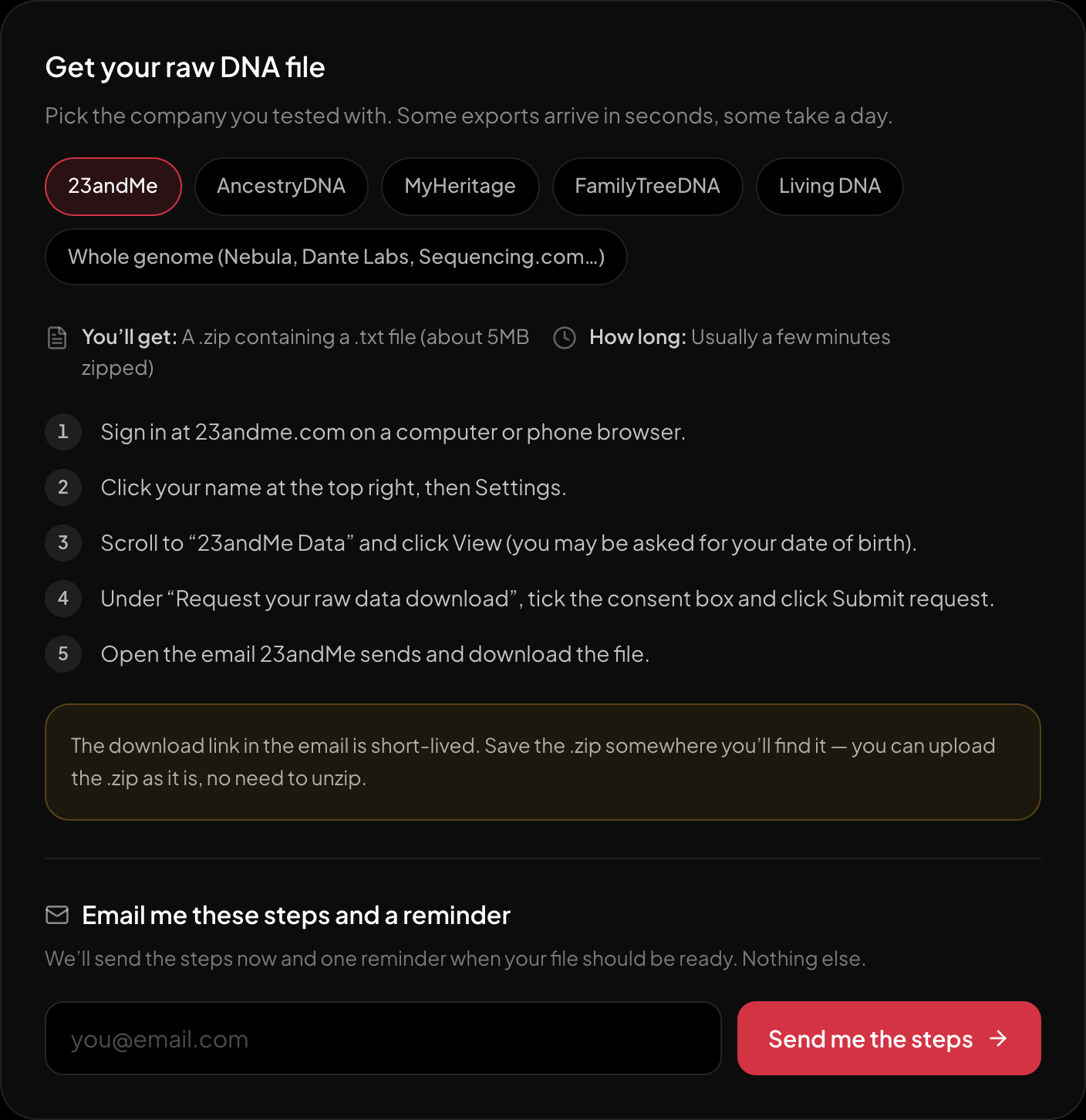
The download steps for 23andMe, on the page itself.
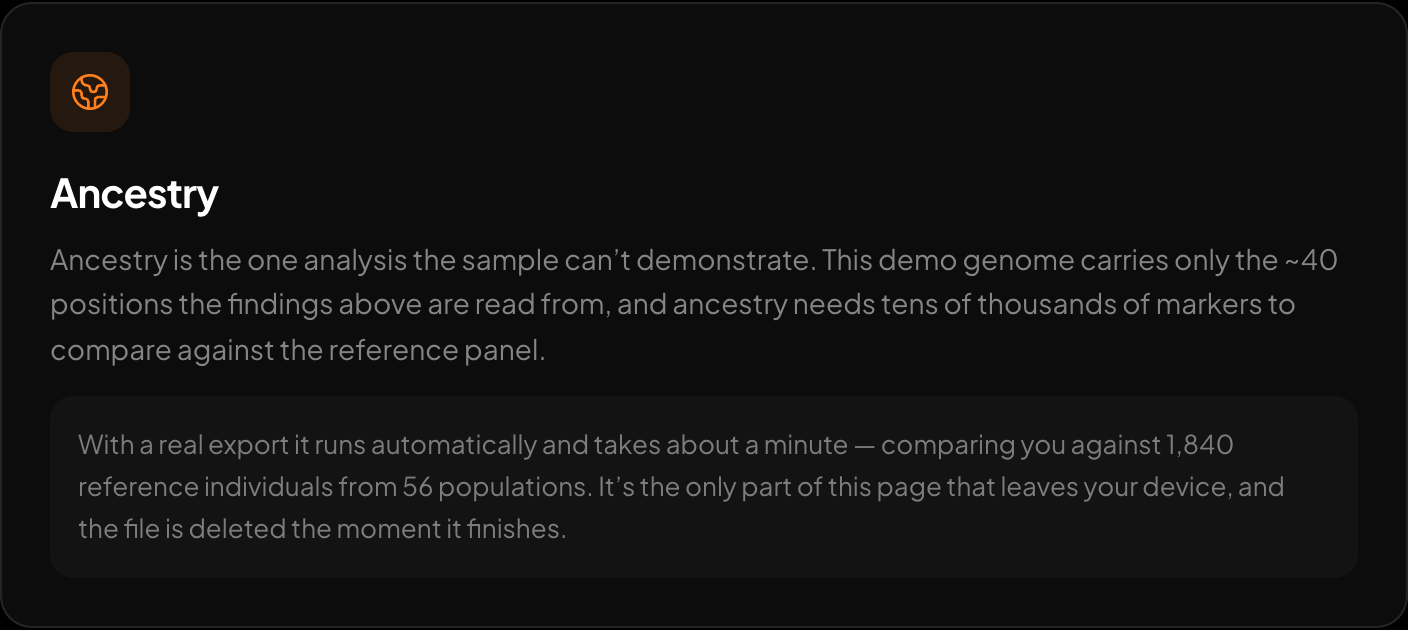
Ancestry across 15 regions and 157 reference populations.
If you have a raw file or a whole-genome VCF and want to see what it contains, the free tool at healthosx.com/dna reads it in your browser. It reports LPA and SLCO1B1 findings from a chip file, and screens whole-genome VCFs against ClinVar in the browser, grouped into panels including the ACMG secondary-findings genes. A clear panel means no such variant was called, not an all-clear, and it does not detect FH from chip data. None of it replaces the lipid panel.
New to raw DNA files? Start with the full guide: 23andMe Raw Data Interpretation Free in Your Browser
Written by
HealthOSX Research