My 23andMe Raw Data Says I Can Digest Lactose So Why Does Milk Still Upset My Stomach
A 23andMe file showing lactase persistence only says the enzyme should stay on in adulthood. Milk can still upset you for several other reasons, and a few can be tested.
If your 23andMe raw data shows the lactose tolerance gene but milk still gives you stomach problems, the result is probably not wrong. It only tells you the lactase gene (LCT) is not expected to switch off after childhood. It does not tell you the enzyme is working today, that you make as much of it as someone with AA, or that lactose is what is upsetting you. Milk can still cause bloating or diarrhoea because AG gives you less enzyme than AA, or through a damaged gut lining, irritable bowel syndrome (IBS), small intestinal bacterial overgrowth (SIBO), a milk allergy, other fermentable foods, or a different food altogether.
What the gene result actually says
The usual marker is rs4988235, sitting in the MCM6 gene. It does not code for lactase. It sits in a regulatory stretch that controls whether the neighbouring LCT gene keeps running after weaning. That is what "lactase persistence" means: a prediction about the switch, not a measurement of enzyme in your gut.
Roughly two thirds of adults worldwide lose most of their lactase activity, so persistence is the minority pattern globally. The file is answering one narrow question. Everything below is about the questions it does not answer.
Reading your own file
23andMe reports rs4988235 on the plus strand, where the persistence allele shows as A. Older papers and some websites describe the same change on the opposite strand, where it appears as T. T and A are the same allele read from opposite strands, so if you see AA and a page mentions T, you have not misread your file. AA or AG means lactase is expected to persist. GG means it is expected to switch off.
| Marker and genotype | Expected result | Read by the chip? |
|---|---|---|
| rs4988235 AA (T/T on the opposite strand) | Persistent | Yes, on current 23andMe chips |
| rs4988235 AG (C/T on the opposite strand) | Persistent, often with less enzyme than AA | Yes, on current 23andMe chips |
| rs4988235 GG (C/C on the opposite strand) | Expected non-persistent | Yes, on current 23andMe chips, but another variant could still keep lactase on |
| rs182549 (European) | Usually matches rs4988235 | Possibly, depends on the array |
| rs145946881, rs41380347, rs41525747 (African and Middle Eastern) | Persistent if present | Often not, they may not be on your chip |
Scroll the table sideways for the rest →
Expected persistence from the gene alone, not a measure of enzyme in your gut.
If your file says GG: GG is only a prediction that lactase switches off. The chip does not read several other variants that keep lactase on, including rs145946881, rs41380347 and rs41525747, which are described in African and Middle Eastern populations. Because of that, a GG result can look worse than it really is, especially if your ancestry points to those populations. A breath test or a dose trial tells you what your gut actually does.
How undigested lactose causes the symptoms
Lactase sits on the tips of the small intestine's villi and splits lactose into glucose and galactose. If it is missing or too little, lactose travels on to the colon. There it pulls water in by osmosis and gets fermented by bacteria into hydrogen, carbon dioxide, short-chain fatty acids and, in some people, methane. Water gives you the diarrhoea. Gas gives you the bloating and cramps. Knowing this lets you reason about cases I have not listed.
So anything that leaves lactose undigested, or produces the same fermentation from something else, looks identical from the inside. Symptoms usually start between 30 minutes and two hours after the drink.
| Does the lactase gene result show it? | What helps tell it apart | |
|---|---|---|
| AG: one working copy, less enzyme | Yes | Breath test or a dose trial |
| Lactase lost after gut illness or coeliac disease | No | Timing after illness, coeliac blood tests |
| IBS | No | Symptom pattern with other foods, doctor assessment |
| SIBO | No | Doctor assessment, interpreted alongside a breath test |
| Milk protein allergy | No | Immune symptoms, doctor assessment |
| Fat or FODMAP load | No | Skimmed versus full-fat comparison, food diary |
| Genetically switched-off lactase (the case the gene does rule out) | Yes | Genotype, confirmed by breath test |
Scroll the table sideways for the rest →
Qualitative guide, not a diagnosis.
Seven reasons the gene looks fine and the symptoms are real
- AG means one working copy and usually less enzyme. People with AG typically make less lactase than people with AA, often noticeably less. The file calls both persistent, but a large dose, such as a big glass of milk on an empty stomach or a protein shake, can be more than that smaller enzyme supply handles. Smaller amounts with food may be fine.
- Lactase lost after a gut insult. A stomach bug, coeliac disease or Crohn's disease can flatten the villi where lactase is made. This is called secondary lactase deficiency. Your DNA is unchanged, so the file stays reassuring. After an infection it often recovers over weeks to months. In coeliac disease it recovers as the gut heals on a gluten-free diet.
- Irritable bowel syndrome (IBS). A sensitive gut can react to normal amounts of gas and fermentable food. Bloating, cramps and loose stools after milk are common in IBS even when lactose is digested fine.
- Small intestinal bacterial overgrowth (SIBO). Extra bacteria in the small intestine ferment sugars early and produce gas and bloating. SIBO can also give a positive hydrogen breath test, so a positive result does not prove lactase is low.
- Milk protein allergy. An immune reaction to casein or whey, not a sugar problem. It is mainly a childhood condition and uncommon in adults, but hives, wheezing or swelling after milk point here and need a doctor, not a gene.
- Fat and other fermentable sugars. Lactose is one of the FODMAPs, so milk on top of onions, wheat or fruit can push you over a threshold that milk alone would not. Fat is a separate trigger in some people, particularly with IBS, and is not a lactose effect. If you suspect it, compare skimmed milk with full-fat milk in the same amount. Whether a protein variant in some cows' milk (A1 beta-casein) matters for symptoms is argued about, and the evidence is thin.
- It was not the milk. Coffee, sweeteners like sorbitol, the oat or protein powder in the same shake, or a gluten-containing breakfast are all common culprits that happen to travel with milk.
Do I need to give up milk completely?
Not necessarily, and this is where people go wrong in the other direction. Lactase deficiency is a spectrum. Many people with low lactase cope with about 12 g of lactose, roughly one cup of milk, especially with food. Hard cheese and yoghurt contain much less lactose or have live bacteria that digest part of it. So the question is a threshold, not a yes or no.
Two practical options help if lactose does turn out to be part of it. Lactase enzyme tablets taken with the first sip or bite supply the missing enzyme. Taking milk or dairy in small doses with a meal, rather than on an empty stomach, also slows delivery and often keeps symptoms below your threshold.
How to find out which one it is
- Swap for lactose-free milk for two weeks. It is the same milk with the lactose already split. If symptoms vanish, lactose is likely the trigger. If they do not, lactose is probably not the problem, but this trial cannot tell fat, protein or FODMAPs in the milk apart, because lactose-free milk keeps all of them. Pair it with a skimmed versus full-fat comparison if fat is a suspect.
- Try a dose comparison, especially if you are AG. Have a small amount of milk with a meal on one day and a large glass on an empty stomach on another. If only the large dose causes symptoms, a lower enzyme level is a likely part of the story.
- A hydrogen breath test is the standard objective check. After fasting you drink a set dose of lactose (protocols use 25 to 50 g) and breath hydrogen is measured for a few hours. Many labs measure methane too, because some people produce methane rather than hydrogen and would otherwise be missed. A rise of about 20 ppm over baseline is the usual cut-off for malabsorption. It tests your gut now, which is what the DNA cannot do. Remember that SIBO can also make the test positive.
- Coeliac blood tests are worth asking about if symptoms are persistent, come with weight loss, anaemia or other foods, and you are still eating gluten. Do this before cutting gluten, because avoiding it can make the test unreliable.
The lactase gene tells you what your enzyme was built to do. A breath test tells you what it is doing today.
Checking your own result
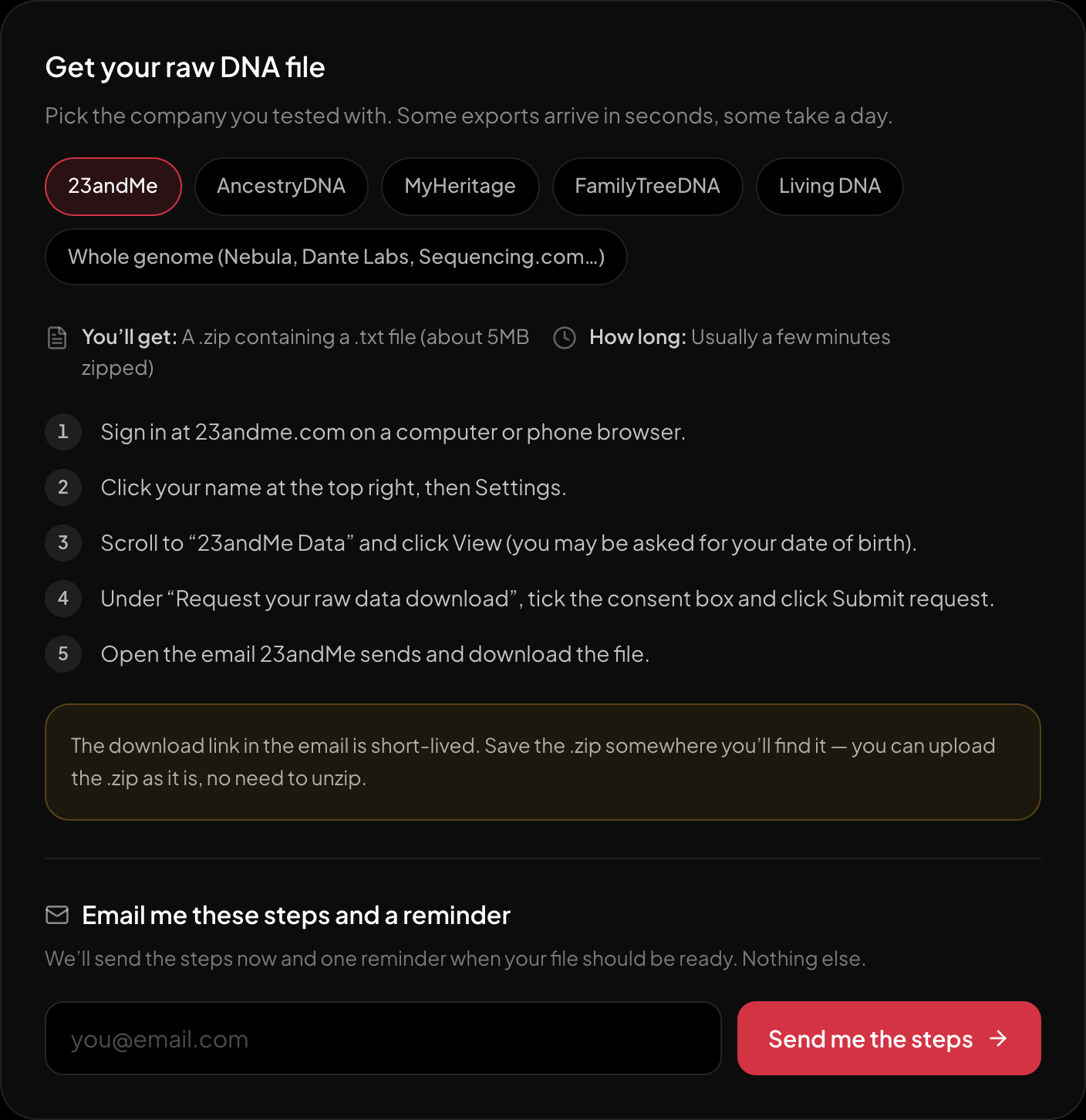
The download steps for 23andMe, on the page itself.
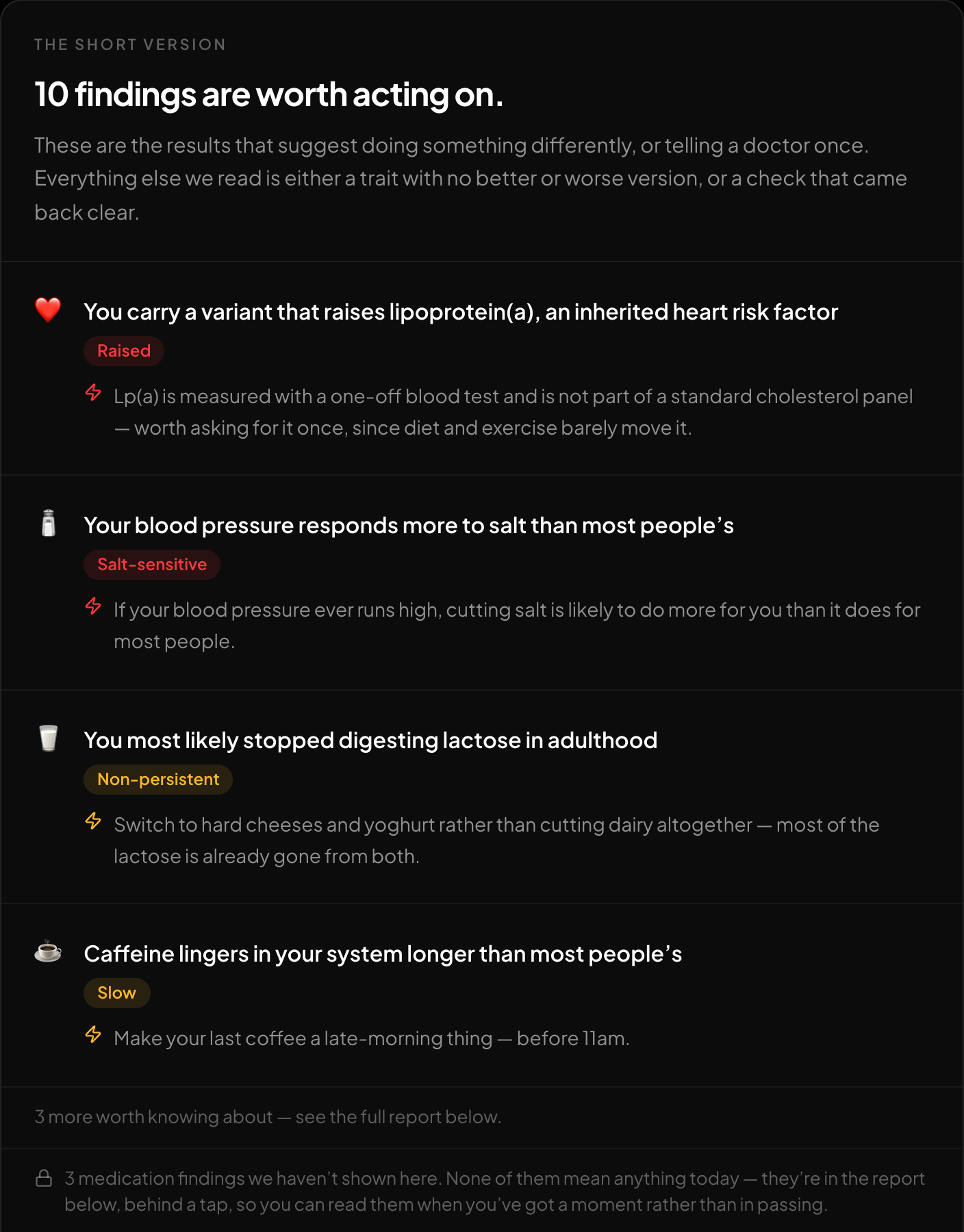
The short version: what is worth acting on, first.
SNPedia lists what each rs4988235 genotype is associated with and in which populations. If you want to see your own lactase result, the free tool at /dna reads a raw 23andMe, AncestryDNA, MyHeritage or whole-genome VCF file in your browser. Its report includes an MCM6 / LCT finding on whether milk still works for you, and the full report opens after a one-time email code. Then use the two-week swap and the dose comparison and, if it is still unresolved, a breath test with your doctor.
New to raw DNA files? Start with the full guide: 23andMe Raw Data Interpretation Free in Your Browser
Written by
HealthOSX Research