What Do the VDR Fok, Bsm, Taq and Apa Variants Mean in My 23andMe Raw Data
FokI, BsmI, TaqI and ApaI are four old named spots in the vitamin D receptor gene. Here is a letter-by-letter table to read them in a 23andMe file, and why they do not tell you your vitamin D level.
The VDR FokI (rs2228570), BsmI (rs1544410), TaqI (rs731236) and ApaI (rs7975232) results in a 23andMe raw data file are four classic named variants of the vitamin D receptor gene. They do not tell you your vitamin D level, whether you are deficient, or whether to supplement. Their links to bone, immunity and disease are small and inconsistent, and the thing to measure is a blood 25-OH vitamin D test.
Four old enzyme names for one receptor gene
The VDR gene makes the receptor that the active form of vitamin D (calcitriol) docks into. Once docked, the receptor switches on genes involved in calcium handling, bone turnover and immune cells. So the gene matters. The question is whether common spelling differences in it change anything you could act on, and mostly the answer is: barely, and not in a way anyone can turn into advice.
The four names are leftovers from the era of restriction enzymes. Researchers found each spot because a particular enzyme either cut the DNA there or did not, so people wrote the result as cut or uncut. Arrays and sequencing later gave each spot an rsID, but the old names stuck in papers and on report pages.
| Name | rsID | Location | Changes the protein? |
|---|---|---|---|
| FokI | rs2228570 | Exon 2, start codon | Yes, shorter by 3 amino acids |
| BsmI | rs1544410 | Intron 8 | No |
| ApaI | rs7975232 | Intron 8 | No |
| TaqI | rs731236 | Exon 9, synonymous | No |
Scroll the table sideways for the rest →
Where each sits in the gene and what it does to the protein.
Only FokI changes the protein. One version loses the first start codon, so the cell starts building the receptor three amino acids further along and makes a slightly shorter protein, 424 amino acids instead of 427. In cell studies the shorter F form is often reported as somewhat more transcriptionally active. That is a lab finding, not a clinical one, and it has not been turned into advice for people. BsmI and ApaI sit in an intron, and TaqI is a synonymous change, so none of the three alters the protein sequence. If they do anything, it is probably through how stable or abundant the messenger RNA is, and that is still not settled.
Those three also tend to be inherited together as a block in most populations studied. Reading all three gives you mostly one piece of information, not three.
How to find the four rsIDs in your raw file
Open the downloaded 23andMe text file. Lines starting with # are the header. Every other line has four columns: rsID, chromosome, position, genotype.
- Search the file (Ctrl+F, or grep on a command line) for each of the four rsIDs. To check a single rsID without opening the file, the DNA lookup is easier for most people.
- Read the genotype column: two letters, one for each copy of the gene you inherited, such as CT.
- A genotype of -- is a no-call, meaning the chip could not read it. It is not a normal result.
- If an rsID is missing entirely, your chip did not include it. Chip versions can differ in which SNPs they carry, so a missing rsID may reflect your file's chip version rather than anything about you.
What your letters mean: genotype to label
This is the table most people are looking for. The left letter is what 23andMe prints (plus strand, GRCh37). Next to it is the letter most VDR papers use and the restriction label that goes with it. Your genotype is two of these letters, so CT at BsmI means one b and one B. The ApaI row is the exception: papers do not agree on which letter is called A, so read the caption.
| Variant | 23andMe letter (plus strand) | Paper letter (coding strand) | Label |
|---|---|---|---|
| FokI rs2228570 | G | C | F, shorter 424 aa receptor |
| FokI rs2228570 | A | T | f, 427 aa receptor |
| BsmI rs1544410 | T | A | B |
| BsmI rs1544410 | C | G | b |
| TaqI rs731236 | A | T | T |
| TaqI rs731236 | G | C | t |
| ApaI rs7975232 | A | T | A or a, differs between papers |
| ApaI rs7975232 | C | G | a or A, differs between papers |
Scroll the table sideways for the rest →
Alleles from dbSNP, GRCh37 plus strand; labels per Uitterlinden et al. 2004 (Gene). VDR is on the minus strand, so papers show the complement. ApaI: sources disagree on which allele is called A and which a, so its label is left open instead of printing a mapping that cannot be defended.
None of the four are A/T or C/G SNPs (they are G/A, T/C, A/G and A/C on the plus strand), so flipping between strands never gives an ambiguous letter and the complement rule below always works.
Why the same variant shows different letters and names elsewhere
The VDR gene lies on the minus strand of chromosome 12. 23andMe reports plus-strand letters, while most VDR papers use coding-strand letters, so your file shows the complement of what the papers show. That one fact explains most of the confusion: where your file says G, the paper says C, and A becomes T.
The labels add a second layer. F and f stand for FokI, B and b for BsmI, T and t for TaqI, A and a for ApaI. Uppercase conventionally means the cut site is absent and lowercase means present, but the label is tied to the base the author used, so check the table rather than the case of the letter. For ApaI in particular, published papers describe the alleles inconsistently, so match the letters to the paper you are reading, not to a single fixed rule. FokI also has an older rsID, rs10735810, that was merged into rs2228570.
So never match by eye. If your file says CT and a page says AG, check the strand before concluding anything, and never assume an uppercase letter means the "good" version.
Why the associations with bone, immunity and disease stay modest
There are decades of studies linking these variants to bone density, fracture, tuberculosis, several cancers and autoimmune disease. Most were small. Pooled analyses mostly find small effects at best, and results often differ between ancestry groups. One concrete reason is that the BsmI/ApaI/TaqI block is strongly linked in people of European ancestry and less tightly linked in people of African ancestry, so a variant that stands in for its neighbours in one group does not in another. Calling any of these a "risk variant" overstates what the evidence supports.
There is also a mechanism reason. The receptor sits downstream of vitamin D status. Your circulating level is set by sun exposure, latitude, season, skin pigmentation, diet, body weight and supplements, and the receptor only responds to whatever arrives. A different version of the receptor does not make you produce less vitamin D. Genome-wide studies of circulating 25-OH vitamin D put GC (vitamin D binding protein) first, followed by CYP2R1 and DHCR7/NADSYN1. VDR is not among the top loci for vitamin D level.
Do not set a supplement dose from these four letters
In theory a less responsive receptor could mean you need a higher level for the same effect. In practice nobody has a validated way to convert a VDR genotype into a dose, and a recommendation that claims to is guessing.
What you can measure is the 25-hydroxyvitamin D blood test. Results come in nmol/L or ng/mL, and you divide nmol/L by 2.5 to get ng/mL. The thresholds below come from different bodies, and they do not fully agree. The 2011 Institute of Medicine (now National Academy of Medicine, IOM/NAM) report set below 30 nmol/L (12 ng/mL) as deficient and 50 nmol/L (20 ng/mL) as adequate for most people. The Endocrine Society's 2011 guideline used 75 nmol/L (30 ng/mL) as its target. Its 2024 guideline no longer endorses a specific target level.
| Level | nmol/L | ng/mL | Set by |
|---|---|---|---|
| Deficient, below | 30 | 12 | IOM/NAM, 2011 |
| Adequate for most people, about | 50 | 20 | IOM/NAM, 2011 |
| Target, Endocrine Society 2011 | 75 | 30 | Endocrine Society, 2011 (2024 guideline no longer endorses a target) |
Scroll the table sideways for the rest →
Different bodies, different cut-offs. Divide nmol/L by 2.5 for ng/mL.
If you change your intake, the test lags. The marker has a half-life of a few weeks, so it takes roughly two to three months to settle at a new level before a retest tells you much. Whether and how much to supplement is a question for a doctor with your actual number in hand.
What to do after reading your four letters
- 1.Note your genotypes, and treat any no-call (--) or missing rsID as unknown, not normal.
- 2.Ask for a 25-OH vitamin D blood test. That number, not the genotype, is what guides a decision.
- 3.If you change your dose, retest 8 to 12 weeks later.
- 4.Bring the number to the doctor, not the genotype.
Your VDR genotype is how the receptor is spelled. Your 25-OH vitamin D test is how much there is to receive.
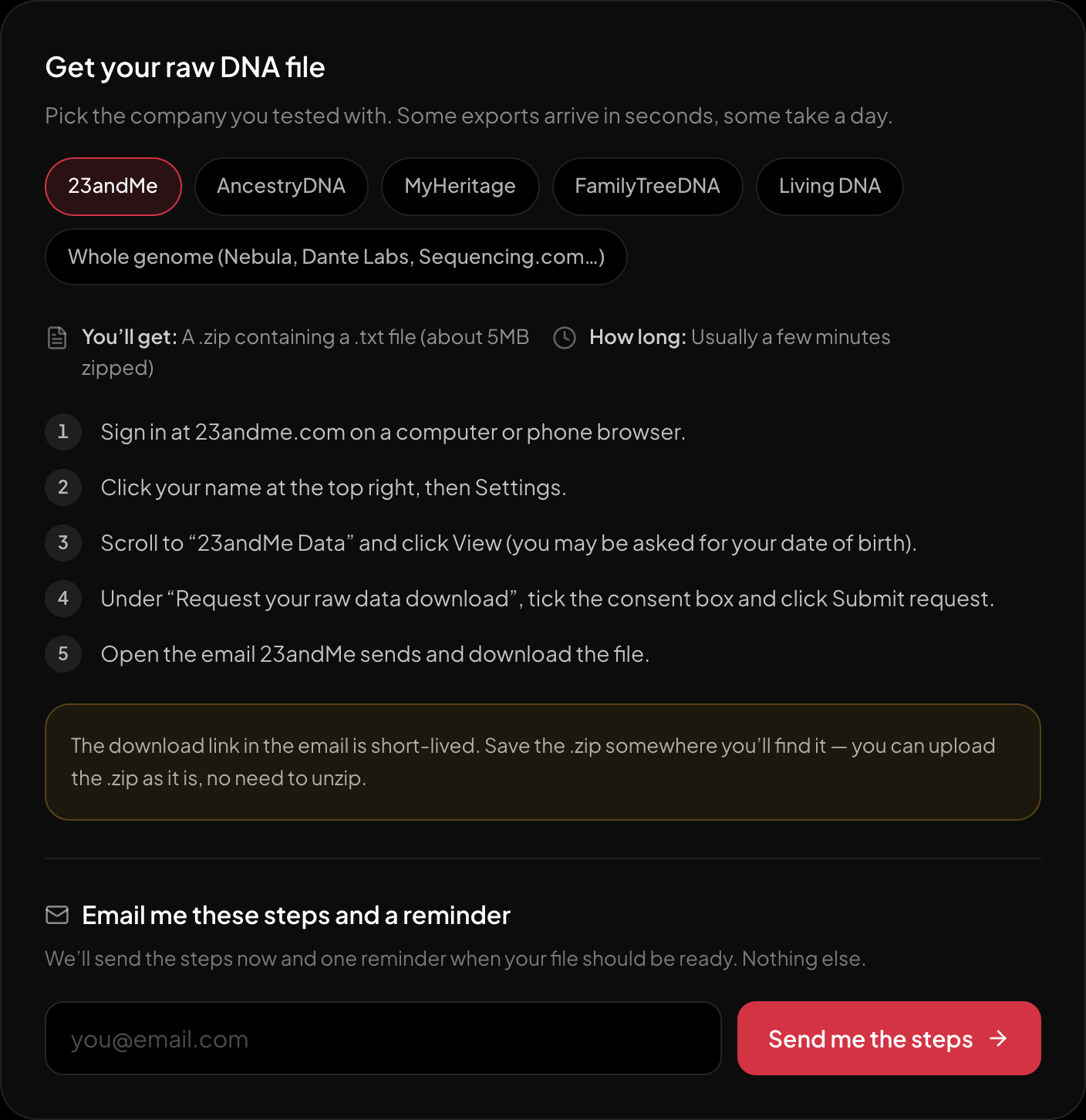
The download steps for 23andMe, on the page itself.
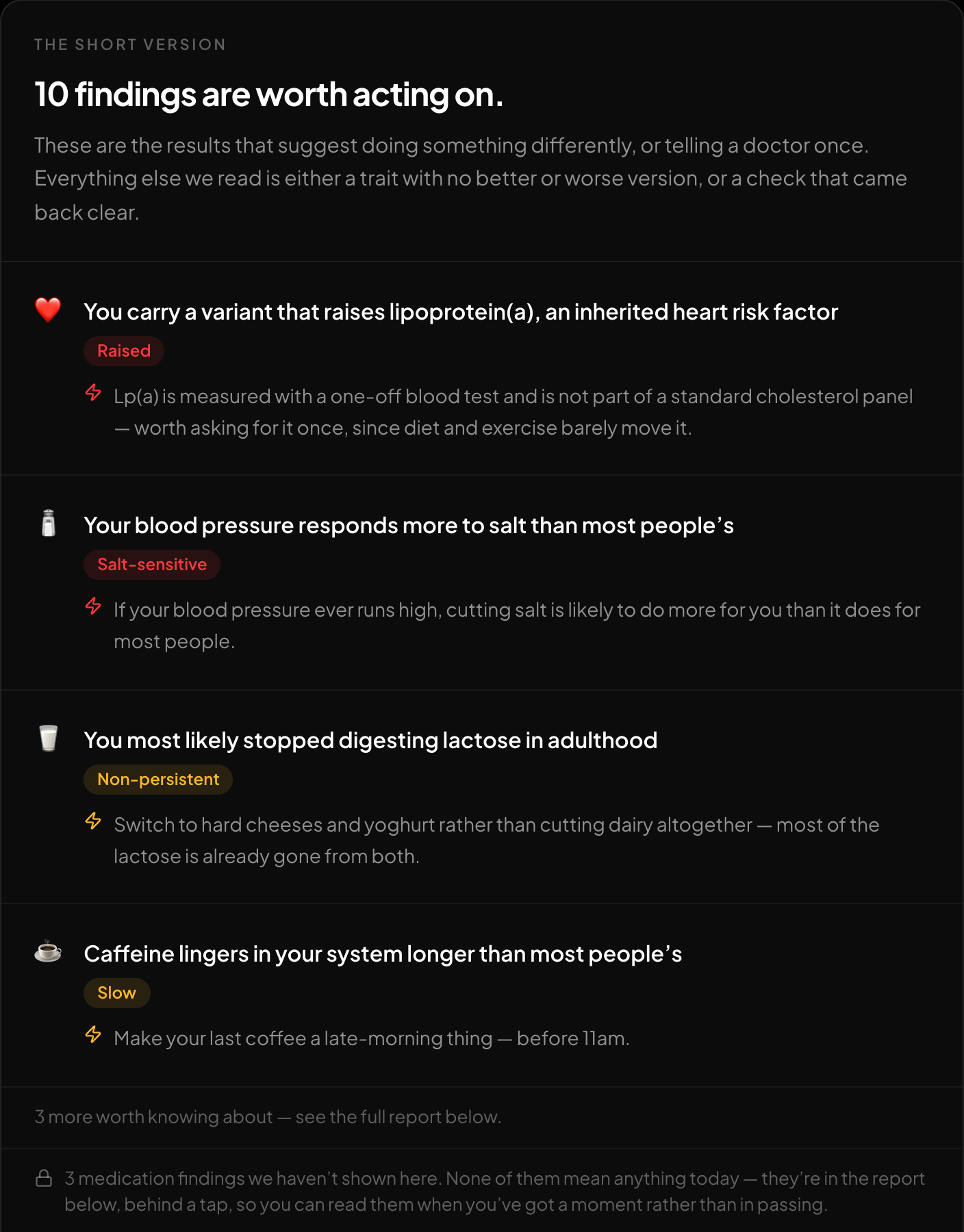
The short version: what is worth acting on, first.
The VDR variants are not in the HealthOSX report, so for these four you would look up the rsIDs in your file as above or with the DNA lookup. The free DNA tool reads a raw 23andMe, AncestryDNA, MyHeritage or whole-genome VCF file in your browser, and its report does include the GC vitamin D binding protein finding, the gene that speaks more directly to where your vitamin D tends to sit. Read it next to a blood result, not instead of one.
New to raw DNA files? Start with the full guide: 23andMe Raw Data Interpretation Free in Your Browser
Written by
HealthOSX Research