My Raw DNA Data Shows a Disease Variant, Is It a False Positive
A rare disease variant in a 23andMe raw file is far more likely to be a chip error than a common trait SNP. Here is how to judge it and what to bring to a clinic.
A pathogenic variant in a 23andMe raw data file can be a false positive, and the rarer the variant, the better the odds that it is. In Tandy-Connor et al. (Genetics in Medicine, 2018), about 40% of raw-data variants sent for clinical confirmation were not confirmed. The chip reads hundreds of thousands of positions cheaply, which suits common trait SNPs, but for a disease variant the result should be confirmed in a clinical-grade test before anything medical rests on it. Do not panic and do not dismiss it. Treat it as a lead.
Why a chip can call a variant that isn't there
A genotyping array does not read your DNA letter by letter. Each position has a probe, your DNA sticks to it, a fluorescent signal comes out, and software sorts that signal into one of three clusters: two copies of one letter, one of each, or two of the other.
For a common SNP those clusters are tight, because the software has seen them in millions of people. For a rare variant almost everyone lands in one cluster, and the carrier cluster is a handful of dots. A smudge at the edge of the main cluster can get called a carrier. Probes can also stick to a similar sequence elsewhere in the genome, which is a known headache around genes with near-copies such as GBA.
And the raw file shows none of this. You see CT, with no hint whether the signal was clean or marginal.
A second kind of error happens after the chip. Third-party interpreters that read a raw file can flip strands, swapping A with T or C with G when they match your genotype to a database, and then report a 'pathogenic' genotype the chip never called. The file is fine and the report is wrong.
Real data bear this out. Weedon et al. (BMJ, 2021) checked UK Biobank array calls against sequencing and found that for variants rarer than about 1 in 100,000, the positive predictive value of the chip call was only about 16%, meaning roughly 5 in 6 positive calls were wrong. Tandy-Connor et al. found that about 40% of the raw-data variants they followed up were not confirmed.
Rare variants fail more often than common ones
The same small error rate does very different damage depending on how many real carriers there are. Take a deliberately simple case: 100,000 people, and the chip wrongly calls a carrier in 1 in 1,000 non-carriers. The chart is an illustration of the same pattern the measured studies above show.
The 1 in 1,000 false-call rate is chosen for illustration. It is not a measured rate for 23andMe or any other company.
The 1 in 1,000 false-call rate is chosen for illustration. It is not a measured error rate for 23andMe or any other company, so read the chart as a demonstration of the arithmetic and not as a 23andMe statistic.
The figure assumes every true carrier is detected, which flatters the chip. A variant carried by 30% of people gives 30,000 true carriers and about 70 false ones, so nearly every positive call is real. A variant carried by 1 in 5,000 gives 20 true carriers and about 100 false ones, so most positive calls are wrong. At 1 in 50,000 only about 2 in 100 positive calls are real. Same chip, same error rate. That is why a trait SNP like the one behind coffee metabolism can be trusted on an array and a rare disease variant cannot, not without a second look.
Was it in 23andMe's own report?
This changes how much weight to give the result. 23andMe's own FDA-authorised health reports, for example the report covering three BRCA founder variants, go through validated reporting. A variant shown there was handled by that process, although it is still a screening result and not a diagnosis. The same rsID found only in the raw file, or surfaced by a third-party tool, did not go through that process, and everything below applies to it in full.
Six checks before you decide what it means
- No-calls. 23andMe writes
--where the signal was not good enough to call. A lot of them across the file, or failed neighbouring probes in the same gene, means a weaker sample and a call to trust less. - Ancestry. Some chip variants are there because they are known founder variants in one population. The 23andMe BRCA report covers just three variants, chosen because they are common in people of Ashkenazi descent, out of thousands known. The same variant in someone with different ancestry is less expected, and databases such as ClinVar lean on studies of European-ancestry people.
- Rarity. Look the variant up in gnomAD, the public allele frequency database. A variant labelled pathogenic for a severe dominant disease that turns up in 1 in 100 healthy people from your ancestry group is suspicious, either of the label or of the call.
- Strand and allele orientation. Compare three things: the risk allele the report names, the genotype actually written in your file, and the ClinVar entry for that variant. If the report names a letter your file does not contain, or the match only works after swapping A with T or C with G, suspect a strand flip in the interpreter and not a real finding.
- Chip version. 23andMe has run different array versions over the years, with different probe designs. The practical way to tell which one your kit used is to count the data lines in the file: roughly 630,000 SNPs suggests v5, roughly 570,000 v4, and roughly 960,000 v3. If you also have an AncestryDNA or MyHeritage file, check whether the same rsID is on it and agrees. Recent 23andMe (v5) and newer AncestryDNA kits both use Illumina arrays built on the Global Screening Array, so a match between them is less independent than it looks.
- Whole-genome data. If you have a sequencing file, find the same position and read the depth and the share of reads that carry the variant.
Can a whole-genome file settle it?
It can raise or lower your suspicion a lot, and it still does not replace a clinical test. Sequencing reads each position many times (30x means about 30 reads on average), so a real heterozygous variant should show up in roughly half the reads. A VCF with depth and genotype quality lets you see that. One read supporting the variant out of eight is not convincing.
| Raw chip file | Whole-genome VCF | Clinical test | |
|---|---|---|---|
| Shows signal quality | No | Depth and quality | Yes |
| Can rule a variant out | No | If well covered | For the tested variant |
| Accepted for medical decisions | No | Usually no | Yes |
Scroll the table sideways for the rest →
General pattern, not a rule for every lab or file.
Two traps. Most VCFs list only the positions where a variant was called, so a missing line does not mean a reference call. Absence only means something if the file is a gVCF or otherwise records coverage at that position. And a VCF with no rsIDs in the ID column cannot be searched by name, so you match on genome coordinates.
What the word pathogenic leaves out
Even a real variant does not mean what the headline suggests. For recessive conditions, one copy usually makes you a carrier who is well. For dominant ones, many people with the variant never develop the disease, which is called incomplete penetrance. And classifications move: variants get downgraded from pathogenic to uncertain as more people are sequenced. How much of this should be shown to consumers at all is still argued among geneticists.
A raw-data result is a lead, not a finding. Only a clinical test turns it into one.
What to bring to a doctor or genetic counsellor
- The rsID, your genotype and the genome build from the file, plus which company produced it, whether it appeared in the company's own report or only in the raw file, and your best inference of the chip version.
- A screenshot of the ClinVar entry and the gnomAD frequency for your ancestry group.
- Your family history, including relatives with the condition and their ages at diagnosis.
- Any whole-genome or second-company file that covers the position.
Then ask whether a clinical confirmation test on a fresh sample is warranted, and whether a genetic counsellor referral makes sense. Genetic counsellors regularly see raw-data results. Who can order a test differs by country, and for counsellors by US state. A genetic counsellor, including through telehealth genetics services, can often arrange single-site confirmation through an ordering clinician.
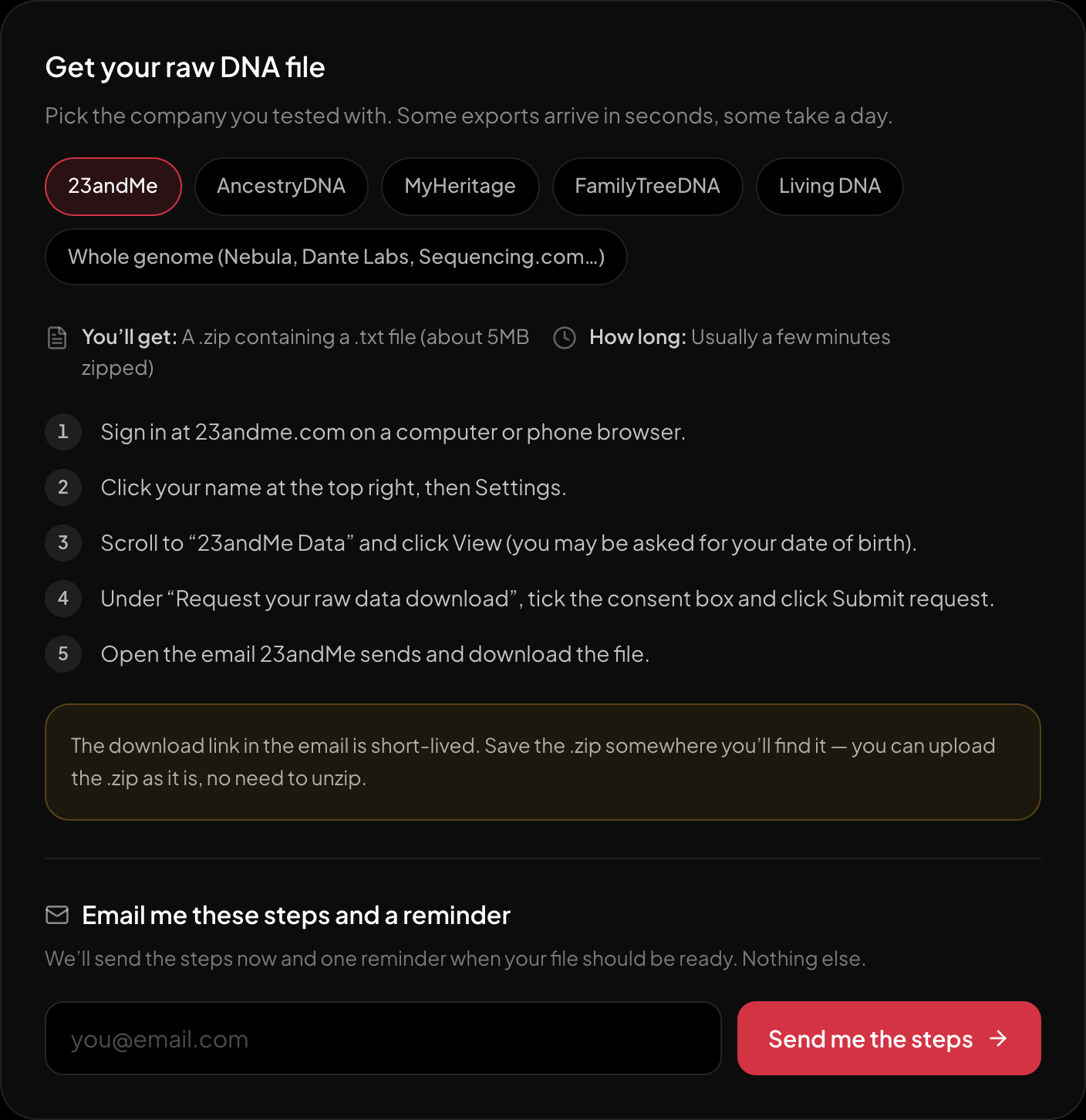
The download steps for 23andMe, on the page itself.
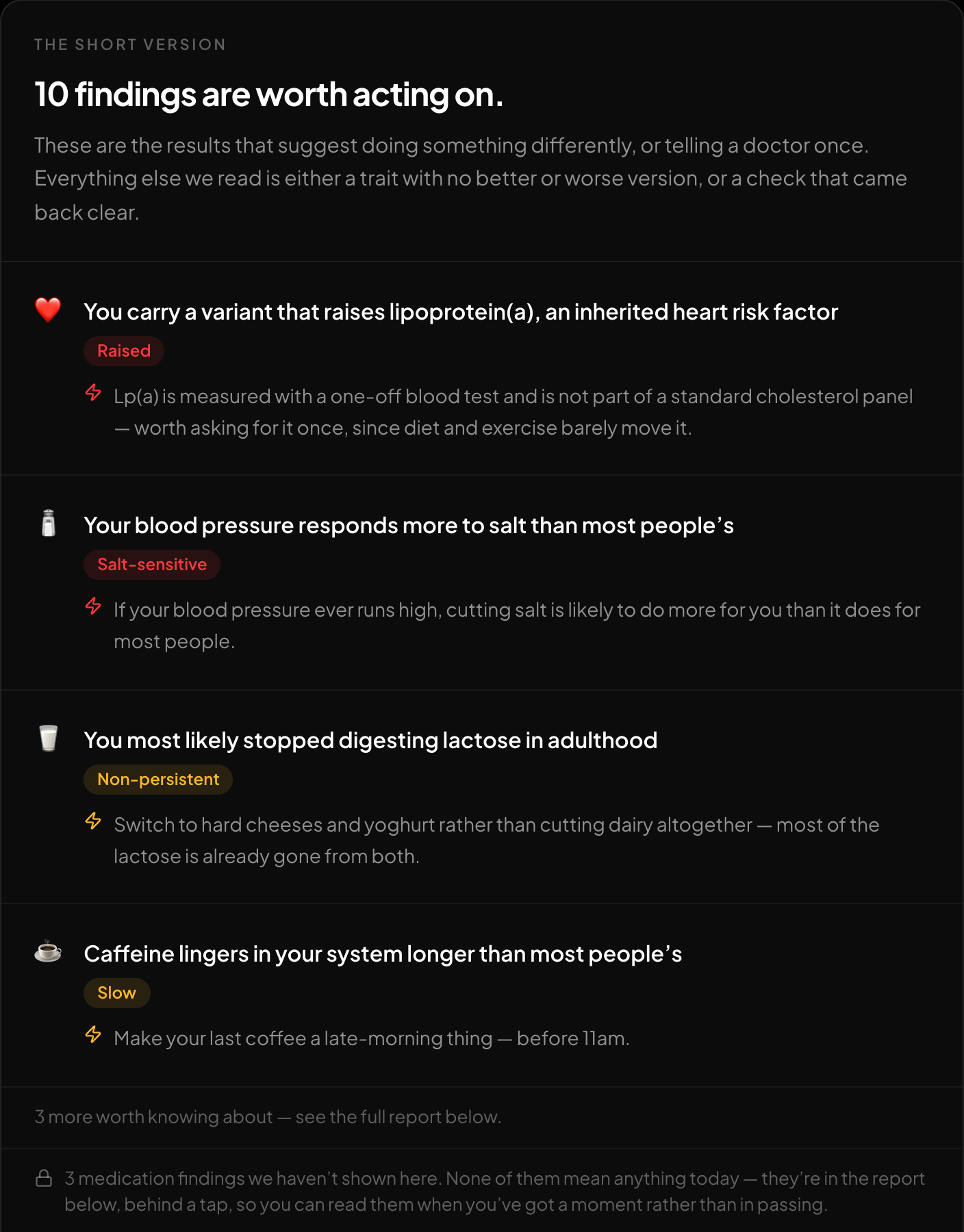
The short version: what is worth acting on, first.
If you want to see which named findings your file triggers before that appointment, the free DNA tool reads a 23andMe, AncestryDNA, MyHeritage or whole-genome VCF file in your browser and lists single-variant findings such as GBA, LRRK2, MUTYH and SERPINA1. Whole-genome files are also screened against ClinVar. The tool reads the same genotype as the raw file, so it cannot confirm or refute an array call. It will not turn an array call into a diagnosis, and a clear result is not an all-clear, but it shows you what to ask about.
New to raw DNA files? Start with the full guide: 23andMe Raw Data Interpretation Free in Your Browser
Written by
HealthOSX Research