What PPARG Pro12Ala rs1801282 Means in Your 23andMe or AncestryDNA Raw Data
rs1801282 is the PPARG Pro12Ala variant. In 23andMe or AncestryDNA data, G is the Ala allele, and carrying it slightly lowers type 2 diabetes odds. It is a nudge, not a verdict.
In a 23andMe or AncestryDNA raw file, rs1801282 is the PPARG Pro12Ala variant: a C to G change that swaps proline for alanine at position 12 of the PPARG2 protein. The G allele (alanine) is the less common one, and in large European studies it goes with slightly lower odds of type 2 diabetes, so GG or CG is not the bad result people assume. Whichever genotype you have, it is a small, population-dependent nudge on insulin sensitivity, not a diagnosis and not a diet plan.
Why a weaker PPAR gamma can mean better insulin sensitivity
PPARG codes for PPAR gamma, a receptor that sits in the nucleus of fat cells and switches on genes for storing fat and responding to insulin. Pioglitazone and rosiglitazone, the thiazolidinedione (TZD) diabetes drugs, work by binding it directly. So this is a gene where we know the biology unusually well, because a drug class was built on it.
The number 12 comes from counting amino acids in the PPARG2 isoform, whose extra N-terminal stretch is made mainly in fat cells. In the original laboratory work (Deeb 1998, Nature Genetics), the alanine version showed reduced transactivation: it switched its target genes on a little less. One proposed explanation is that slightly weaker PPAR gamma activity puts slightly less pressure on fat cells to expand, which could mean somewhat better insulin sensitivity in some people. That mechanism is a hypothesis, not a settled finding. The word is slightly. Altshuler 2000 (Nature Genetics) made this one of the first common diabetes variants to replicate across studies, and later meta-analyses such as Gouda 2010 put the effect at an odds ratio of about 0.86 per G allele. That is modest even where it holds.
How to find it in your raw file
Open the .txt file (unzip it first if it came zipped) and search for rs1801282. It is on chromosome 3, at position 12393125 in the GRCh37 (hg19) build. Most 23andMe and AncestryDNA files list this SNP by its rsID, but a file can carry an internal ID instead (23andMe uses 'i' numbers for some SNPs). In those cases, searching for chr3:12393125 or for the position 12393125 on chromosome 3 helps.
- 23andMe: one line with rsid, chromosome, position and a two-letter genotype, such as
CG. - AncestryDNA: the same line, but the two alleles sit in separate columns (
CandG). - Not found: your chip version simply did not include it. That means no data, not a normal result.
- Missing call:
--in 23andMe,0and0in AncestryDNA. The position was tried and not called. Treat it as missing.
| Genotype | Amino acids | Roughly how common | Direction of the nudge |
|---|---|---|---|
| CC | Pro / Pro | About 3 in 4 | Reference, no change |
| CG | Pro / Ala | About 1 in 5 | Slightly lower diabetes odds |
| GG | Ala / Ala | About 1 in 70 | Probably similar or slightly lower; few GG people studied |
Scroll the table sideways for the rest →
Approximate European-ancestry frequencies, rounded, from gnomAD and 1000 Genomes (G allele frequency about 0.12). The G allele is about 0.02 to 0.04 in East Asian and about 0.01 in African ancestry. GRCh37 position chr3:12393125.
One trap: C and G are complements of each other, so the strand matters. 23andMe and AncestryDNA report on the GRCh37 plus strand, where C = Pro and G = Ala, so read the letters in your file exactly as they are. Only third-party tools that re-orient strands can flip them. If a tool shows the opposite letter for your genotype, trust the plus-strand letters in your raw file and read C as proline and G as alanine.
CC, CG and GG: what each one is
CC means two proline copies, the common version. CG means one alanine copy. GG means two, which is uncommon: in people of European ancestry the G allele frequency is about 0.12 (gnomAD and 1000 Genomes), or roughly one chromosome in eight, so GG is around one person in seventy. Because so few people are GG, the estimate for two copies is uncertain, and it is safest to read it as probably similar to CG or slightly lower. In East Asian ancestry groups the G allele frequency is about 0.02 to 0.04, and in African ancestry groups about 0.01, so the variant is far rarer there.
The common mistake is reading the G as the risk allele because it is the unusual one. It is the reverse. In large European meta-analyses the alanine allele goes with lower type 2 diabetes odds, roughly 14 percent per allele (OR 0.86). That sounds meaningful, but lifetime type 2 diabetes risk is roughly 1 in 3 in many Western populations, and a roughly 14% relative reduction moves a person's own risk only a little next to weight, age and family history.
Where the evidence gets weaker
Three things are still argued about.
- Population: the association is clearest in Europeans. Because the allele is rare elsewhere, studies in other groups are smaller and less consistent.
- Interaction with weight and diet: some studies find the effect depends on BMI or on dietary fat, and others do not find it. None of those findings is settled.
- Drug response: whether Pro12Ala changes how someone responds to pioglitazone or rosiglitazone has been studied and has not produced a result strong enough to guide prescribing. There is no CPIC gene to drug guidance for it.
So nobody can honestly tell you to eat differently or take or avoid something because of your rs1801282 genotype.
What would say far more than this SNP
The variant is a lifelong, slight tilt in a pathway. Your blood shows where you actually are now. The table gives the standard glucose and HbA1c cut-offs; two more measures add context.
| Measure | Normal | Prediabetes | Diabetes range |
|---|---|---|---|
| Fasting glucose (mg/dL) | Under 100 | 100 to 125 | 126 or more |
| HbA1c (%) | Under 5.7 | 5.7 to 6.4 | 6.5 or more |
Scroll the table sideways for the rest →
American Diabetes Association cut-offs. A diagnosis needs a doctor and usually a repeat test.
- Fasting insulin: not routinely ordered, but a high value with a normal glucose is the early sign of insulin resistance, often years before glucose moves. Labs differ on reference ranges, so ask yours.
- Waist and BMI: waist circumference and BMI track insulin resistance closely, and for most people they say more about diabetes risk than any single common variant.
A CC person with an HbA1c of 6.0 has more to act on than a GG person with an HbA1c of 5.2, and the G allele does not make that 6.0 any less real.
Should I get this retested or confirmed?
For a result you only plan to read about, no. Consumer chips call common SNPs like this one accurately. If something clinical hangs on a genotype, a lab test ordered by a doctor is the right route, but here nothing clinical should hang on it. If your numbers are the concern, the glucose and HbA1c above are what to take to a doctor.
In European studies the G allele goes with slightly lower diabetes odds, and your glucose, HbA1c and waist say far more.
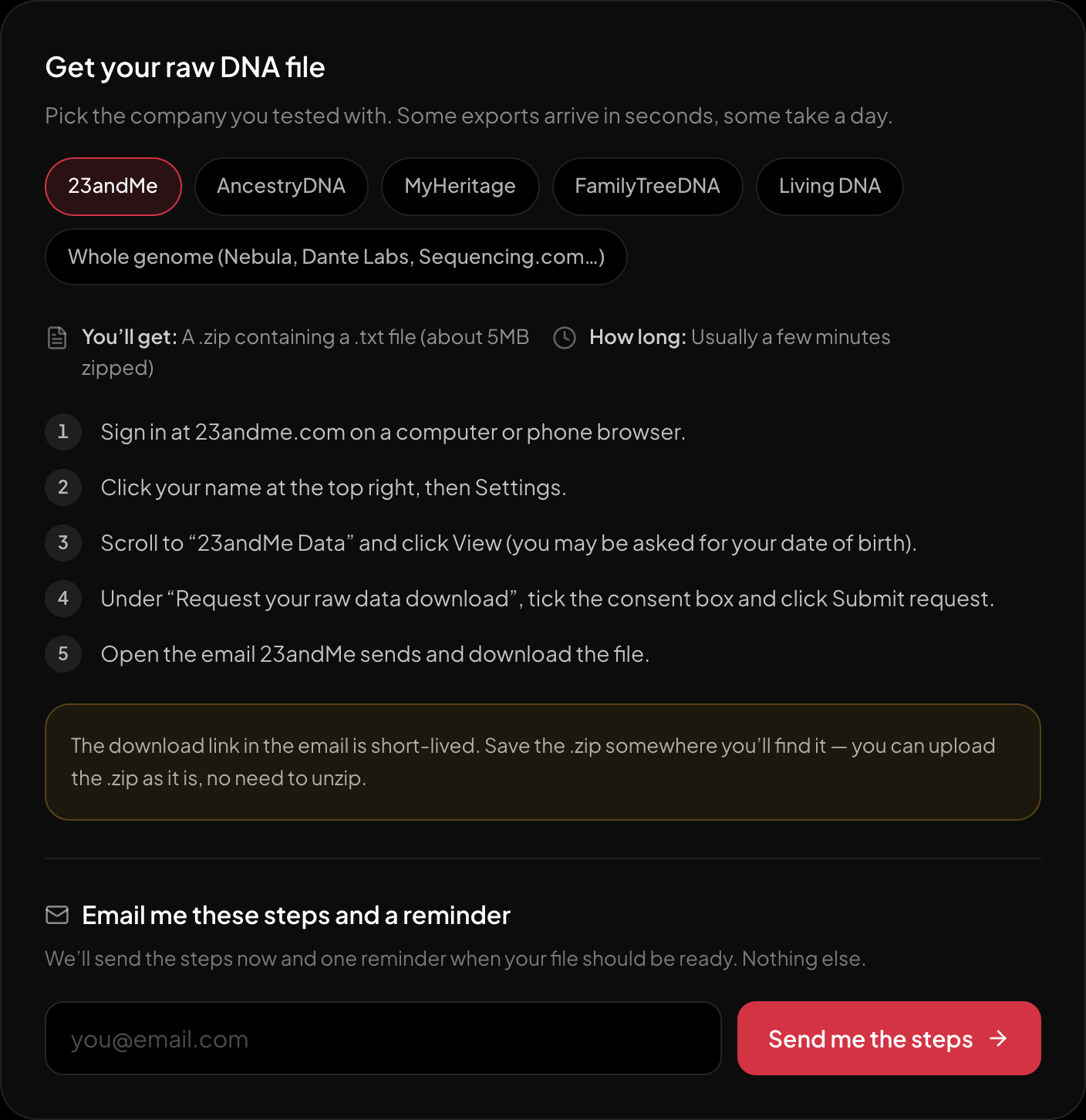
The download steps for 23andMe, on the page itself.
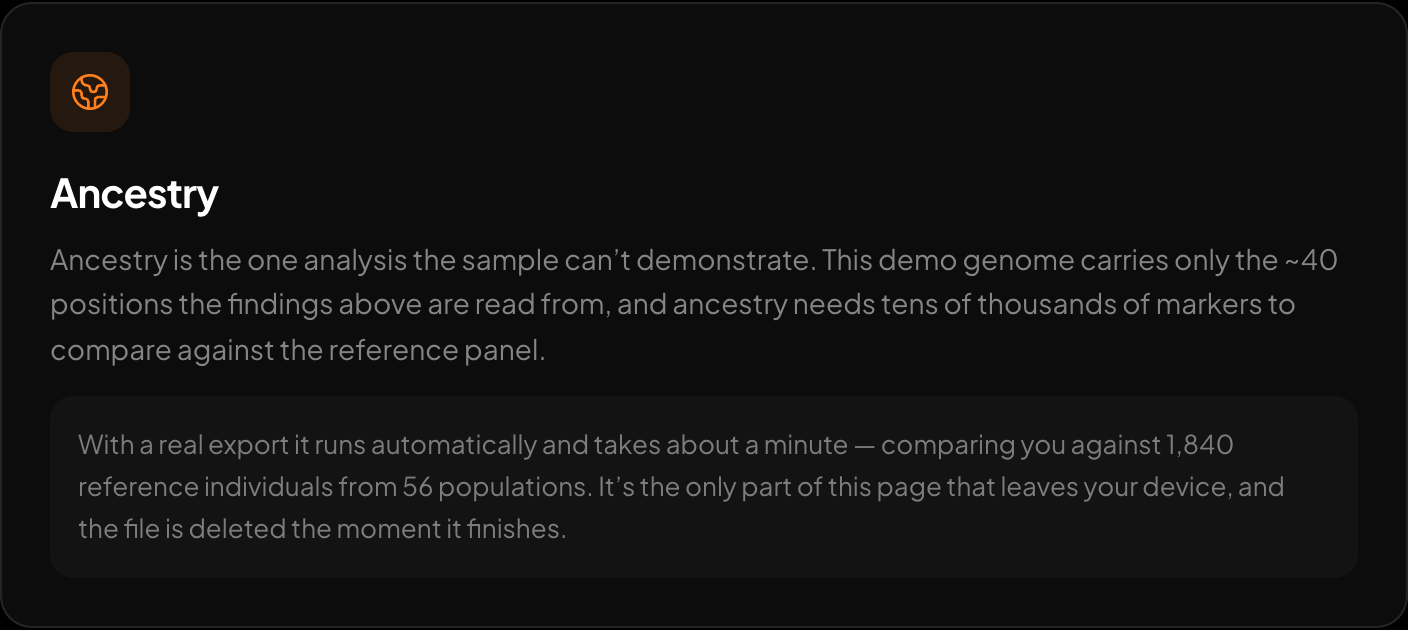
Ancestry across 15 regions and 157 reference populations.
The free report on healthosx.com does not cover this variant, though other type 2 diabetes related findings such as TCF7L2 are in it. To check a single variant, healthosx.com/dna/lookup looks up one rsID, so you can enter rs1801282 directly. If you store your file with HealthOSX, Ask your DNA can look up any variant in it and also gives a relative type 2 diabetes polygenic tendency, shown against people in the 1000 Genomes reference panel. That is a relative comparison, not a prediction of whether you will develop diabetes. If you want to see the rest of your raw file read the same way, the free DNA tool at healthosx.com/dna reads a 23andMe, AncestryDNA, MyHeritage or whole-genome VCF file in your browser and reports traits, medication response and carrier-relevant findings, with an optional ancestry breakdown.
New to raw DNA files? Start with the full guide: 23andMe Raw Data Interpretation Free in Your Browser
Written by
HealthOSX Research