What NOD2 R702W, G908R and 1007fs Mean in Your 23andMe or AncestryDNA Raw Data and Do They Show Crohn's Disease Risk
NOD2 R702W, G908R and 1007fs in 23andMe or AncestryDNA raw data do not mean you will get Crohn's. One copy takes lifetime risk from roughly 0.3 to 0.5% to about 1 in 100, and two copies to roughly 1 in 12 to 1 in 20.
NOD2 R702W (rs2066844), G908R (rs2066845) and 1007fs (rs2066847) are the three common variants most strongly linked to Crohn's disease, but finding one in your 23andMe or AncestryDNA raw data does not mean you will get Crohn's. One copy takes lifetime risk from roughly 0.3 to 0.5% to about 1 in 100, and two copies to roughly 1 in 12 to 1 in 20. Most carriers never develop the disease.
Why most carriers never get Crohn's
Crohn's affects well under 1% of people, while about 10 to 15% of people with European ancestry carry at least one of these three variants. Carriers vastly outnumber patients.
"Mutation" is part of the confusion. These are common variants found in perfectly healthy people, not rare high-impact changes. NOD2 was the first gene tied to Crohn's, back in 2001, and it is still among the strongest. But it explains only a fraction of the inherited risk, and well over a hundred other regions of the genome now contribute small amounts each. Diet, smoking, infections, the gut microbiome and plain chance fill in the rest.
One copy versus two copies
Copies are counted across both chromosomes, and two different NOD2 variants can count together. One R702W plus one 1007fs (compound heterozygous) is only a true double hit if the two variants sit on different copies of chromosome 16. If both sit on the same copy, the other copy is typical and it behaves more like a single hit. A raw file cannot show phase, so the double-hit reading is likely but unconfirmed.
| Copies of NOD2 variants | What the file shows | What research shows |
|---|---|---|
| None | Typical alleles at all three (CC at rs2066844, GG at rs2066845, no insertion) | Baseline risk, roughly 0.3 to 0.5% lifetime |
| One | One variant allele at one position, e.g. CT at rs2066844 | About 2.4 times baseline, roughly 0.7 to 1.2% lifetime |
| Two | TT at rs2066844, or CT at rs2066844 plus a variant call at rs2066845 or rs2066847 (double hit likely but phase unconfirmed) | About 17 times baseline, roughly 5 to 9% lifetime, so most carriers are still unaffected |
Scroll the table sideways for the rest →
Relative risks from Economou et al. 2004. Absolute figures assume a baseline lifetime risk of roughly 0.3 to 0.5% in European-ancestry populations.
Ratios are easier to judge with absolute numbers. Lifetime risk of Crohn's in European-ancestry populations is roughly 0.3 to 0.5%. The Economou et al. 2004 meta-analysis put the relative risk at about 2.4 for one copy and about 17 for two copies (homozygous or compound heterozygous). Applied to that baseline, one copy comes to roughly 0.7 to 1.2%, about 1 in 100, and two copies to roughly 5 to 9%, about 1 in 20 to 1 in 12. These are approximate ranges, not personal predictions. Even with two copies, most people stay unaffected. The studies behind these ratios are mostly in people of European ancestry. These variants are much rarer in East Asian and African populations, so the numbers carry over poorly.
What the three variants do to the protein
NOD2 is a sensor that sits inside gut lining cells and immune cells. It detects muramyl dipeptide, a fragment of bacterial cell wall. When it binds one, it switches on NF-kB signalling, and the cell responds with inflammatory messengers and antimicrobial peptides. In the small intestine, Paneth cells make many of those peptides, and lower defensin output in carriers of NOD2 variants has been reported as an association, not a settled cause.
All three variants weaken that response, and 1007fs cuts the protein off short. A gut that senses bacteria poorly is probably slower to deal with them, and the immune system may overcorrect later. Exactly how that tips into disease is still argued. The pattern does fit what is seen clinically: NOD2 variants associate mainly with Crohn's in the ileum, the end of the small intestine, and not with ulcerative colitis.
| Variant | rsID | Protein change | Effect | Variant allele in the raw file | Approx. frequency (gnomAD non-Finnish European) |
|---|---|---|---|---|---|
| R702W | rs2066844 | Arginine to tryptophan at position 702 | Reduced response to bacterial cell wall fragments | T | About 4% |
| G908R | rs2066845 | Glycine to arginine at position 908 | Reduced response, in the bacteria-sensing repeat region | C | About 1 to 1.5% |
| 1007fs | rs2066847 | One C inserted, frameshift at 1007 | Shortened protein with the clearest loss of function | I (insertion), where called | About 2% |
Scroll the table sideways for the rest →
All three sit in or next to the leucine-rich repeat region that senses bacterial fragments. Frequencies are approximate.
Finding them in your raw file
- Unzip the download and open the .txt in a text editor or spreadsheet. Each line is an rsid, a chromosome, a position and a genotype.
- Search for rs2066844, rs2066845 and rs2066847. All three are on chromosome 16. AncestryDNA chips may not include some of these three positions at all, so a missing line is possible.
- Read the genotype as two letters, one per chromosome copy. Check the genome build and strand stated in your file's header, because the variant letters below assume the plus strand. The typical allele is C at rs2066844 and G at rs2066845, and the variant alleles are T and C respectively.
- Be careful with third-party tools. G908R is a G/C SNP, so a strand flip cannot be detected from the letters: a C could be the variant on the plus strand or the typical allele on the minus strand. A converter or third-party tool can silently report the opposite allele at a G/C site, so compare against the original file.
- 1007fs (rs2066847) is an insertion, so it is reported differently from the other two. Look for the rsID first. 23andMe uses internal i-numbers instead of rsIDs for some variants on some chip versions, so if the rsID is absent, an i-number line may stand in for it. Check 23andMe's own documentation for the ID and the letter coding on your chip version before reading any genotype.
Why the insertion call looks odd or is missing
The 1007fs variant is an inserted C, not a swap of one letter for another. Chips are built to read swaps, so insertions are awkward. In a raw file the position may appear under rs2066847, under an internal i-number, as a no-call ("--"), or not at all, because some chip versions simply leave it out.
So a missing line is not a negative result. And even three clean lines do not clear NOD2: the chip tests only a handful of its many variants, and rare ones elsewhere in the gene go unseen.
Children and clinical testing
With one copy, each child has a 50% chance of inheriting it. With two copies, every child inherits one. A child with one copy is in the same position as above: an absolute lifetime risk of roughly 0.7 to 1.2%, about 1 in 100, so most children who inherit one will still never develop Crohn's.
NOD2 genotyping is not used to diagnose Crohn's. After a diagnosis it is sometimes discussed in relation to disease course, such as ileal or stricturing disease, but it does not replace symptoms, imaging, calprotectin or colonoscopy.
What a result should and should not change
Worth taking seriously:
- Symptoms lasting weeks, such as diarrhoea, blood in the stool, ongoing abdominal pain or unexplained weight loss. Worth asking a doctor about whatever your genotype is. Stool calprotectin and colonoscopy are how gut inflammation is actually checked, not a DNA file.
- Close relatives with inflammatory bowel disease. That history says more about your risk than a single NOD2 call does.
- Smoking, the best-established modifiable risk factor for Crohn's, with or without NOD2 variants.
- A hit that matters to you, particularly with East Asian or African ancestry where these variants are rare. Raw chip calls for rare variants can be wrong, so it is worth confirming in a clinical lab before treating it as fact.
Not worth doing:
- Changing your diet or starting supplements because of a carrier result.
- Assuming you need a colonoscopy with no symptoms.
- Reading a missing or odd-looking 1007fs line as either good or bad news.
A NOD2 variant in your raw data is a small nudge to risk, not a diagnosis, and symptoms matter far more than the genotype.
What is still unknown is why one carrier develops Crohn's and their sibling with the same genotype does not. Nobody can currently predict that.
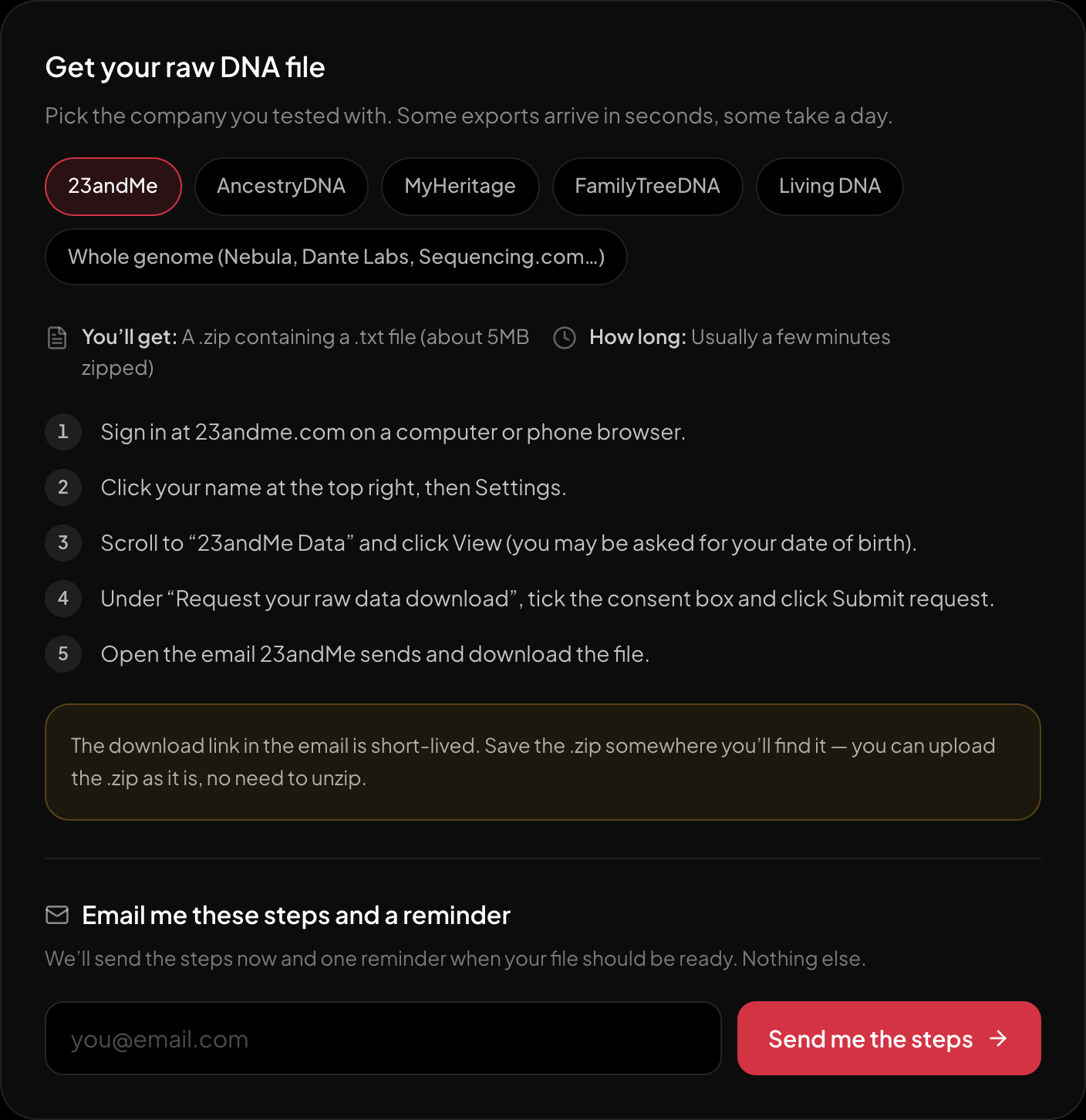
The download steps for 23andMe, on the page itself.
Ancestry across 15 regions and 157 reference populations.
NOD2 is not one of the findings in the HealthOSX DNA report. To find rs2066844, rs2066845 and rs2066847 in your file, use the single-rsID lookup for these three positions only, and read the rs2066847 line with the notes above on insertions.
New to raw DNA files? Start with the full guide: 23andMe Raw Data Interpretation Free in Your Browser
Written by
HealthOSX Research