What NAT2 Slow Acetylator Means in Your 23andMe or AncestryDNA Raw Data
NAT2 slow acetylator means two reduced-function copies of a drug-clearing gene. Here is how rs1801280, rs1799930 and rs1799931 in 23andMe or AncestryDNA data point to it, and what a chip cannot tell you.
If a report says NAT2 slow acetylator, it means the liver enzyme N-acetyltransferase 2 probably clears certain drugs and chemicals more slowly than average, because you carry two reduced-function copies of the gene. In a 23andMe file that call is inferred from a handful of SNPs, mainly rs1801280 (5), rs1799930 (6) and rs1799931 (*7). AncestryDNA chips may not include all three of these SNPs, so check which lines your file actually has. Either way it is a partial reading, not a dosing instruction.
What NAT2 actually does
NAT2 sits mostly in the liver and the gut lining. Its job is to take an acetyl group from acetyl-CoA and attach it to an amine group on a drug or chemical. That usually makes the molecule less active and easier to excrete. It is a phase II enzyme: for many compounds, other enzymes (the CYP family) change the molecule first and NAT2 then acts on the amine that is exposed. Some drugs skip that first step. Isoniazid and hydralazine are acetylated directly, with no CYP step before NAT2.
The classic substrates are isoniazid (a tuberculosis drug), sulfonamide antibiotics such as sulfamethoxazole, hydralazine (a blood pressure drug) and procainamide (a heart rhythm drug). Environmental aromatic amines, found in tobacco smoke and some dyes, go through the same step. NAT2 is one of the oldest pharmacogenetic genes: differences in how fast people acetylate isoniazid were among the first inherited drug-response differences to be described. Commonly published isoniazid half-life ranges are about 0.5 to 1.6 hours in rapid acetylators and about 2 to 5 hours in slow acetylators, and individual values vary with dose, method and population.
Which NAT2 variants your chip tests
The fully working reference version is called *4. Several single-letter changes weaken the enzyme, either by making it less stable or by lowering how much of it is made. Many consumer chips include the three common ones, but chip versions differ, so check your own file. Search it for each rsID and treat a missing line as not tested, never as reference.
| Allele | SNP | Change | Effect |
|---|---|---|---|
| *5 | rs1801280 | 341T>C | Lower expression |
| *6 | rs1799930 | 590G>A | Unstable protein |
| *7 | rs1799931 | 857G>A | Lower affinity and stability |
| *14 | rs1801279 | 191G>A | Reduced activity; often missing from chips |
Scroll the table sideways for the rest →
Reference allele is the working one. A copy of the variant allele weakens the enzyme. *14 is often missing from chips.
14 (rs1801279) is a rarer slow allele that is often missing from chips. It matters mainly in African-ancestry populations, which makes the point concrete: someone with that background can look rapid on 5, 6 and 7 alone while actually carrying a slow allele the chip did not read. Among the three common alleles, 5 and 6 are the usual culprits in people of European descent, while *7 is relatively more common in East Asian populations.
How to read your NAT2 genotype in the raw file
The raw file never contains the words "slow acetylator". That label comes from a third-party tool that interprets the file. What the file holds is a pair of letters at each SNP, and the label is a summary of those letters.
The NAT2 alleles act additively: each weakened copy lowers enzyme activity a step, giving rapid, intermediate or slow. Only the slow phenotype needs two weakened copies, so you count how many of your two chromosomes carry a slow allele.
| Slow copies | Usual label | Enzyme speed |
|---|---|---|
| 0 | Rapid | Full |
| 1 | Intermediate | Reduced |
| 2 | Slow | Low |
Scroll the table sideways for the rest →
Based on counting slow alleles across *5, *6 and *7. A chip gives a partial call.
In the raw file each SNP appears as two letters, for example CT at rs1801280. The reference letter is T, so CT means one *5 copy and CC means two. This table shows what each possible pair means for the three SNPs:
| SNP | Genotype | Slow copies |
|---|---|---|
| rs1801280 (*5) | TT | 0 |
| rs1801280 (*5) | CT | 1 |
| rs1801280 (*5) | CC | 2 |
| rs1799930 (*6) | GG | 0 |
| rs1799930 (*6) | AG | 1 |
| rs1799930 (*6) | AA | 2 |
| rs1799931 (*7) | GG | 0 |
| rs1799931 (*7) | AG | 1 |
| rs1799931 (*7) | AA | 2 |
Scroll the table sideways for the rest →
Letters as shown on the forward strand. A missing line means not tested, not reference. Add the slow copies across all three SNPs.
Check the strand your file reports, because some files show the complementary letters, and compare against the reference allele rather than assuming. To look up a single rsID such as rs1801280, you can use /dna/lookup.
If you are heterozygous at two different SNPs, say one 5 and one 6, a chip cannot tell whether those sit on separate chromosomes (two slow copies, so slow) or both on the same one (one slow copy, so intermediate). The file is unphased. Tools usually assume the two variants sit on different chromosomes, which is the likelier arrangement in most populations, but that is an assumption.
Why a chip gives only a partial call
A chip result is a partial reading, and three limits matter:
- Chips cover only some NAT2 positions. A rare slow variant you were not tested for, such as *14, is invisible, so an apparent rapid result can be wrong.
- Phasing is missing, as above, so some combinations are ambiguous.
- Genotype is not the whole phenotype. Agreement between NAT2 genotype and measured acetylation phenotype is high but imperfect.
Slow acetylators make up roughly half of people of European ancestry, a smaller share in East Asian populations, and more in some Middle Eastern groups. So this is a common variation, not a rare defect.
What slow acetylation can change
Slower clearance means the parent drug stays around longer. Whether that matters depends on the drug, and the evidence is firmer for some than others:
- Isoniazid: liver injury has the strongest meta-analytic link to slow acetylation, with odds roughly 2 to 4 times higher. Peripheral neuropathy from vitamin B6 depletion is the older, classic slow-acetylator effect, which is why pyridoxine is co-prescribed.
- Hydralazine and procainamide: drug-induced lupus is more common in slow acetylators.
- Sulfonamides: slow acetylation has been linked to hypersensitivity reactions, but the association is weaker and still disputed.
- Aromatic amines: slow acetylators have been linked to higher bladder cancer risk with heavy exposure, such as smoking or occupational dyes. The effect is modest.
None of this converts into a dose by itself. A pharmacist or prescriber weighs genotype against kidney and liver function, other drugs and the reason for treatment. Genotype-based dosing guidance is rare but not absent: the FDA label for amifampridine gives a lower starting dose for known NAT2 poor metabolizers. For isoniazid, a randomized trial in Japan (Azuma et al., 2013) tested NAT2-guided dosing, so the idea is studied, but that is not the same as a rule you can apply from a raw file.
What should I do with the result?
Check it clinically before relying on it. Most clinical NAT2 genotyping is also unphased and infers haplotypes from more SNPs. Clinical panels test more positions (including *14 and the tag SNPs), use established haplotype inference, and can be backed by a phenotype test such as a caffeine-metabolite ratio or an isoniazid level. Mention your result before one of these drugs is prescribed, and let the prescriber decide whether a confirmatory test is worth doing.
A NAT2 slow acetylator call from a chip is a clue about how you clear a few specific drugs, not an instruction to change any of them.
Does the free HealthOSX report cover NAT2?
No. NAT2 is not among the genes in the free HealthOSX report. Its medication section follows CPIC gene and drug guidance and covers other genes such as CYP2C19, CYP2C9, SLCO1B1, TPMT and DPYD.
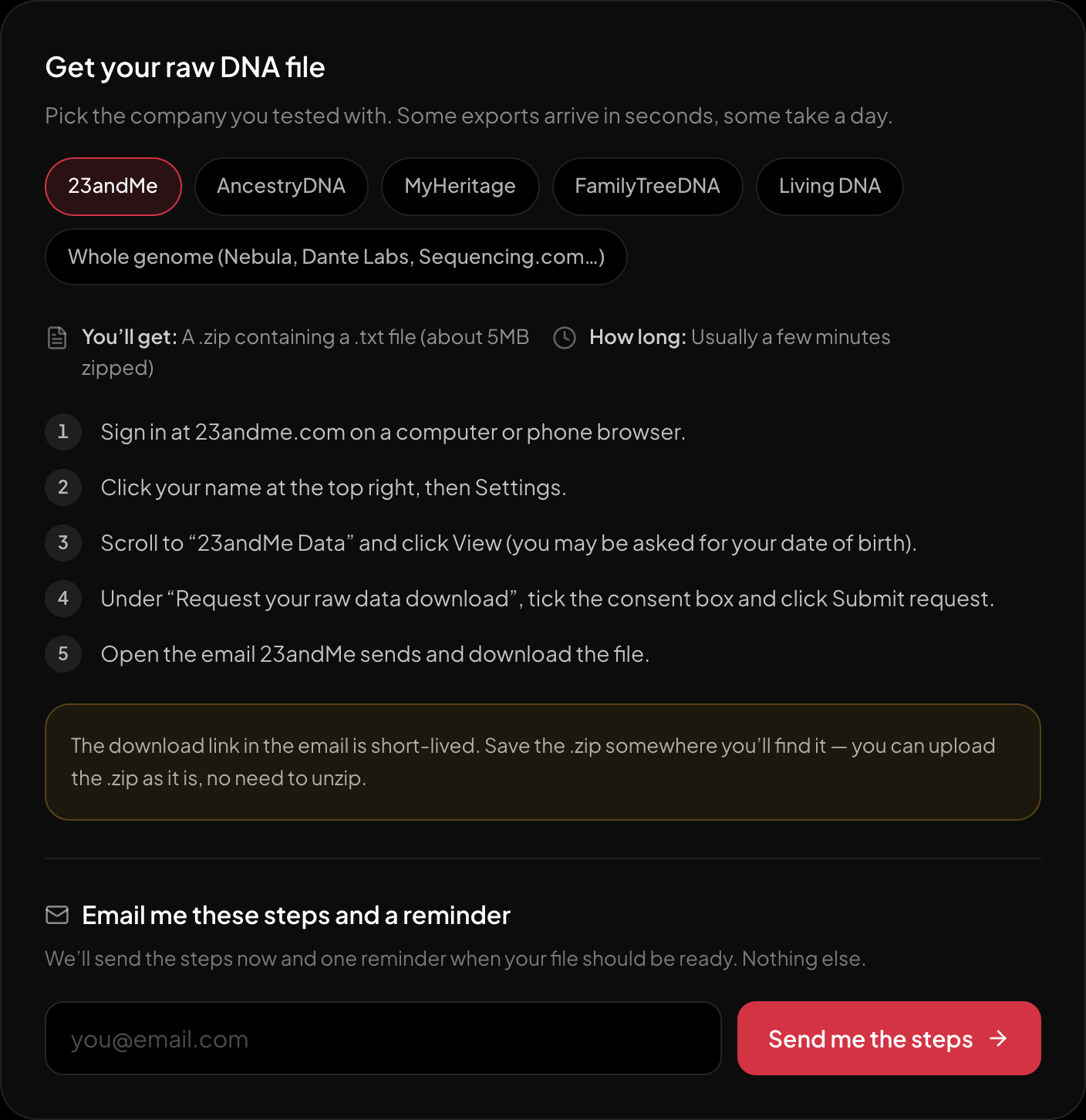
The download steps for 23andMe, on the page itself.
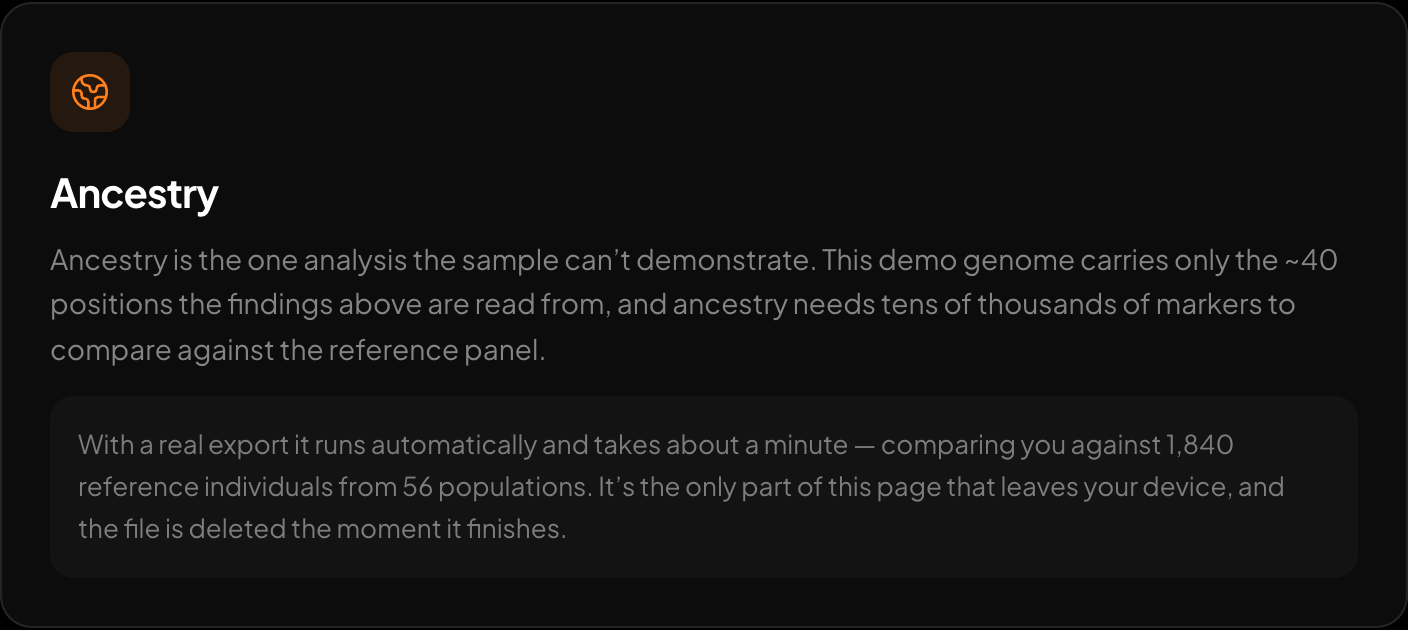
Ancestry across 15 regions and 157 reference populations.
If you want to see what your own file says about drug response and the rest of your genome, the free HealthOSX DNA tool reads a raw 23andMe, AncestryDNA, MyHeritage or whole-genome VCF file in your browser and lists medication response drug by drug alongside traits and carrier-relevant findings. If you store your file, you can also ask Ask your DNA to look up any variant, including rs1801280, rs1799930 and rs1799931. For NAT2 itself, read the genotypes above and bring them to whoever prescribes.
New to raw DNA files? Start with the full guide: 23andMe Raw Data Interpretation Free in Your Browser
Written by
HealthOSX Research