Can My 23andMe or AncestryDNA Raw Data Show If I Have the MAOA Warrior Gene
The MAOA 'warrior gene' is a repeat-length variant that 23andMe and AncestryDNA chips don't read. Here is what your raw file can and can't show.
No, not directly. The 'warrior gene' is a repeat-length variant in the promoter of the MAOA gene (the uVNTR), and the chips behind 23andMe and AncestryDNA raw data read single letters, not repeat counts. A few nearby MAOA variants in your file are weak stand-ins at best, and no version of this gene predicts aggression.
Why a chip cannot read the repeat
A genotyping chip checks individual positions in the genome and reports the letter found at each one. The MAOA uVNTR is something else: a stretch of 30 DNA letters copied several times in a row, just upstream of the gene. People carry 2, 3, 3.5, 4 or 5 copies. The 3-copy version is the one usually called 'low activity' and the 3.5 and 4 versions 'high activity'. To know which you have, someone has to measure the length of that stretch. A chip has no probe that does that, so the answer is simply not in your file.
Whole-genome sequencing does not fix this by default. A standard VCF from a sequencing company does not report the uVNTR at all. Specialist repeat-calling tools run on the underlying BAM file (ExpansionHunter-style tools, for example) can sometimes estimate it, but that is a separate analysis, not something the VCF contains.
| Chip file (23andMe, AncestryDNA) | Whole-genome VCF | |
|---|---|---|
| uVNTR repeat count (the 'warrior gene') | No | Not in the VCF; sometimes from the BAM with special tools |
| Nearby single-letter variants such as rs6323 | If on the chip | Yes |
| Enzyme activity or behaviour | No | No |
Scroll the table sideways for the rest →
Based on how genotyping chips and short-read sequencing work. Which MAOA markers a chip includes varies by version.
Where the 'warrior gene' label came from
In 1993 a Dutch team described one family in which several men carried a rare mutation that switched MAOA off entirely, and they showed impulsive, sometimes violent behaviour. Later studies reported a few other families with different MAOA-deficiency mutations, so this has not appeared only once. All of it is a different thing from the common repeat variant. In 2002 the Dunedin study in New Zealand (Caspi and colleagues) reported that boys with the low-activity repeat who were maltreated in childhood were more likely to show antisocial behaviour, while the same repeat without maltreatment showed little. The label 'warrior gene' came later. It was coined in a 2004 news piece in Science by Ann Gibbons and spread widely once press coverage in 2006 set off a controversy over a study by Lea and Chambers on Māori men, published in the New Zealand Medical Journal in 2007. Meta-analyses (Kim-Cohen 2006, Byrd and Manuck 2014) found the gene by maltreatment interaction moderately supported, with a small effect.
Why the enzyme matters, and why the repeat is still argued about
MAOA is an enzyme that breaks down serotonin, noradrenaline and dopamine after they have done their job. In lab assays the 3-copy version drives less production of the enzyme, and the 3.5 and 4-copy versions drive more. The picture is not tidy, though: the 2-copy version is also low, and results for the 5-copy version conflict. How much any of this changes brain chemistry in a living person is not settled, and it is the weakest link in the whole story.
| Repeat copies | Activity reported in lab assays | Approximate frequency in European men |
|---|---|---|
| 2 | Low | Under 1% |
| 3 | Low | About 35% |
| 3.5 | High | About 1% |
| 4 | High | About 60% |
| 5 | Conflicting | Under 1% |
Scroll the table sideways for the rest →
Activity as reported in lab assays. Frequencies are approximate and refer to men of European ancestry; they vary by population.
What the nearby variants in your file can and cannot show
Depending on chip version, your raw file may contain MAOA single-letter variants such as rs6323 or rs1137070. The variant rs6323 is a synonymous change in exon 8 (G/T), meaning it does not alter the protein. Its only value here is partial linkage with the uVNTR. That linkage is ancestry-dependent and unvalidated, so no letter can be reliably read as 'the low-activity repeat'. Some sites use these variants to guess your repeat length. Treat a 'your MAOA type' result built on them as a rough guess, not a measurement.
- They can tell you which letter you carry at that one position.
- They cannot tell you your repeat count.
- They cannot tell you your enzyme activity.
- They say nothing about behaviour.
Men and women see different data
MAOA sits on the X chromosome. Men have one X, so they carry one copy of the gene and their file shows one allele. 23andMe usually writes a single letter for a male X call, while AncestryDNA writes a doubled letter. A doubled letter in a male X call is not two copies; it is one allele written twice. Women have two X chromosomes, so two copies, but in each cell one X is largely switched off, at random. A woman with two different versions is therefore a mosaic of cells running one or the other. Her file shows both letters and cannot show the mix. Whether MAOA escapes that silencing in part is still argued about.
Why one gene never predicts behaviour
Roughly 30 to 40% of men of European ancestry carry the 3-copy repeat, and the share varies by population. A variant carried by about a third of men cannot be a violence marker on its own. Behaviour comes from thousands of small genetic nudges, upbringing, health, money and chance. Even in the studies that found an association, it was a statistical shift across a large group, not a trait you could read off one person. The common mistake is hearing 'low activity' as 'aggressive'. It only describes how much of one enzyme a promoter makes in a dish.
The warrior gene is a repeat length your chip never measured, and even when measured it describes a group average, not you.
What to search for, and what to ignore
Search for:
rs6323andrs1137070, if your chip version includes them.- Chromosome X (23andMe writes it as X, AncestryDNA as 23) with position roughly 43,515,000 to 43,606,000, which is where MAOA spans on GRCh37, the build both companies use. That shows how many MAOA markers your file has.
Ignore:
- Any report that states your 'MAOA-L' or 'MAOA-H' status from a standard chip file.
- Any claim that links your result to violence, criminality or 'warrior' traits.
- The rare loss-of-function mutation from the 1993 family. It was found only in that family, and later studies reported other families with different MAOA-deficiency mutations. Whether your chip covers any such rare variant depends on its version, and a normal result would not rule out the others.
Where the free report stops
MAOA is not among the findings in the HealthOSX DNA report. That list covers things like caffeine metabolism, lactose, medication response and carrier-relevant variants, and it does not include this gene. So it will not hand you a warrior-gene answer, and it is better that it does not invent one.
The only concrete thing worth checking is rs6323 in the DNA lookup, which looks up one rsID in your own file and shows the letters you carry. Its result still says nothing about repeat length.
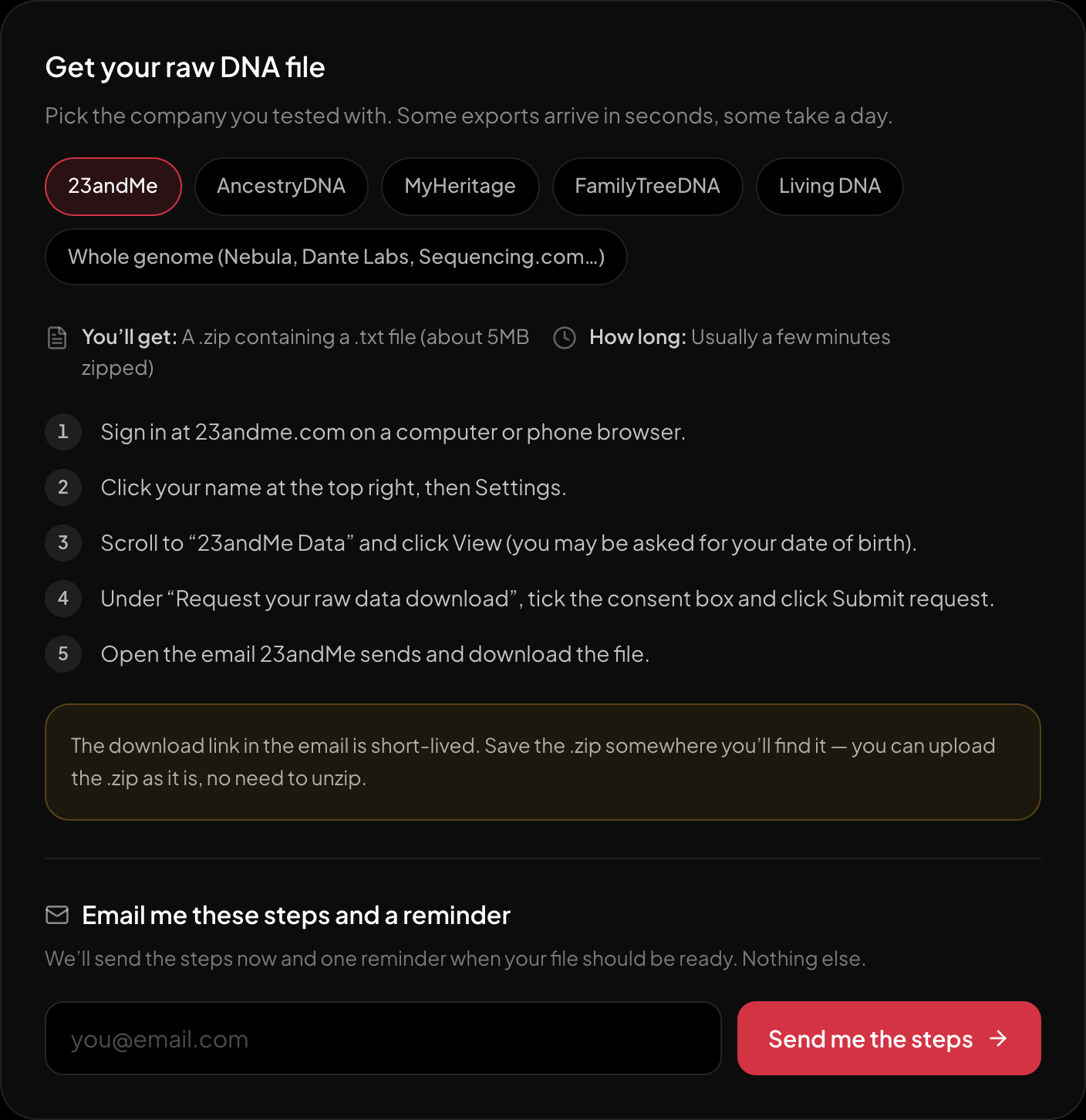
The download steps for 23andMe, on the page itself.
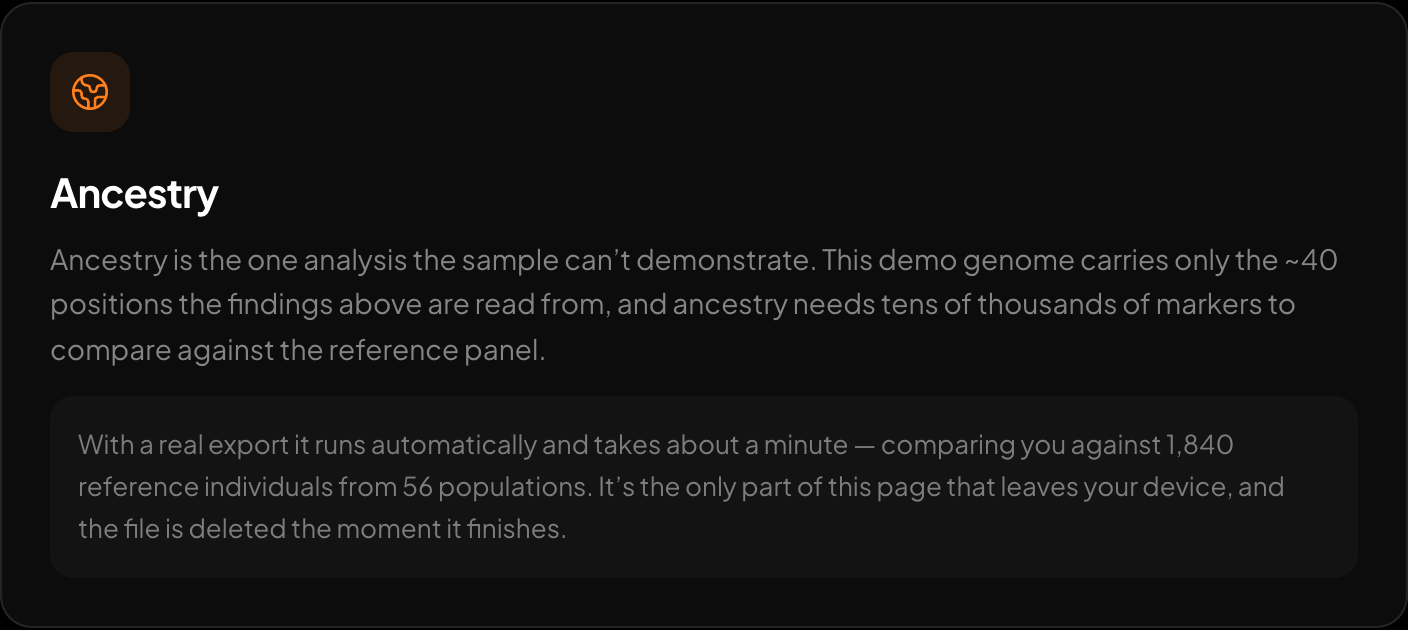
Ancestry across 15 regions and 157 reference populations.
If what you want is something in your file that is actually informative, the free DNA tool reads a 23andMe, AncestryDNA, MyHeritage or whole-genome VCF file in your browser and shows traits, medication response and carrier-relevant findings you can check against your own letters.
New to raw DNA files? Start with the full guide: 23andMe Raw Data Interpretation Free in Your Browser
Written by
HealthOSX Research