How Can I Tell If My 23andMe Raw Data File Is Really Mine and Not Mixed Up With Someone Else's
Three checks need no tool: the X and Y rows should match your sex, a few known traits should agree, and the file's date and name should fit your own download. They catch a stranger's file, not a relative's. Retesting or comparing with a parent's file is the near-definitive check.
Your 23andMe raw data file is probably really yours, and not mixed up with someone else's, if the X and Y rows match your sex, a few traits you know about yourself agree with the genotypes, and the date and name on the file fit your own download. These checks catch a stranger's file, not a relative's, and none of them proves identity. But a sex mismatch, or several trait misses at once, is the reason to stop and look closer before you trust what the file says about your health.
What a raw data file can and cannot tell you
A 23andMe raw data file is a plain text table with one line per marker: an rsID, a chromosome, a position and a genotype. Nothing in that table records whose saliva it came from. So ownership can only be tested by comparing the genome with something else: what you already know about yourself, or a second sample from you or a relative.
The first kind of comparison works because DNA predicts a few things almost perfectly (sex) and a few others well (earwax, eye colour). It does not work against relatives. A parent, child or full sibling will pass most of these checks, and an identical twin will pass all of them. The checks below catch a stranger's file or a swapped kit. They cannot catch a family mix-up. Only a second sample can, as the retest section explains.
Check one: do the X and Y rows match your sex?
Search the file for the lines whose chromosome column says X, then Y. On a phone or desktop, open the .txt file in a text editor and use its find function, or open it in a spreadsheet (import it as tab-separated text, skipping the # lines) and filter the chromosome column. A v5 file has roughly 600,000 or more lines, so judge by the thousands of X rows, not the first few you see.
Men have one X chromosome, so most X genotypes appear as a single letter, such as A. Women have two, so the genotype is two letters, such as AG. On Y, a man's rows show single letters and a woman's rows show -- (no call), because there is nothing to read.
| Male | Female | |
|---|---|---|
| X chromosome rows | Mostly one letter, e.g. A | Two letters, e.g. AG |
| Y chromosome rows | Single letters | -- (no call) |
| What a mismatch looks like | A man's file with mostly two-letter X calls and -- on Y | A woman's file with mostly single-letter X calls and letters on Y |
Scroll the table sideways for the rest →
Typical pattern for most people. A small stretch at the ends of X is shared with Y and can show two letters in men.
Look at the bulk of the rows, not the first few. A small stretch at the ends of X is shared with Y and can show two letters even in men. Two rare chromosome conditions can break the pattern. XXY (Klinefelter syndrome) often goes undiagnosed, and it makes X look female-like (two letters) with Y calls present. Turner syndrome (one X) looks male-like on X, with no Y calls. If everything else fits and the sex rows still look off, a doctor's test is worth considering. A clear sex mismatch, with no known chromosome condition, is the strongest single warning the file can give you.
Check two: do a few traits you know about yourself agree?
Pick things you are sure of, then look up the marker. Three are easy to verify by hand, and a fourth needs a tool:
- Eye colour: rs12913832 in HERC2. GG usually means blue or light eyes, AA usually brown. AG is usually brown, hazel or green, and rarely blue. It is a strong predictor, not a guarantee.
- Earwax: rs17822931 in ABCC11. TT means dry, flaky earwax. CC or CT means wet. This one is near-Mendelian in most populations; rare other ABCC11 variants exist.
- Lactose: rs4988235 near MCM6/LCT. In people of European ancestry an A copy usually means milk stays comfortable into adulthood, and GG usually means lactase declines in adulthood. Outside Europe other variants do the same job, so a mismatch there means less.
- Blood type: the ABO gene, read from several markers together. Doing it by hand is fiddly, which is why a tool is easier.
| Trait | Marker | Genotype | Usually means |
|---|---|---|---|
| Eye colour | rs12913832 (HERC2) | GG | Blue or light |
| Eye colour | rs12913832 (HERC2) | AG | Usually brown, hazel or green, rarely blue |
| Eye colour | rs12913832 (HERC2) | AA | Brown |
| Earwax | rs17822931 (ABCC11) | TT | Dry |
| Earwax | rs17822931 (ABCC11) | CC or CT | Wet |
| Lactose, European ancestry | rs4988235 (MCM6/LCT) | A copy present | Milk usually tolerated as an adult |
| Lactose, European ancestry | rs4988235 (MCM6/LCT) | GG | Lactase usually declines in adulthood |
Scroll the table sideways for the rest →
Genotypes as 23andMe reports them. Predictions are strong for earwax and eye colour, weaker for lactose outside Europe. Blood type (ABO) is not listed because it needs a tool.
One miss means little, since eye colour in particular has exceptions. Several misses at once point to a different person's file.
Check three: do the header date and name fit?
The first lines of the file start with # and include a sentence beginning This data file generated by 23andMe at, followed by a date. That date is usually when the download was prepared, so it should fall after your results were ready, not merely after you registered your kit. A date from before your kit was registered or your results existed is a problem.
The account name may show up in the file name rather than inside the file. If a name is there and it is not yours, the file came from another account. If you renamed the file, or someone sent it to you stripped, the name simply is not there, and that alone is not a red flag.
Does the ancestry story fit what you know?
If you know all four grandparents came from Lebanon and the file reports mostly Northern European ancestry, something is wrong. Ancestry results are estimates with ranges, and a surprise can be a true discovery, so treat it as a prompt to look at the other checks and not as a verdict.
To get an estimate to compare, you can run the free ancestry breakdown at healthosx.com/dna with your consent. The maternal and paternal haplogroups, which the tool reads on your device, can also be compared with a known relative's line: your maternal haplogroup follows your mother's side, and if you are male your paternal haplogroup follows your father's.
Before any of this, you can confirm the file is readable at all with the free format check at healthosx.com/dna/check. It tests the layout, not who the file belongs to.
What is the closest thing to a definitive check?
Retest with another company, or with a fresh 23andMe kit, and compare the genotypes. Different companies use different chips, so compare only the markers both files share, and watch for strand flips, where one file reports A and the other reports T for the same base. The same person typically agrees on well over 99% of shared markers, and a stranger agrees far less.
You can also compare against a parent's file. Count the markers where parent and child share no allele. A true parent-child pair shows almost none, only genotyping errors, a small fraction of a percent of markers. An unrelated person shows thousands. This is also the only way to catch the family mix-up that the checks above cannot.
Ask your DNA can check relatedness between two files uploaded with consent, for people who stored their file.
When should I contact 23andMe?
Write to their support if any of these hold:
- The X and Y rows contradict your sex.
- Several known traits disagree at once.
- The ancestry story is nowhere near the family history you know.
- A retest or a parent's file does not match.
- The date or name cannot be explained by anything you did.
Say plainly that you suspect a registration error or sample swap, and ask them to check which kit barcode is attached to your account. A lab swap is a real possibility but not a common one, so rule out the boring explanations first: a family member using your login, or a download from the wrong profile.
And if I have no file of my own?
Then there is nothing to verify yet. The HealthOSX DNA Kit is a saliva kit whose results go to your own HealthOSX account. It is a genotyping chip that reports ancestry and traits, with no health report.
A raw file can only be tested against what you know about yourself or against a second sample, so test it before you trust anything it says about your health.
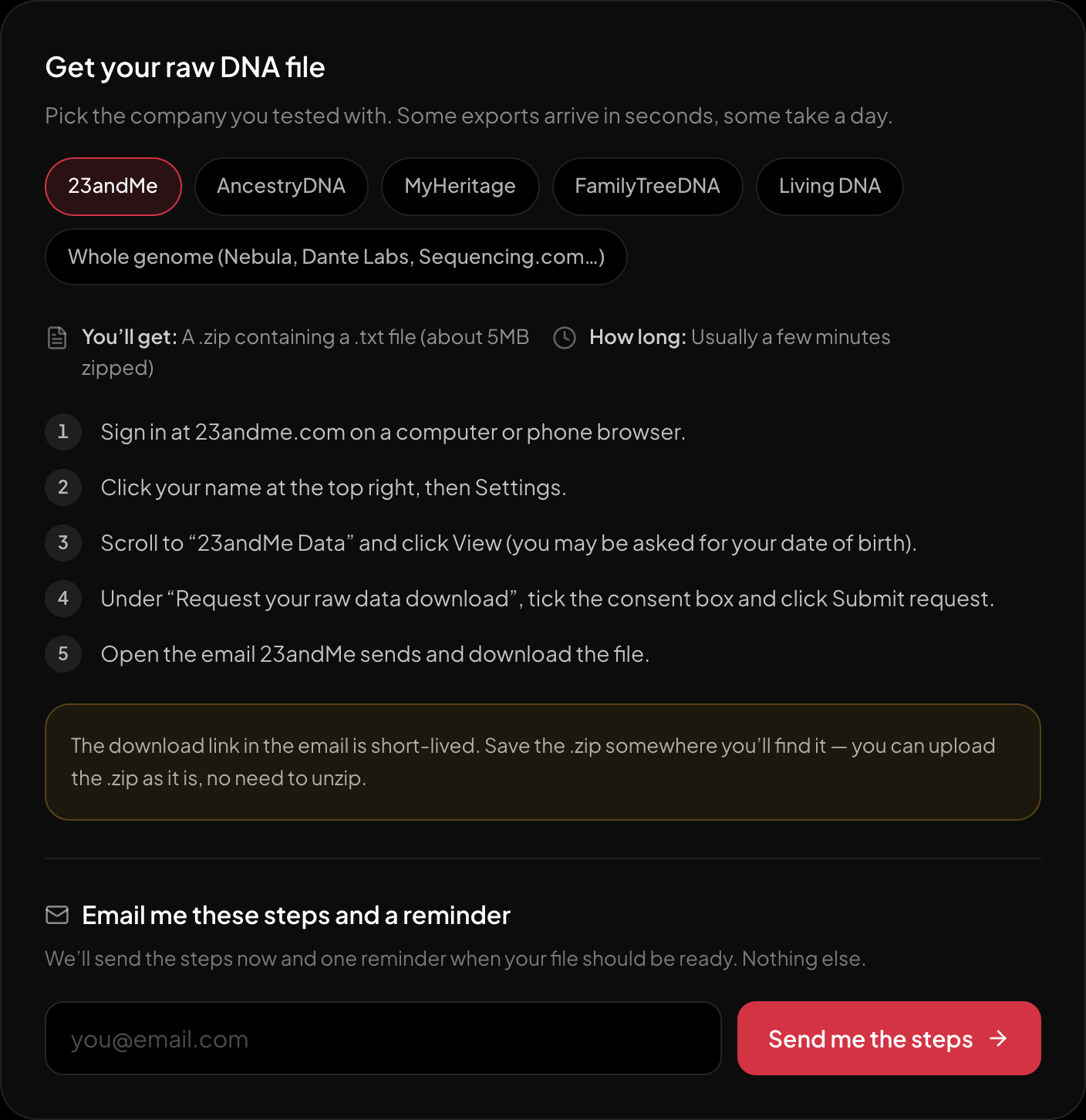
The download steps for 23andMe, on the page itself.
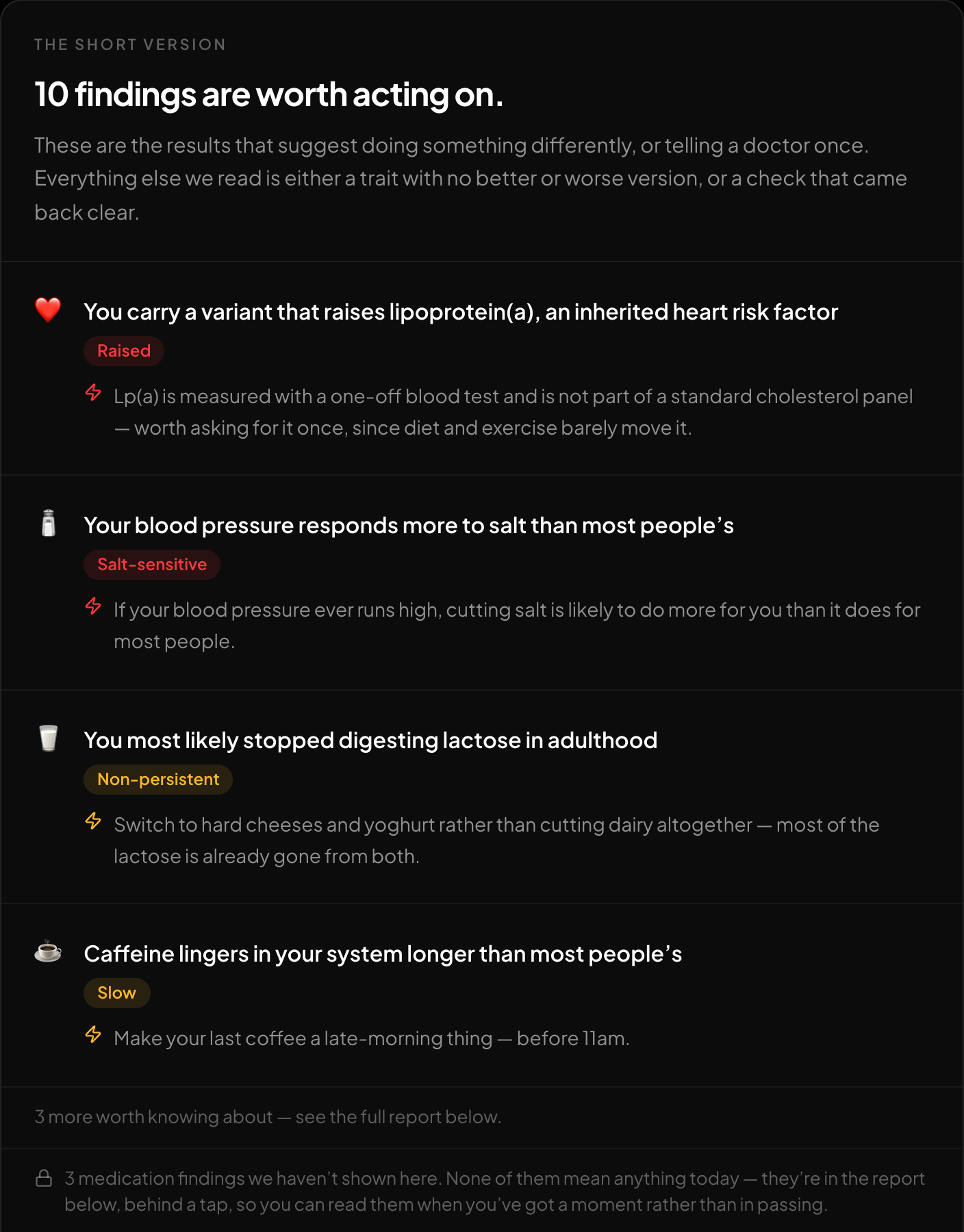
The short version: what is worth acting on, first.
If the checks pass and you want to see the file against your own life, the free DNA tool reads a 23andMe, AncestryDNA, MyHeritage or whole-genome VCF file in your browser. Its report already reads ABO blood group (ABO), eye colour (HERC2/OCA2), earwax (ABCC11) and lactose (MCM6/LCT), so you can compare those headlines with yourself without hand lookups. Everything reads in your browser; the genetic ancestry breakdown is optional and runs on the server only with your explicit consent, sending only the markers it needs.
New to raw DNA files? Start with the full guide: 23andMe Raw Data Interpretation Free in Your Browser
Written by
HealthOSX Research