How Do I Record My Grandparents Telling Our Family Stories on My Phone
Use your phone's voice memo app in a quiet room, ask permission, let them talk, note names as they are said, and back up the files. Then see what a DNA kit adds.
Open the Voice Memos app (iPhone) or your phone's built-in voice recorder (Recorder on Pixel phones, Voice Recorder on Samsung), sit in a quiet room with the phone on a table between you, and ask one warm question at a time. Get permission first, write down every name and place as it is said, and copy the files off the phone the same day.
How do I record my grandparents telling family stories on my phone?
Ask first, plainly, and say what it is for: "I'd like to keep your stories for the family. Is it all right if I record?" Some people freeze at a red button, and that is their call. If they say yes, say it again on the recording itself, with the date and where you are sitting.
Then set up:
- Use the built-in app. Nothing to install, nothing to learn halfway through a story.
- On iPhone, set Voice Memos to Lossless audio (Settings > Apps > Voice Memos > Audio Quality).
- Check your free storage before a long session. A recording that stops when the phone is full is a hard loss.
- Pick the quietest room you have. A phone microphone hears the fridge, the street and the television as clearly as a soft voice, and you cannot cleanly remove them afterwards. Noise reduction exists, but it harms soft voices.
- Put the phone on a table or cushion about an arm's length from the speaker. Holding it adds handling noise.
- For a soft or quiet speaker, consider an optional clip-on lavalier mic. It is the single biggest audio upgrade and it is cheap.
- Turn on Airplane Mode so a call cannot cut the recording. Airplane Mode stops calls but does not silence alarms on iPhone or Android, so check for alarms or timers set for the session window.
- If they agree, a video propped up on a shelf also keeps faces and hands, not just the voice.
- Record ten seconds and play them back before you begin.
Five questions that get the stories going
Start warm, not with dates. People remember a kitchen long before they remember a year.
- Where did you grow up, and what did the house or street look like?
- What was cooked on special days, and who did the cooking?
- Which names and places do you remember, even half of them?
- Who in the family moved, and why?
- Which story do you most want the grandchildren to know?
Let them talk, and write the names down
After the first question, mostly stay quiet. "And then what happened?" is a better prompt than any prepared list. Silence is fine. People often fill it with the best part.
Keep a notepad beside you. Write every name and place as you hear it, your best guess at the spelling, and the minute on the recording. Speech-to-text mangles surnames and village names, and the spelling is exactly what you will need later to search archives, passenger lists and old maps.
Voice Memos (iOS 18 and later) and Pixel Recorder can transcribe on the phone. Treat the transcript as searchable notes, not a record of spellings, which is why the notepad still matters.
The common mistake is correcting them. If a date is wrong, let it stand. The story is the point, and you can check the date afterwards.
When they tire, wander or contradict each other
Short sessions beat marathons. Half an hour is plenty for most people; stop while they are still enjoying it. Come back another day.
Old photographs work as prompts when the words dry up. Point at a face and ask who it is.
If two relatives remember the same event differently, record both and do not settle it at the table. Memory of old events is rebuilt each time it is told, so details drift. That drift is worth keeping too.
Back them up the same day
A voice memo lives on one phone, and phones get lost, dropped and traded in. The old 3-2-1 rule still works: three copies, on two kinds of storage, with one kept somewhere else.
In practice, the three copies are the phone, a computer and the cloud, and the cloud copy is the off-site one. A copy for a sibling is an extra on top of the three:
- Phone: leave the original where it is. That is copy one.
- Computer: copy the files over the same day. That is copy two. On iPhone use AirDrop or the Share sheet, on Android use USB or Google Drive.
- Cloud: put them in a cloud folder. That is copy three, and the off-site one.
- Sibling: give someone in the family a copy. This is an extra, beyond the three.
Rename each file so it makes sense later, with the person, the date and the place, for example Grandma-Leila_2026-11-10_kitchen.m4a. Photograph your notepad and keep that beside the audio.
What a DNA kit adds that memory cannot reach
Stories usually thin out around the great-grandparent generation. The names go first, then the places. DNA does not forget in that way, because you carry DNA from many of the people who came before, though not all of them, and a kit can read some of it.
Be clear about what this is not. The HealthOSX tool will not find named relatives or confirm that a specific person was your ancestor, so it will not settle a story about a named cousin. What it does is read your own DNA and describe deep, general patterns.
A genotyping kit estimates your ancestry as proportions across world regions, each with a range. It can show which ancient groups your DNA is most similar to, and that wording matters: similarity, not descent. It reads your maternal line from mitochondrial DNA and your paternal line from the Y chromosome, as haplogroups, which are deep lines and not names.
| A recording | A DNA kit | |
|---|---|---|
| Names, jokes and the voice itself | Yes | No |
| Why someone left home | Yes | No |
| Ancestry across world regions | No | Yes, with a range |
| Closest ancient groups | No | Similarity only |
| Maternal line | Only as far as names reach | Haplogroup (deep line), not names |
| Paternal line | Only as far as names reach | Haplogroup (deep line), not names, and only if the person has a Y chromosome |
Scroll the table sideways for the rest →
A recording and a DNA kit answer different questions.
The limits are real. Only people with a Y chromosome carry a Y line, so if you want a paternal line and do not have one, a father or brother would need to be tested. Ancestry percentages are statistical estimates that depend on the reference panel behind them.
Sometimes a result disagrees with the family story. Treat that as a new question, and ask it while your grandparents are still here to answer. Don't wait for a better moment.
Test the grandparents themselves while you can
If your grandparents are willing, the most useful DNA to test may be theirs, because it reads lines you cannot read from your own. Only your paternal grandfather carries your father's Y line; your maternal grandfather carries a different Y line. Only your mother's mother shares your mtDNA, so each of the other three grandparents adds one maternal mtDNA line you could not read from yourself.
A grandparent's DNA is their own data. Get their explicit consent, and agree beforehand who holds the file and who sees the results.
Where to take it next
Choosing a file. The report is read on your own device.
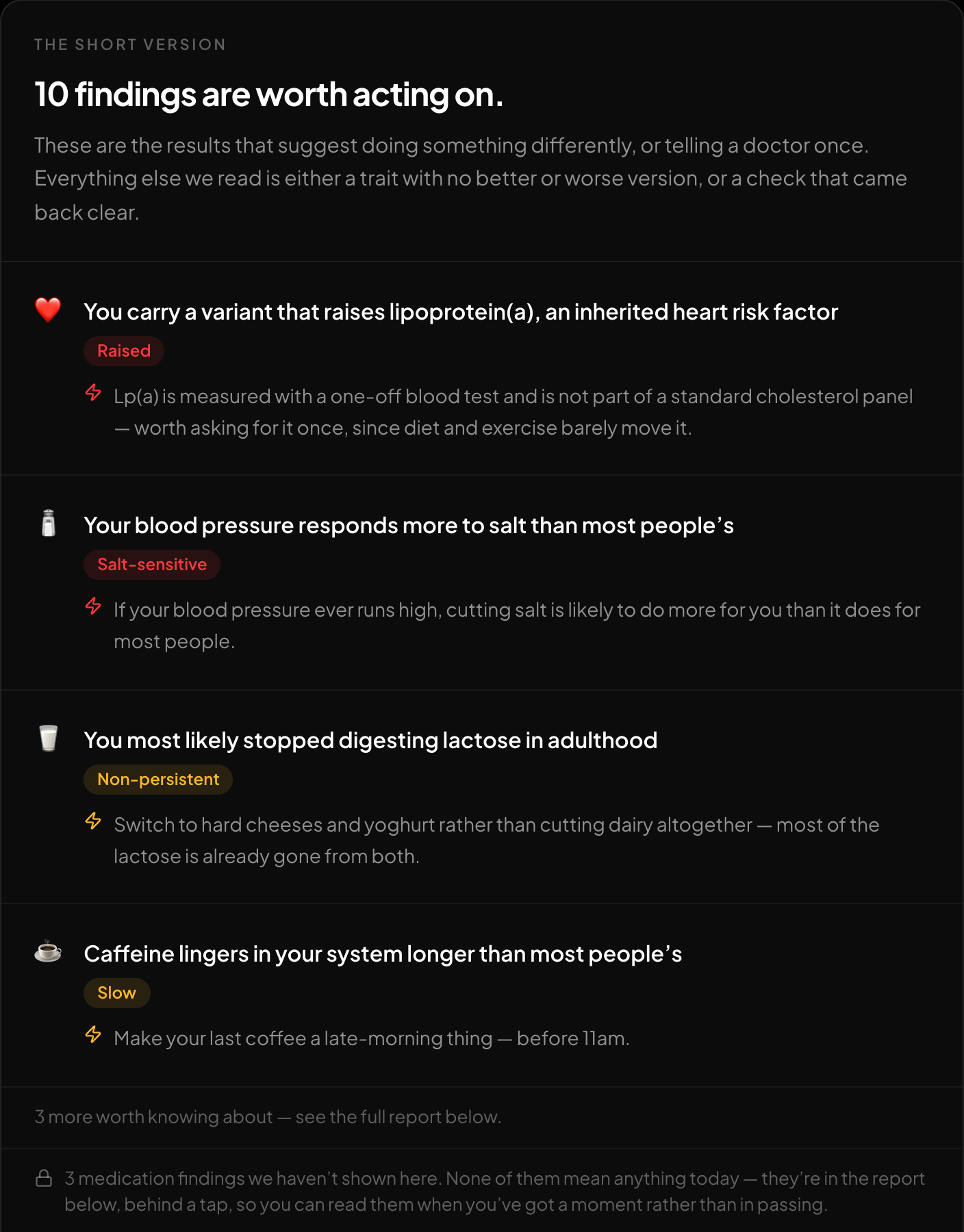
The short version: what is worth acting on, first.
If you already have a raw file from 23andMe, AncestryDNA or MyHeritage, the free DNA tool reads it in your browser. The genetic ancestry breakdown is optional: it runs on the server only with your explicit consent, and it sends only the markers it needs. It shows your ancestry, your closest ancient groups, and your maternal and paternal haplogroups. The sample report shows what that looks like. If you have no file yet, the HealthOSX DNA Kit is a saliva kit whose results land in a HealthOSX account; it covers ancestry and traits, not health.
New to raw DNA files? Start with the full guide: 23andMe Raw Data Interpretation Free in Your Browser
Written by
HealthOSX Research