What FOXO3 rs2802292 Means in Your 23andMe or AncestryDNA Raw Data and Is It the Longevity Gene
rs2802292 in FOXO3 shows as T or G in your raw file. G is linked to more very long-lived people, but it shifts odds and cannot predict your lifespan.
FOXO3 rs2802292 is a common single-letter variant in an intron of the FOXO3 gene on chromosome 6. In a 23andMe or AncestryDNA raw data file it appears as a pair of letters drawn from T and G, and the G allele is the one found more often in studies of centenarians and people past 95. That is a shift in odds across a population, and the largest estimates come from extreme-age designs. It is not a lifespan prediction, and FOXO3 is not the longevity gene.
Where rs2802292 sits in your raw file
A raw file is plain text with one line per marker. 23andMe gives rsid, chromosome, position and a two-letter genotype. AncestryDNA gives the same fields but splits the genotype into two columns, allele1 and allele2. Either way, open the file in a text editor, search for rs2802292, and you land on a chromosome 6 line.
- Look for the rsid, not a position. Positions depend on the genome build and differ between files.
- A pair like
TGorGGis a real result.--in 23andMe, or0in AncestryDNA, means the chip failed on that marker for you. - No line at all means the marker may not be on your chip version. That is a limit of the kit, not something wrong with your sample.
To check for this marker, search the file for the rsid, or look up one rsID at https://healthosx.com/dna/lookup.
What does my FOXO3 rs2802292 genotype mean
There are three possible results. The G allele is the one linked to longevity in the original reports.
| Genotype | Same pair on the minus strand | What the studies report |
|---|---|---|
| TT | AA | Baseline: no copy of G |
| TG | AC | One G: higher odds of very old age, smaller per-allele effect in German centenarians (Flachsbart 2009) |
| GG | CC | Two Gs: odds ratio about 2.75 vs TT in men aged 95+ (Willcox 2008). Extreme-age design, smaller in later replications |
Scroll the table sideways for the rest →
Forward-strand letters as reported by 23andMe and AncestryDNA. The minus-strand column shows what a flipped source would display.
The first signals came from two studies. Willcox and colleagues in 2008 found the G allele enriched in Japanese-American men from Hawaii who reached very old age, and linked it to healthier ageing. Comparing men aged 95 and over with controls, they reported an odds ratio of about 2.75 for GG versus TT. Flachsbart and colleagues in 2009 tested German centenarians and found the same direction of effect with a smaller per-allele odds ratio.
Two cautions go with the 2.75. It comes from an extreme-age case-control design, which compares the very old with ordinary-lived people and tends to give the biggest numbers. And it shrank in later replications. Cohorts of Italian and Han Chinese long-lived people reported the same direction of association, but not every cohort did, and results differed between studies.
The G allele is common in all five 1000 Genomes superpopulations (African, American, East Asian, European and South Asian), but its frequency differs between them, so the share of people with GG or TG depends on ancestry.
Reading it without strand confusion
FOXO3 sits on the forward strand of the reference genome, and 23andMe and AncestryDNA both report forward-strand letters. So you should see T and G. Both letters here have a different complement (T pairs with A, G pairs with C), which makes this variant easy to check. If your file or another website shows A or C, that source is using the opposite strand. Flip A back to T and C back to G before comparing.
The common mistake is the opposite one: reading a flipped result as a different genotype and concluding you have a variant you do not.
Why a G allele would matter: the mechanism
FOXO3 is a transcription factor, a protein that switches other genes on. When insulin and IGF-1 signalling is high, FOXO3 is tagged and held outside the nucleus. When signalling drops, as in fasting or cellular stress, it moves in and activates genes for stress resistance, autophagy and DNA repair. The worm gene daf-16 is the same kind of factor. In worms, daf-2 and age-1 were the first lifespan genes found, and daf-16 is the factor that daf-2 mutants need for their long life.
rs2802292 itself sits in a non-coding stretch, so it does not change the protein. The main regulatory evidence comes from Grossi and colleagues, who reported that the G allele creates a binding site for the stress-response factor HSF1 and raises FOXO3 expression under stress. That points to regulation of how much FOXO3 is made, not to the signalling switch itself. Which exact variant does the work is still not settled, because rs2802292 is inherited together with neighbouring variants. That matters, because your result is a marker for a stretch of DNA, not a lever you can see.
FOXO3 is a longevity gene, not the longevity gene
Lifespan is shaped by many genes with tiny effects, plus smoking, weight, infections, accidents and luck. How much of that is inherited is disputed. Ruby and colleagues in 2018 estimated the heritable share at about 7% or less, arguing that earlier twin-based figures were inflated by assortative mating. A 2026 paper in Science estimated about 50% heritability of intrinsic lifespan once extrinsic mortality is removed. The two estimates use different definitions and methods, so treat them as competing estimates, not a settled direction.
FOXO3 is one of the few loci replicated across populations in studies of extreme old age, alongside APOE, which is why it gets attention.
The evidence thins out in three places. The effect is clearest when comparing the very old with everyone else, and weaker for ordinary lifespan. Most data come from a few populations, mainly Japanese-American and European cohorts, so how well the effect carries over to your ancestry is less certain. And plenty of people who reached 100 carry no G at all.
What your genotype cannot tell you
- How long you will live. A population odds shift says nothing about one person.
- Whether to change your diet, fasting or training. No trial has tested habits by FOXO3 genotype.
- A clinical health finding. Willcox and colleagues in 2016 (Aging Cell, cause-specific mortality in the Kuakini Honolulu cohort) linked the G allele to lower coronary heart disease mortality, but that is a population finding. This variant is not a clinical result and is not in the HealthOSX report.
- Whether TT is bad. It is the comparison group, not a flaw.
The obvious follow-up is whether GG means you are protected from a poor lifestyle. It does not. Nothing in the data suggests the G allele offsets smoking or inactivity, and the studies were not built to show that.
A G at rs2802292 tilts the odds of reaching very old age. It does not set your lifespan.
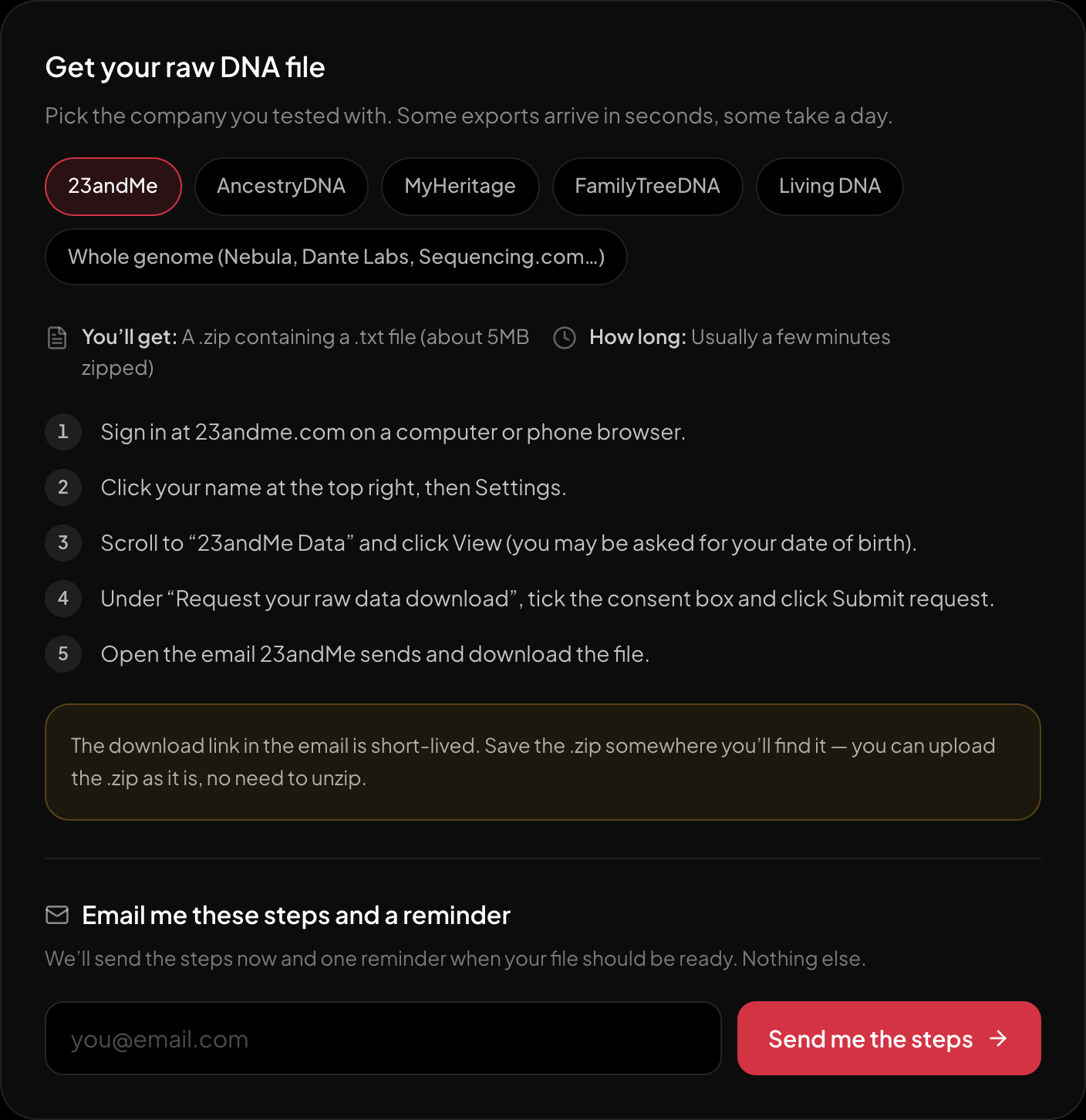
The download steps for 23andMe, on the page itself.
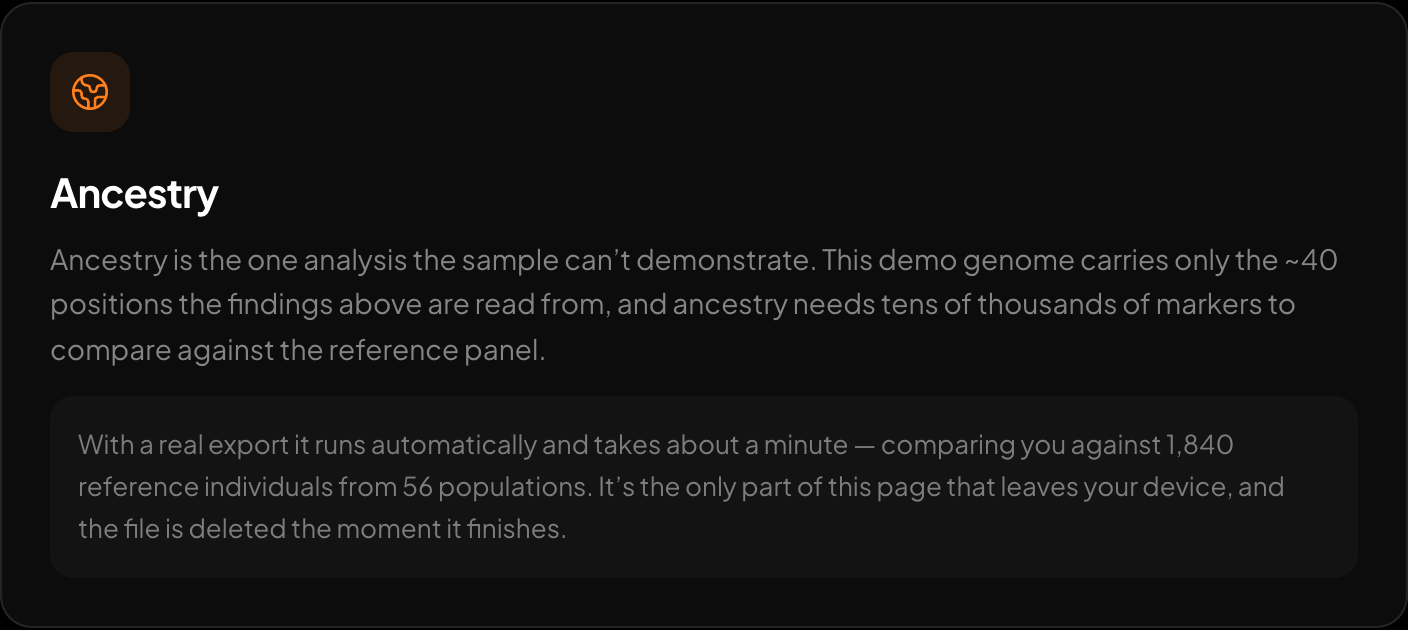
Ancestry across 15 regions and 157 reference populations.
FOXO3 is not one of the findings in the main report, so a lookup is the way to check this one variant: look up one rsID at https://healthosx.com/dna/lookup.
New to raw DNA files? Start with the full guide: 23andMe Raw Data Interpretation Free in Your Browser
Written by
HealthOSX Research