Can a DNA test show how I compare with Ötzi the Iceman?
A consumer DNA file can be compared with Ötzi and five other named ancients. The result is a percentile of similarity against living people, not descent or a family tie.
Yes, a raw DNA file from 23andMe, AncestryDNA or MyHeritage can be compared with a named ancient person such as Ötzi the Iceman. The free HealthOSX DNA tool does it for Ötzi, Loschbour man, the Stuttgart woman, La Braña man, Mota man and Sunghir 1. It reports a percentile that ranks your similarity to each of them among present-day people. It does not measure descent or kinship.
What the comparison reports
Each of these ancient genomes was sequenced from bone, teeth or tissue and published in a paper, listed in the table below. For each one, the tool reports where you fall as a percentile against present-day people.
So a 70th percentile reads as: you resemble that ancient genome more than about 70 in 100 present-day people in the reference set do. It says nothing about 70 percent of anything. And the reference set matters: the same file placed against a different set of living people could land on a different number.
| Person | Found in | About how old | Paper |
|---|---|---|---|
| Ötzi the Iceman | Alps, Italy and Austria | 5,300 years | Keller et al. 2012 |
| Loschbour man | Luxembourg | 8,000 years | Lazaridis et al. 2014 |
| Stuttgart woman | Germany | 7,000 years | Lazaridis et al. 2014 |
| La Braña man | Spain | 7,000 years | Olalde et al. 2014 |
| Mota man | Ethiopia | 4,500 years | Llorente et al. 2015 |
| Sunghir 1 | Russia | 34,000 years | Sikora et al. 2017 |
Scroll the table sideways for the rest →
Ages are approximate. Each genome was published in the paper listed.
Why a high percentile is not a family tie
Resembling Ötzi does not mean you descend from him. He lived about 5,300 years ago in the Alps, and his genome is one sample of a population, not a branch you can trace.
What a high score does reflect is shared population history. Ötzi's ancestry was dominated by early farmers whose roots lay in Anatolia, and people with a lot of that kind of ancestry tend to score higher. Loschbour man, from Luxembourg, represents hunter-gatherers of western Europe. The Stuttgart woman represents early farmers in central Europe. La Braña man is a Spanish hunter-gatherer. Mota man, from Ethiopia, anchors a deep East African lineage. Sunghir 1, from Russia, is an Upper Palaeolithic individual from tens of thousands of years back. Each one is a stand-in for a type of ancestry, and your percentiles show which stand-ins you resemble more than other living people do.
How this differs from the closest ancient groups list
The tool also lists your closest matches among 133 ancient groups from the AADR, such as Natufian hunter-gatherers, Neolithic Anatolian farmers and Viking Age Scandinavia. The two views answer different questions.
| Named ancient person | Closest ancient groups | |
|---|---|---|
| What it compares you with | One individual | An averaged group of many |
| How it is reported | Percentile against living people | Closest matches; groups that cannot be told apart are shown as equally close, not ranked |
| What it answers | How you rank against living people for one famous genome | Which ancient populations your genome sits nearest |
| Shows a family tie | No | No |
| Best for | A story with a paper attached | The broad pattern of your ancestry |
Scroll the table sideways for the rest →
Both are similarity, never descent.
A group is many people averaged into a profile, so it smooths out the oddities of any one body. A named individual is one person with one set of quirks, which is why it reads as a curiosity and not a conclusion. Use the group list to see the broad pattern. Use the named people when you want the story attached to a face and a paper.
Who tends to score high on which
The best-documented pattern comes from the Ötzi paper itself: Keller et al. 2012 found that present-day Sardinians are genetically closest to him. So people with a lot of early-farmer ancestry, such as Sardinians and people from parts of southern Europe, tend to place high on Ötzi. People with more hunter-gatherer ancestry tend to place relatively higher on Loschbour man or La Braña man. For Mota man, people with East African ancestry tend to place higher; most others place lower. A low result is not a bad one. It simply means those lineages sit apart from yours.
Here is an illustrative example, not a real person's result: someone with mostly southern European ancestry might see a 92nd percentile for Ötzi and a 12th percentile for Mota man. You can see real output in the sample report.
A percentile near 50 is just ordinary. A very high score is interesting and still only a similarity.
Where the comparison runs out
- Ancient DNA is damaged and patchy, so only some positions can be compared, and the number of usable sites differs by ancient genome and by the reader's file.
- A single genome cannot represent everyone who lived near it. Ötzi was one man.
- The number depends on the reference panel and may change if the panel changes.
- Nothing here is medical. It says nothing about your health, and Ötzi's famous cardiovascular and other findings do not transfer to you.
Do I need a file to try it?
Yes, you need a raw file, but the tool reads many kinds: 23andMe, AncestryDNA, MyHeritage, FamilyTreeDNA, WeGene, LivingDNA and whole-genome VCFs. Your file is first read in your browser. Ancestry, including the named-ancient comparison, then runs on the server and only with your explicit consent. That step sends the markers it needs, not the whole file, and keeps them with your result until you press "Delete my DNA data". If you are not sure your file will work, the file checker will tell you, and whole-genome VCFs without rsIDs still work for ancestry.
You need no account or email for the browser step, but the full report, where ancestry lives, needs a one-time email code.
If you have no file yet, the HealthOSX DNA Kit is a saliva kit whose results land in a HealthOSX account. It is a genotyping chip for ancestry and traits, not a health test. The HealthOSX Whole Genome (Europe only) sequences the whole genome at 30x for ancestry, lineages and the raw genome. It is also not a health test.
There is no relative-matching database.
Choosing a file. The report is read on your own device.
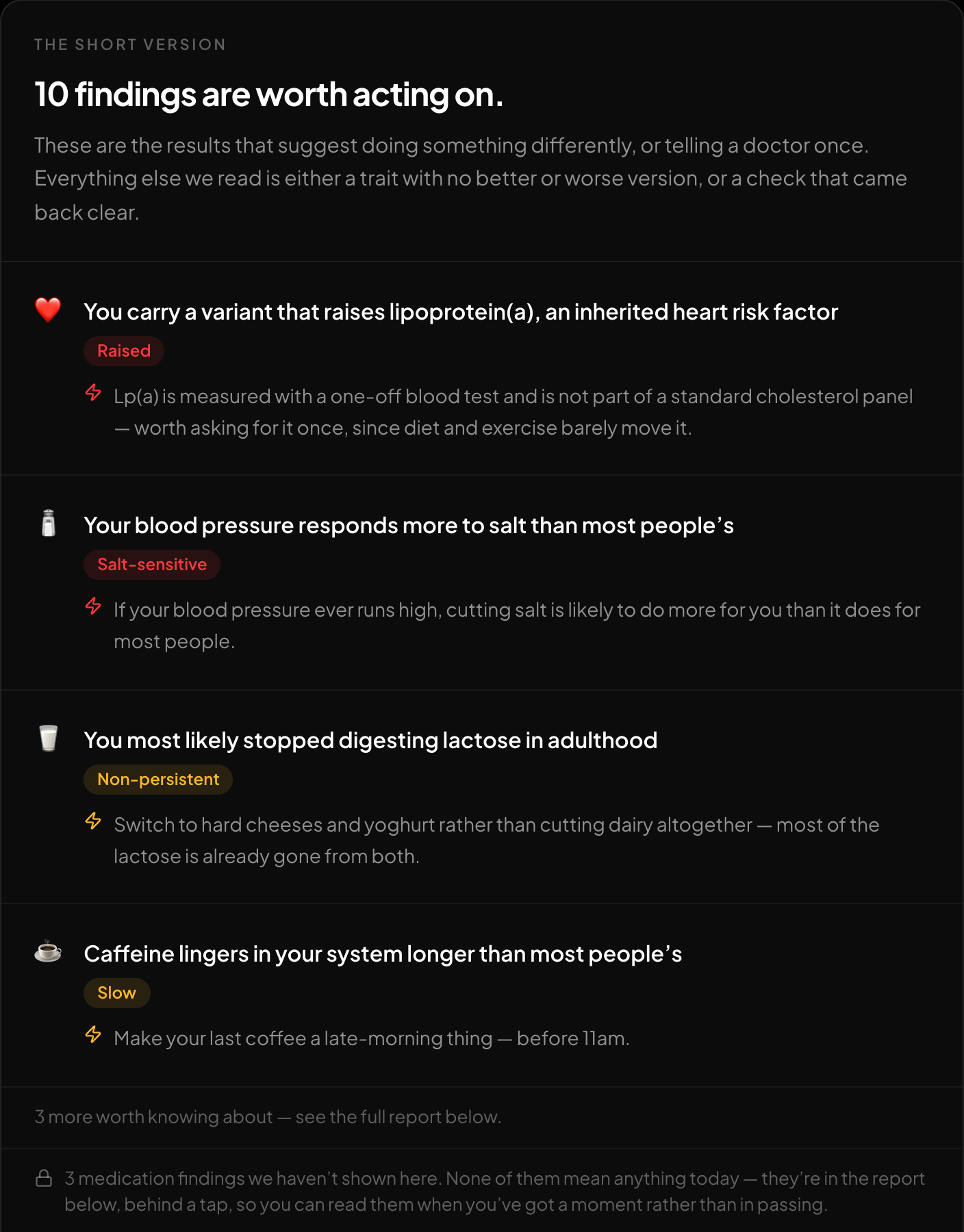
The short version: what is worth acting on, first.
To see your own percentiles for Ötzi and the five others, open the free HealthOSX DNA tool and drop in your raw file. Open the sample report to see what the named-ancient section looks like, then upload your own file.
New to raw DNA files? Start with the full guide: 23andMe Raw Data Interpretation Free in Your Browser
Written by
HealthOSX Research