What CYP4F2 rs2108622 V433M Means in Your 23andMe or AncestryDNA Raw Data and Warfarin Dose
CYP4F2 rs2108622 (V433M) nudges warfarin dose up by a few percent for CT and roughly 8 to 12% for TT compared with CC. It is a minor modifier, far smaller than VKORC1 and CYP2C9, and never a result on its own.
CYP4F2 rs2108622 (V433M) is a common variant where each T allele means a little less enzyme activity and, on average, a slightly higher warfarin dose: a few percent higher for CT and roughly 8 to 12% higher for TT than for CC. In a 23andMe or AncestryDNA file, CC is the typical result, CT carries one T and TT carries two. It is a minor dose modifier beside VKORC1 and CYP2C9, it says nothing about other blood thinners, and warfarin is dosed by a prescriber from an INR, not from a raw file.
What V433M actually does
Warfarin works by blocking VKORC1, the enzyme that recycles vitamin K so the liver can keep making working clotting factors II, VII, IX and X. Less recycling means slower clotting, which is the point. Vitamin K supply is the other half of that balance.
CYP4F2 is a liver enzyme that breaks vitamin K1 down and clears it. The rs2108622 change swaps one amino acid (valine to methionine at position 433), and the T allele goes with lower amounts of working enzyme. Less clearance leaves more vitamin K around, so warfarin has more to fight against. Carriers of T tend to need slightly more drug to reach the same anticoagulation. The effect is small because CYP4F2 acts on vitamin K supply, not on the drug target, which is what VKORC1 changes.
CC, CT or TT: how common each is and what it shifts
| Genotype | What it means | Typical effect on dose |
|---|---|---|
| CC | Two normal copies, usual enzyme activity | Baseline |
| CT | One V433M copy, somewhat lower activity | A few percent higher than CC |
| TT | Two V433M copies, lowest activity | Roughly 8 to 12% higher than CC |
Scroll the table sideways for the rest →
Approximate pooled averages from meta-analyses, mostly European-ancestry cohorts. Individual doses vary widely.
The T allele is common, and how common depends on ancestry. South Asian populations have the highest T frequency, around 0.4. In people of European ancestry it is about 0.3, in East Asian populations roughly 0.2 to 0.25, and in people of African ancestry about 0.1 or lower. So a CT or TT result is not rare and not a warning.
The effect sizes are approximate pooled averages from meta-analyses, mostly of European-ancestry cohorts, and individuals scatter widely around them. They compare TT with CC, as in the often-quoted Caldwell 2008 analysis, not one copy against none. They also line up with the 5 to 10% adjustment in the CPIC guideline. Someone with TT can sit at a lower dose than someone with CC because VKORC1, CYP2C9, age, weight, diet, other drugs and liver function all push harder than this one SNP.
How to find it in your raw data
Open the downloaded file in a text editor or spreadsheet and search for rs2108622.
- 23andMe: one row, with the genotype in a single column, for example
CT. Chromosome is 19. - AncestryDNA: one row, but the two alleles sit in separate columns, for example
CandT. - No row, or a no-call: that chip version did not carry it or the call failed. 23andMe shows
--, AncestryDNA shows 0 and 0. Absence is not a result. - G or A instead of C or T: 23andMe and AncestryDNA both report this SNP on the forward strand as C/T, so this mostly applies to other tools and converted files. Those can report the opposite DNA strand. G pairs with C and A pairs with T, so GA is the same thing as CT.
The variant sits on a consumer chip, which is fine here, since it is a single known position. These calls are usually reliable but can fail, so confirm a result with https://healthosx.com/dna/lookup or a clinical test.
Why it is small next to VKORC1 and CYP2C9
Dose prediction models built from large patient groups attribute most of the genetic part of warfarin dose to two genes. VKORC1 is the drug target, and its common promoter variant changes how much enzyme the liver makes at all. CYP2C9 clears the more potent form of warfarin, and slow-metabolising versions let the drug build up.
| Gene | Role | Share of dose variance (R²) |
|---|---|---|
| VKORC1 | Warfarin's target enzyme | About 20 to 30% |
| CYP2C9 | Clears active warfarin | About 5 to 15% |
| CYP4F2 | Clears vitamin K | About 1 to 2% |
Scroll the table sideways for the rest →
Approximate R² of dose variance from published dosing algorithms, varying by population.
The 2017 CPIC warfarin guideline update does include CYP4F2. It suggests raising the dose by 5 to 10% for rs2108622 carriers when dosing with a validated algorithm in patients who are not of African ancestry, and it does not use CYP4F2 for patients of African ancestry. So it is a small optional adjustment on top of CYP2C9 and VKORC1, which remain the core of the recommendation. If you read a CYP4F2 result alone, you have read the least informative line of the warfarin story. Someone could be CC and still need a low dose because of VKORC1, and the CC would not have told them.
Does it say anything about other blood thinners
No. Apixaban, rivaroxaban, dabigatran and edoxaban do not work through vitamin K, so a vitamin K enzyme variant is irrelevant to them. Clopidogrel is a separate question, handled by CYP2C19. Related vitamin K drugs such as acenocoumarol and phenprocoumon have some CYP4F2 data, but the evidence is thinner and varies by population.
Where the evidence thins out
Most warfarin dosing studies were done in people of European ancestry, so the size of the CYP4F2 effect is less certain elsewhere. And the benefit of any genotype is largest at the start of treatment. Once someone has been on warfarin for weeks and their INR is stable, the dose has already found its level by trial, and a genotype adds very little.
Trials of genotype-guided dosing have given mixed results. COAG (NEJM 2013) found no overall benefit from genotype-guided dosing over clinical dosing, and EU-PACT (NEJM 2013) reported better time in the target INR range with a genotype-guided approach. GIFT (JAMA 2017), which included CYP4F2 in its dosing algorithm, showed a modest benefit on a composite outcome of bleeding, high INR, venous thromboembolism and death. So this is still argued about.
The common mistake is reading TT as warfarin resistance or CC as a safe baseline. Neither is true. The INR, usually aimed at 2.0 to 3.0 for most indications, is what actually measures the drug's effect, and it settles over about a week as the clotting factors turn over.
What to do next
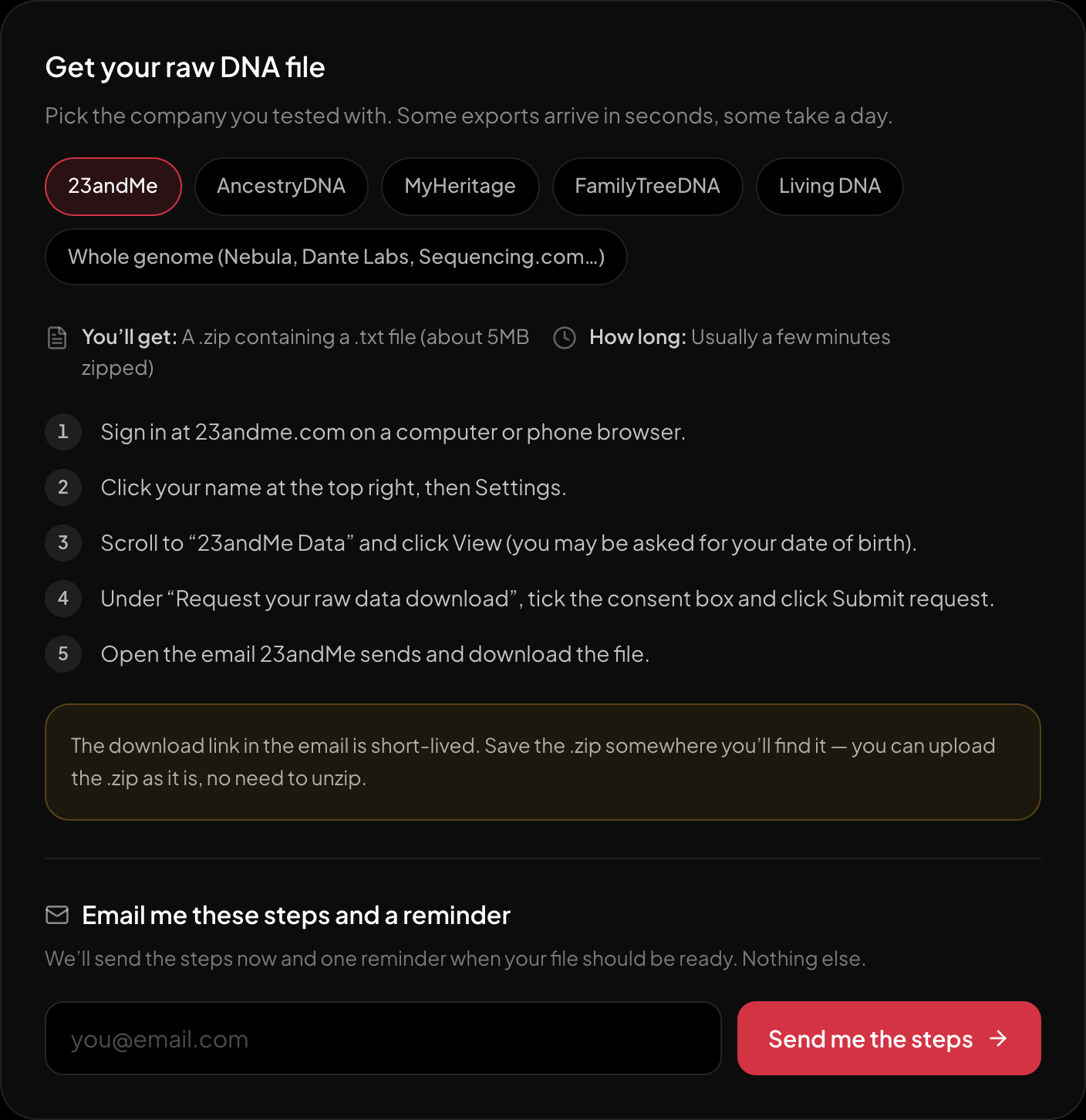
The download steps for 23andMe, on the page itself.
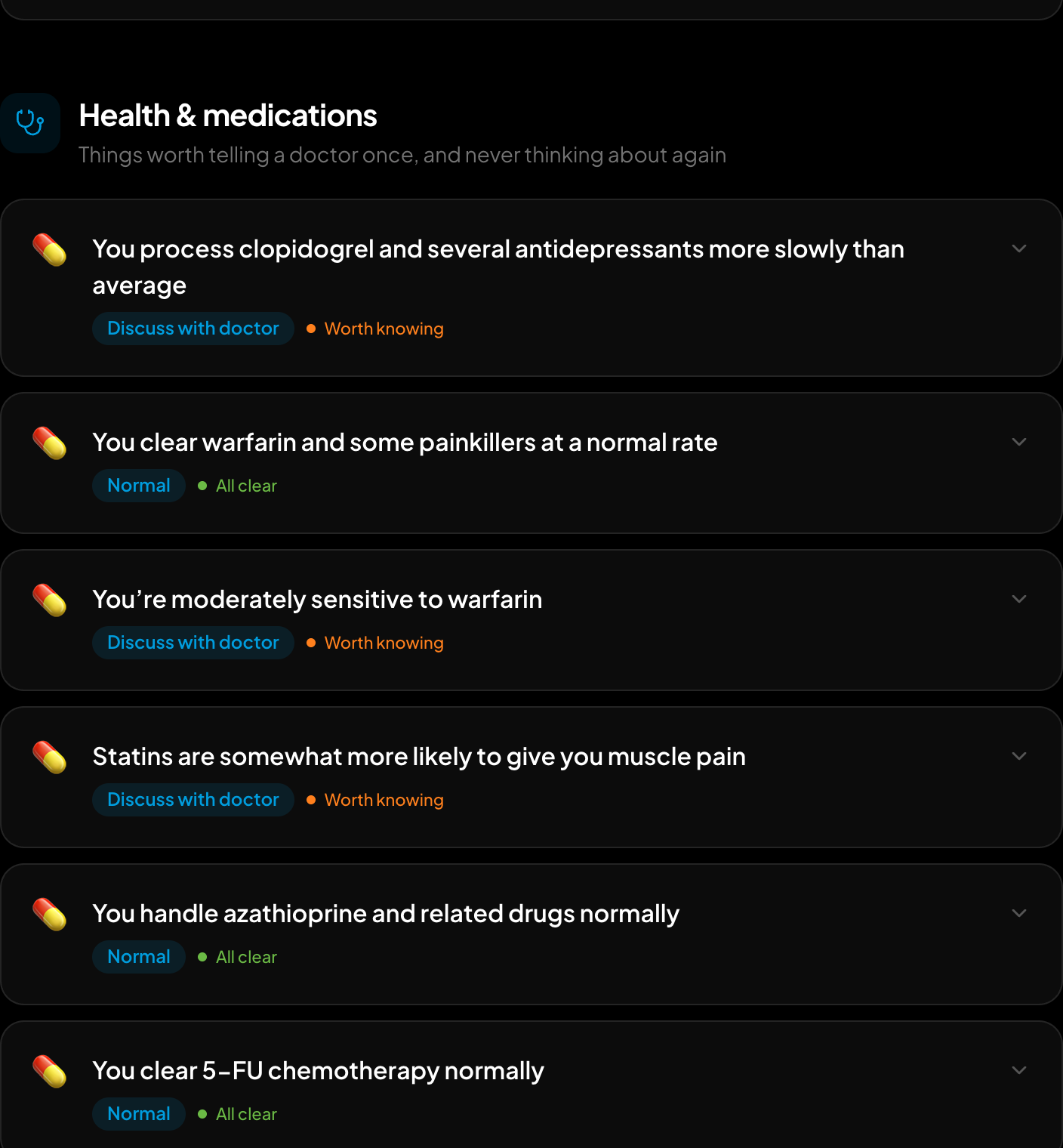
Medication genes, kept behind a tap rather than sprung on you.
If your file lacks the rs2108622 row, or you want the call checked, https://healthosx.com/dna/lookup looks up a single rsID. If you store your file in HealthOSX, you can also ask Ask your DNA to look up any variant, rs2108622 included. The free DNA tool reads a raw 23andMe, AncestryDNA, MyHeritage or whole-genome VCF file in your browser and lists medication response drug by drug. Its report itself does not cover CYP4F2, but it does cover CYP2C9 and VKORC1, the two genes that matter far more for warfarin. Bring those results to the person who manages your dose.
New to raw DNA files? Start with the full guide: 23andMe Raw Data Interpretation Free in Your Browser
Written by
HealthOSX Research