What CYP3A5 rs776746 (*3) Means in Your 23andMe or AncestryDNA Raw Data
rs776746 is CYP3A5 `*3`, the variant that switches the enzyme off. On the forward strand, CC means non-expresser and CT or TT means expresser. Here is how to read it in a 23andMe or AncestryDNA file, and what it can't tell you.
In a 23andMe or AncestryDNA raw file, rs776746 is the marker for CYP3A5 *3, a variant that stops the CYP3A5 enzyme from being made properly. On the forward (plus) strand that both companies report, CC is *3/*3, a non-expresser (the usual result for people of European ancestry), CT is *1/*3, an expresser, and TT is *1/*1, also an expresser. That label describes one enzyme, and the one place it routinely changes a prescription is the transplant drug tacrolimus.
What the *3 variant actually does
CYP3A5 is a liver and gut enzyme that breaks down drugs. It works alongside CYP3A4, which does most of the heavy lifting for the same substrates. *3 is a single-letter change deep inside the gene (in an intron, not in the part that codes for protein). That change creates a new splice site. The cell then splices the message wrongly, adds a stretch of sequence that should not be there, and ends up with a truncated protein that does not work. A small amount of correctly spliced message still gets made, which is why geneticists say "almost none" rather than "none".
The working version is called *1. It is the ancestral form of the gene, even though *3 is now the majority allele in Europe and East Asia. The *3 allele frequency is roughly 0.85 to 0.95 in European-ancestry populations, so about 80 to 90 percent of Europeans are *3/*3 and roughly 10 to 20 percent make a meaningful amount of enzyme. In East Asian populations *3 is at about 0.7, and in African-ancestry populations it is roughly 0.2 to 0.4 (all of these figures are approximate and vary by study). Other loss-of-function alleles, *6 and *7, also exist and are mostly seen in African ancestry. A chip that only checks *3 will miss them.
CYP3A5 rs776746 in 23andMe raw data: what it means
Open the raw file in a text editor (unzip it first if it came as a .zip). Each line is one marker. For 23andMe the columns are rsid, chromosome, position and genotype, so search for rs776746 and look for chromosome 7. AncestryDNA lays it out with the two alleles in separate columns, but the search is the same.
If the line is missing, that chip version did not test it, and there is nothing to read. If the genotype is -- or 00, the call failed. Neither is a result.
If you do have two letters, this is how they are usually taken:
| Genotype | Usual label | Enzyme made | Tacrolimus guidance (CPIC 2015) |
|---|---|---|---|
| `TT` (`*1/*1`) | Normal metabolizer (expresser) | Full amount | 1.5 to 2x the standard starting dose, max 0.3 mg/kg/day, then adjust by blood level |
| `CT` (`*1/*3`) | Intermediate metabolizer (expresser) | Some | 1.5 to 2x the standard starting dose, max 0.3 mg/kg/day, then adjust by blood level |
| `CC` (`*3/*3`) | Poor metabolizer (non-expresser) | Almost none | Standard starting dose, then adjust by blood level |
Scroll the table sideways for the rest →
Forward-strand letters. Labels follow CPIC terms for CYP3A5; "expresser" covers both of the top two rows. Tacrolimus dosing is a clinical decision.
Notice the middle row. One working copy is enough to make some enzyme, so "expresser" covers both of the top two rows, and that is why guidelines group heterozygous people with the full expressers for tacrolimus.
Reading the letters when companies use different strands
DNA has two strands, and the same position can be written as either one. For this marker the pair is C and T on one strand, or G and A on the other. G is C seen from the opposite side, and A is T. On the forward strand, C is the *3 allele and T is the working *1. If your file shows GG, AG or AA, it is the same result read the other way round.
| Forward strand | Opposite strand | Star alleles | Enzyme status |
|---|---|---|---|
| `CC` | `GG` | `*3/*3` | Non-expresser |
| `CT` | `AG` | `*1/*3` | Expresser |
| `TT` | `AA` | `*1/*1` | Expresser |
Scroll the table sideways for the rest →
The same genotype can be written on either strand. Forward-strand letters are the usual convention for 23andMe and AncestryDNA; check your file's strand if it differs.
This is the usual convention, not a guarantee. A company can change builds or strand handling. There is a quick sanity check: if you have European ancestry and your result reads as two working copies, suspect that you have the strand backwards before you suspect you are unusual. Looking the rsID up in a tool that states its strand, or in a clinical report, settles it.
It's about one enzyme, not your metabolism in general
The main reason anyone cares is tacrolimus, an immunosuppressant given after kidney, liver, heart and other transplants. Expressers clear it faster, so the same dose gives a lower blood level. The CPIC 2015 guideline, "Clinical Pharmacogenetics Implementation Consortium Guideline for CYP3A5 Genotype and Tacrolimus Dosing", recommends a starting dose 1.5 to 2 times the standard starting dose for normal and intermediate metabolizers (expressers), not exceeding 0.3 mg/kg/day, and the standard dose for poor metabolizers (non-expressers).
Two things stop that from being a prescription you can apply to yourself:
- Tacrolimus has a narrow window, so teams measure trough blood levels and adjust. Genotype only picks the starting point.
- In a liver transplant, the donor liver's CYP3A5 genotype matters alongside the recipient's own, because gut CYP3A5 and other tissues stay the recipient's. It does not replace it.
The common mistake is to read "non-expresser" as "poor metabolizer of everything". It is a statement about one enzyme, and for most drugs CYP3A4 and other factors (what else you take, grapefruit, liver function, age) move your blood levels more.
Does it matter for any drug other than tacrolimus?
Biologically, CYP3A5 handles many of the same drugs as CYP3A4, so in theory it could matter for some of them. In practice the clinical guidance is thin. Tacrolimus is the one with a clear dosing recommendation. For other drugs the evidence is weaker, still argued about, or limited to small studies, and I would not draw conclusions from a genotype alone. What is unknown is how much *3 shifts exposure to most other CYP3A substrates in real patients.
CYP3A5 *3 is a switch for one enzyme, and a consumer chip can show you the switch but cannot set a dose.What to do with the result
A raw-data result is a hint, not a lab test. Chips can miscall single positions, and clinical genotyping tests several CYP3A5 alleles together with documented quality control. If you are heading for a transplant, or already on tacrolimus, the transplant team decides whether to test and how to dose, and your blood levels will outrank any genotype. If you are only curious, the result is worth knowing and worth keeping in perspective.

The download steps for 23andMe, on the page itself.
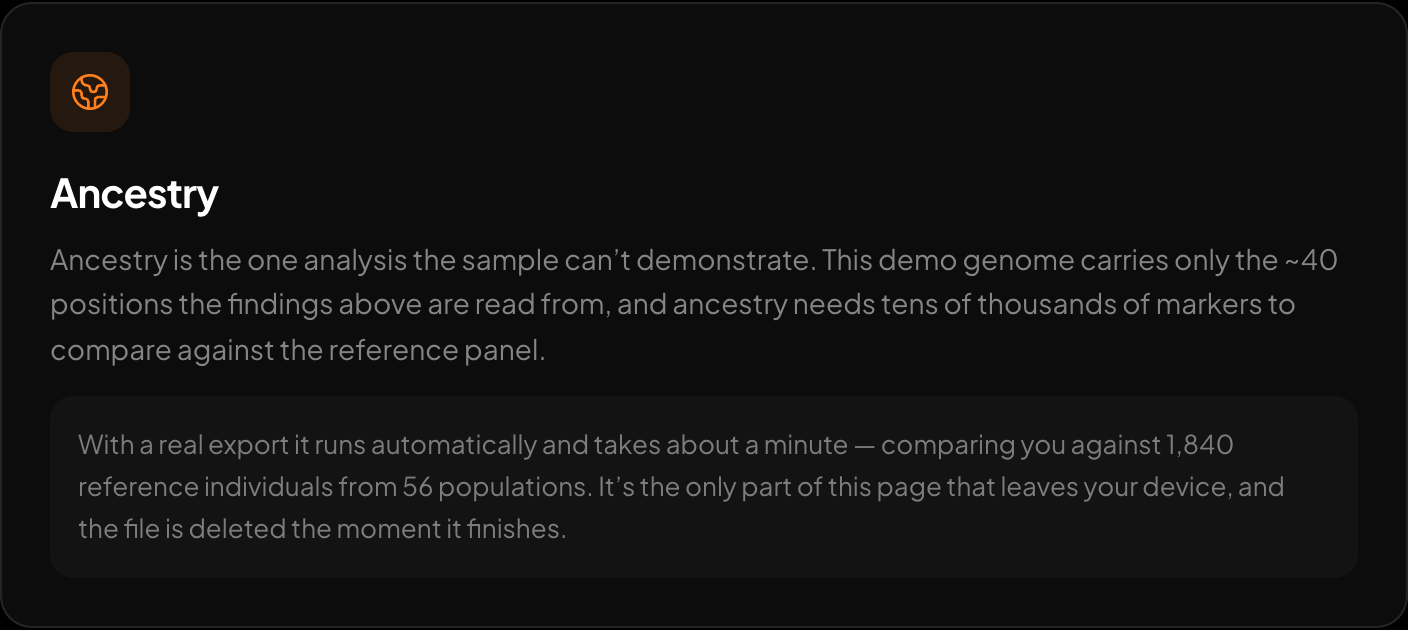
Ancestry across 15 regions and 157 reference populations.
HealthOSX has a free DNA tool for 23andMe, AncestryDNA and MyHeritage files. Its single-rsID lookup looks up rs776746 in your own file. CYP3A5 is not one of the findings in its full report, which does cover other drug genes such as CYP2C19, CYP2C9, SLCO1B1 and TPMT, so for this marker the lookup is the right route.
New to raw DNA files? Start with the full guide: 23andMe Raw Data Interpretation Free in Your Browser
Written by
HealthOSX Research