What CYP2D6 rs3892097 (*4) Means in Your 23andMe or AncestryDNA Raw Data and Does It Show Codeine or Tamoxifen Problems
rs3892097 marks CYP2D6*4, a dead copy of the gene. Here is what C/C, C/T and T/T mean in a 23andMe or AncestryDNA file, and why a chip cannot call codeine or tamoxifen response.
rs3892097 is the marker for CYP2D6*4, a splice-site change that stops the gene making working enzyme. 23andMe and AncestryDNA files are built on GRCh37, where it sits at chr22:42524947 (GRCh38: chr22:42128945), and it is reported as C>T on the forward strand, so most readers will see C/C, C/T or T/T. T/T points towards a CYP2D6 poor metabolizer: codeine and tramadol may give little pain relief and tamoxifen may be less well activated. One copy (C/T) usually means an intermediate metabolizer under the 2020 activity-score rules, but only if the other copy is normal, which the chip cannot confirm. A consumer file cannot give a full CYP2D6 result, so on its own it cannot tell you whether codeine, tramadol or tamoxifen will fail for you.
What rs3892097 actually is
CYP2D6 makes a liver enzyme that activates or clears a long list of drugs. The gene is written on the reverse strand, so the *4 allele is a single G to A change in the gene's own orientation, which appears as C to T on the forward strand used by your raw file. It sits at the junction between intron 3 and exon 4 (you will also see it written 1846G>A or c.506-1G>A). It destroys the splice site, the cell stitches the transcript together wrongly, and what comes out is not a usable protein. In the star-allele system it scores zero activity.
It is the most common no-function allele in people of European ancestry, carried on roughly one chromosome in five. That means about a third of Europeans carry at least one copy and a few percent carry two. It is much rarer in East Asian and African ancestry, where other alleles matter more.
Reading C/C, C/T and T/T
| Gene strand | Raw file (forward strand) | *4 copies | What it tells you |
|---|---|---|---|
| G/G | C/C | 0 | No *4, but other alleles unseen |
| G/A | C/T | 1 | One dead copy: intermediate if the other copy is normal (activity score 1), other allele unknown |
| A/A | T/T | 2 | Both copies dead, poor metabolizer very likely |
Scroll the table sideways for the rest →
Forward-strand letters are what 23andMe and AncestryDNA report. The gene is read on the opposite strand, so C pairs with G and T with A.
The table shows both spellings side by side. Your file will normally use the forward-strand letters in the second column. If a tool shows the gene-strand letters instead, match your row using the first column. Not every chip version carries this marker at all, so a missing line means no information, not a normal result.
Am I a poor metabolizer for codeine or tamoxifen from my 23andMe raw data?
A T/T call (A/A on the gene strand) almost always means no working enzyme, because 4/4 and 4/5 are both poor metabolizers. Even so, consumer-array calls in CYP2D6 can be wrong because of the look-alike gene CYP2D7, so confirm the result clinically before anything changes. C/C tells you much less, for reasons in the next section.
The C/T question comes up most. Under the 2020 CPIC/DPWG activity-score consensus, *4 plus one normal allele has an activity score of 1.0, which is classed as an intermediate metabolizer, not normal. The catch is that the other allele is still unknown. It could be normal, reduced, absent or duplicated, and the chip cannot say which.
The mechanism is what makes this matter. Codeine and tramadol are prodrugs: CYP2D6 converts codeine into morphine and tramadol into its active metabolite, and that product does the pain relief. With no working enzyme you get the parent drug and little pain control. For poor metabolizers, CPIC advises choosing another painkiller. For intermediate metabolizers, CPIC advises label-recommended dosing and watching for poor pain relief, switching to a different drug if relief is inadequate. The opposite problem is the ultrarapid metabolizer, who makes morphine too fast, and regulators warn against codeine in children after tonsil surgery and in breastfeeding mothers for that reason.
Tamoxifen works similarly. CYP2D6 converts it to endoxifen, the form that blocks the oestrogen receptor strongly. For poor metabolizers, CPIC (2018) prefers an aromatase inhibitor where one is suitable (with ovarian function suppression if premenopausal). Where an aromatase inhibitor is contraindicated, CPIC suggests considering 40 mg/day of tamoxifen. The higher dose raises endoxifen in poor metabolizers but does not bring it to normal. The CPIC tamoxifen guideline already counted activity score 1 (1/4) as intermediate, so if you read C/T the intermediate advice applies to you: CPIC suggests considering an alternative to tamoxifen, or the higher dose where an aromatase inhibitor cannot be used. Whether low CYP2D6 activity actually worsens cancer outcomes is still argued, because trial analyses have disagreed. Do not stop or change tamoxifen because of a raw file. That decision belongs to the oncology team.
What a chip cannot see
| True diplotype | Chip shows (forward strand) | Real metabolizer status |
|---|---|---|
| *1/*1 (activity score 2) | C/C | Normal |
| *1/*5 (one gene deleted, activity score 1) | C/C | Intermediate (activity score 1) |
| *1/*1x2 (three working copies, activity score 3) | C/C | Ultrarapid |
Scroll the table sideways for the rest →
Illustrative only, not real people's data. The chip shows the same letters at rs3892097 in every row.
CYP2D6 is one of the hardest genes to read. It has a near-identical neighbour, CYP2D7, and the two swap sequence. A chip tests single letters at chosen positions. It does not count copies, which is why the same chip letters can sit on very different real genotypes, as the illustrative example shows.
- Deletions (5).* One chromosome has no gene. A person with 1/5 shows C/C, which looks normal, but has an activity score of 1 and is an intermediate metabolizer. Someone with 4 on one chromosome and a deletion on the other can show a single letter that reads as T/T, which happens to be right.
- Extra copies. Ultrarapid status is around 1 to 2 percent in northern Europeans and noticeably higher in parts of North Africa and the Arabian peninsula.
- Hybrid genes. CYP2D6/CYP2D7 fusions are invisible to a one-letter test.
- Other star alleles. 10 is very common in East Asians, 17 in people of African ancestry, 41 and 3 and *6 elsewhere. Chip coverage of them varies by version.
So C/C at rs3892097 does not mean normal. It means this one dead allele is absent.
Other medicines can make you a poor metabolizer anyway
Genotype is only half of the picture. Strong CYP2D6 inhibitors such as paroxetine, fluoxetine and bupropion can make a genetically normal person behave like a poor metabolizer for as long as they take them. That matters for tamoxifen in particular, since antidepressants are common in that group. A clean genotype and a poor phenotype can sit in the same person.
One T at rs3892097 is a dead copy of CYP2D6. It is not a full CYP2D6 result.
What to do with the number
- Bring the rsID and your letters to a pharmacist or prescriber, and say plainly that it came from a consumer file.
- If a decision is pending (long-term codeine or tramadol, or starting tamoxifen), ask specifically whether the test reports copy number (deletions and duplications) and the main star alleles.
- Tell them every drug you take now, antidepressants included.
- Do not change or stop any prescription yourself on the strength of the file.
The file is a good reason to ask the question. It is not the answer to it.

The download steps for 23andMe, on the page itself.
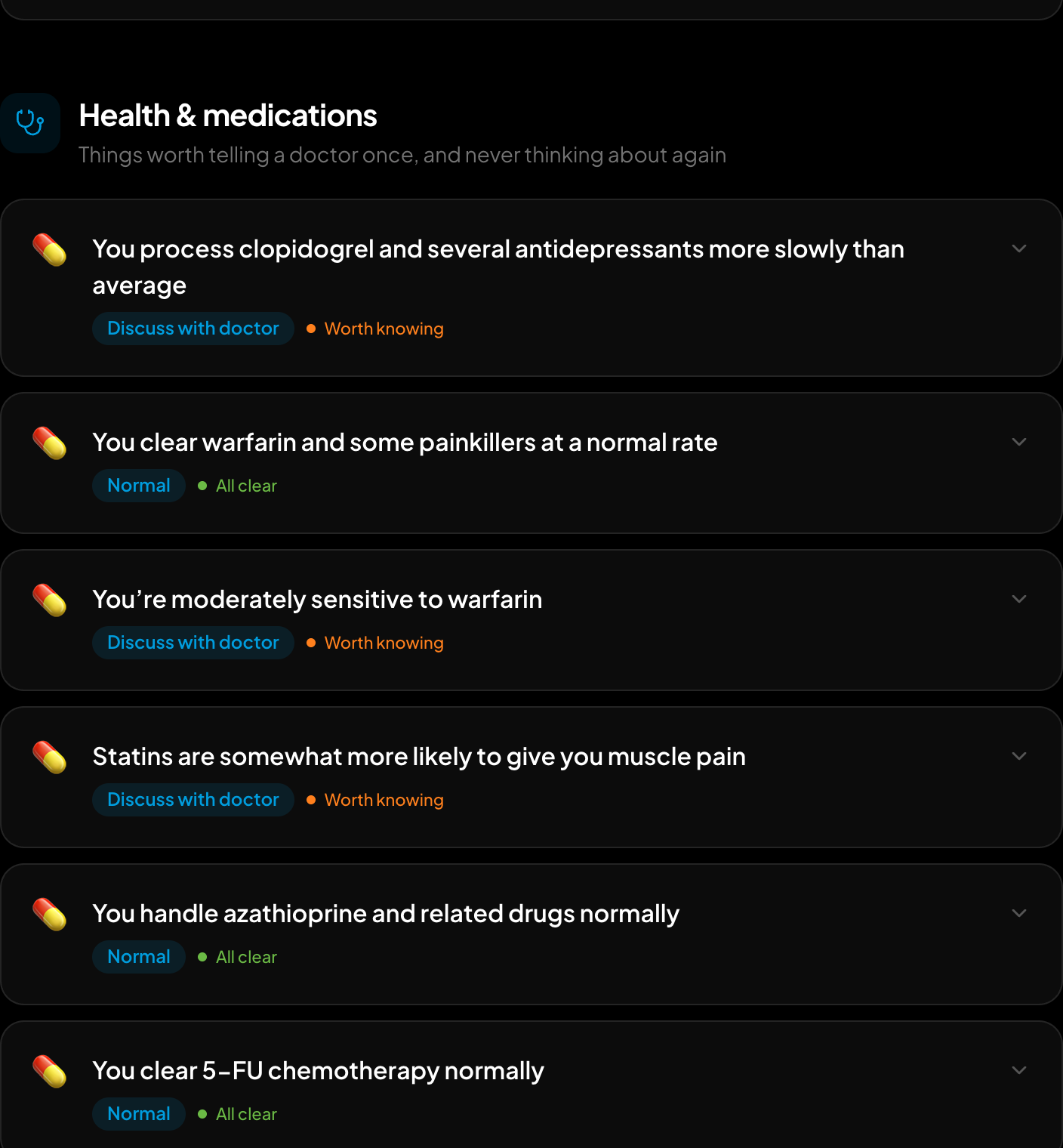
Medication genes, kept behind a tap rather than sprung on you.
To check rs3892097 in your own file for free, use the HealthOSX rsID lookup, which looks up one rsID at a time. The free report at HealthOSX DNA reads a 23andMe, AncestryDNA, MyHeritage or whole-genome VCF file in your browser and covers CYP2C19, CYP2C9, SLCO1B1 and the other listed pharmacogenes, so medication response is shown drug by drug from CPIC guidance. CYP2D6 is not among the findings in the free report, so for this gene the pharmacist conversation above is still the route.
New to raw DNA files? Start with the full guide: 23andMe Raw Data Interpretation Free in Your Browser
Written by
HealthOSX Research