What Does a Comma in the ALT Column of My Whole-Genome VCF Mean, and Why Do I See Genotypes Like 1/2
A comma in the VCF ALT column lists several alternate alleles, and GT numbers point into that list: 0 is REF, 1 the first ALT, 2 the second. So 1/2 is two different non-reference alleles.
A comma in the ALT column of a VCF means the site has more than one alternate allele, and the numbers in the genotype (GT) are positions in that list: 0 is REF, 1 is the first ALT, 2 is the second. So 1/2 means you carry two different non-reference alleles, one on each chromosome copy, and 0/2 means one reference copy plus the second ALT.
Reading GT at a site with two ALT alleles
Take a line where REF is A and ALT is G,T. Number the list from zero with REF first: 0 is A, 1 is G, 2 is T. GT is just two of those numbers, one per chromosome copy. A slash (/) means the copies are unphased, so you cannot tell which number sits on which parent's chromosome. A pipe (|) means the order is meaningful.
| GT | Bases on the two copies | What it means |
|---|---|---|
| 0/0 | A / A | No alternate allele |
| 0/1 | A / G | One reference copy, one first ALT |
| 0/2 | A / T | One reference copy, one second ALT |
| 1/1 | G / G | Two copies of the first ALT |
| 1/2 | G / T | Two different non-reference alleles |
| 2/2 | T / T | Two copies of the second ALT |
Scroll the table sideways for the rest →
Illustrative site. The numbers index the list REF, ALT1, ALT2.
1/2 is heterozygous with no reference copy. The two alleles differ from each other, and both differ from the reference.
Why would a site carry two alternates? Because more than one non-reference base was seen at that position. In a single-person file that can be you, with a different change on each copy. In a file that was joint-called with other people, the second ALT may come from someone else entirely, and your own GT can be a plain 0/0 or 0/1 while the ALT column still lists both.
Count from zero: 0 is REF, 1 is the first ALT, 2 is the second, and every number in GT points into that list.
Other genotype questions
- GT values above 2 work the same way. With three ALTs, 1/3 means the first and third ALT, one on each copy.
- A half-call such as ./1 means one copy was not called and the other carries the first ALT. It is not the same as 0/1 or 1/1.
- 1/2 where allele 2 is
*is one copy with the ALT and one copy deleted, so it is not a compound heterozygote at that base (see the next section).
* means this copy is deleted here, not a base
In VCF 4.2 and later, a * in ALT means the allele is absent because an upstream deletion spans this position. Say one of your copies has a deletion that removes bases 101 to 104. Another variant sits at 103 on your other copy. The record at 103 then reads ALT T,*, and GT 1/2 means one copy carries T while the other has no base here at all.
With * as allele 2, a GT of 0/2 means one reference copy and one copy where the base was deleted. The deleted copy has no base here, and the finding lives on the deletion's own record, which starts at an earlier position, at its anchor base. Treat the * as "no base on this copy", not as a base you can look up.
What <NON_REF> or <*> in ALT means in a gVCF
If your file is a gVCF (often named .g.vcf.gz), you will see <NON_REF> (GATK) or <*> (bcftools, DeepVariant) in ALT. This is not the same as the * deletion allele above. It is a placeholder for any allele not explicitly listed, kept so that files can be merged and joint-genotyped later.
Two kinds of record use it. A reference block is a record whose ALT is only <NON_REF> or <*>, with an END= tag in INFO covering a stretch of bases. A line with ALT G,<NON_REF> is a site record, not a block: it has one real alternate allele, G, plus the placeholder.
Before using lookup tools, either keep only the records with a non-reference call, for example bcftools view -i 'GT!="0/0"' in.g.vcf.gz, or convert the gVCF to a plain VCF first.
Why looking up only the first ALT gives a wrong answer
A tool or script that reads ALT as just G and ignores everything after the comma will get real people wrong. Using the A to G,T site:
- GT 2/2 is T/T, but a first-ALT lookup sees no G and calls it reference.
- GT 0/2 is A/T, but a first-ALT lookup sees no G and calls it reference.
- GT 1/2 is G/T with no A, but a first-ALT lookup reports G/G or G/A depending on the script.
This matters most when the variant is the clinically interesting one. If the allele you care about is the second ALT, the first-ALT shortcut turns a carrier into a non-carrier.
Splitting multi-allelic lines with bcftools
The standard fix is to split each multi-allelic record into one record per ALT, so every line is biallelic. In bcftools:
bcftools norm -m-any -Oz -o split.vcf.gz in.vcf.gzsplits them.bcftools norm -m+anydoes the reverse and joins them back.- Adding
-f reference.faalso left-aligns indels, which makes deletions comparable across files.
bcftools default writes the other allele as 0 (reference); check your version.
Two cautions. After splitting, the same position appears on two lines, so anything that matches by position has to handle both, and a script that reads only the first line at a position will miss the second. And the 1/2 genotype has to be rewritten on each new line. The bcftools default writes the other ALT as 0, meaning reference, so 1/2 becomes 1/0 on the G line and 0/1 on the T line. Your split file will therefore show 1/2 as two heterozygotes, which looks like a reference copy that is not actually there. Behaviour can differ between versions, so run one line you already understand through it and read the result before trusting a whole genome.
The other comma lists on the same row
The ALT column is not the only place commas appear, and they follow the same ordering:
ACandAFin INFO: one value per ALT.AD(allelic depth): one value per allele including REF. So0,18,21means 0 reads for A, 18 for G, 21 for T. A 1/2 call with 18 and 21 reads behind the two alleles is far more convincing than one with 2 and 40.PLandGL: one value per genotype, in the order 0/0, 0/1, 1/1, 0/2, 1/2, 2/2.
The limits
An unphased GT (with /) cannot tell you which allele sits on which parent's chromosome, and even a phased call only says so for the variants in that file. Multi-allelic sites, deletions and repeats are also exactly where callers disagree most, so two pipelines can give different genotypes for the same person. Before acting on a clinical finding at such a site, check the read evidence, for example in IGV.
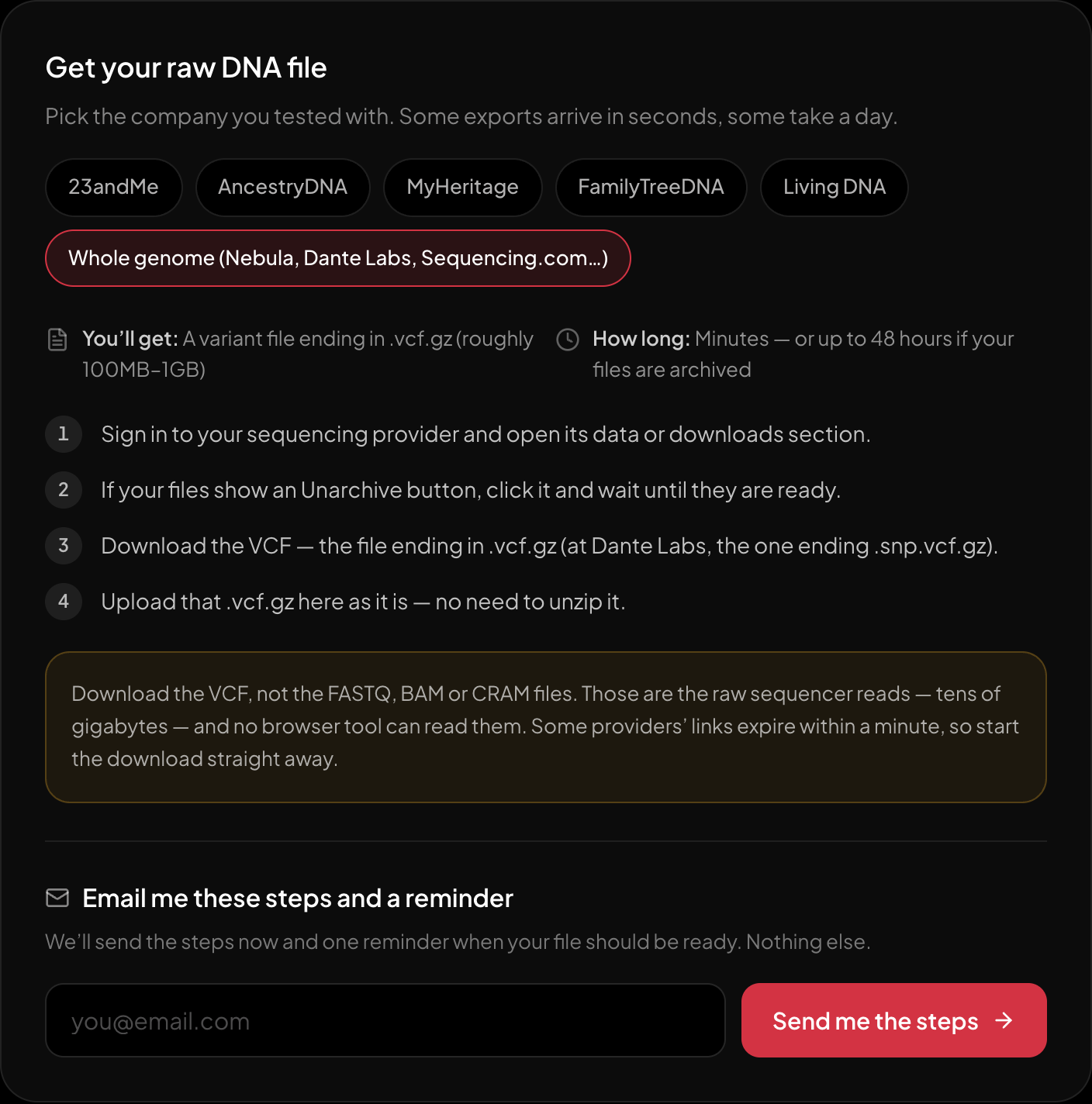
The download steps for whole-genome sequencing, on the page itself.
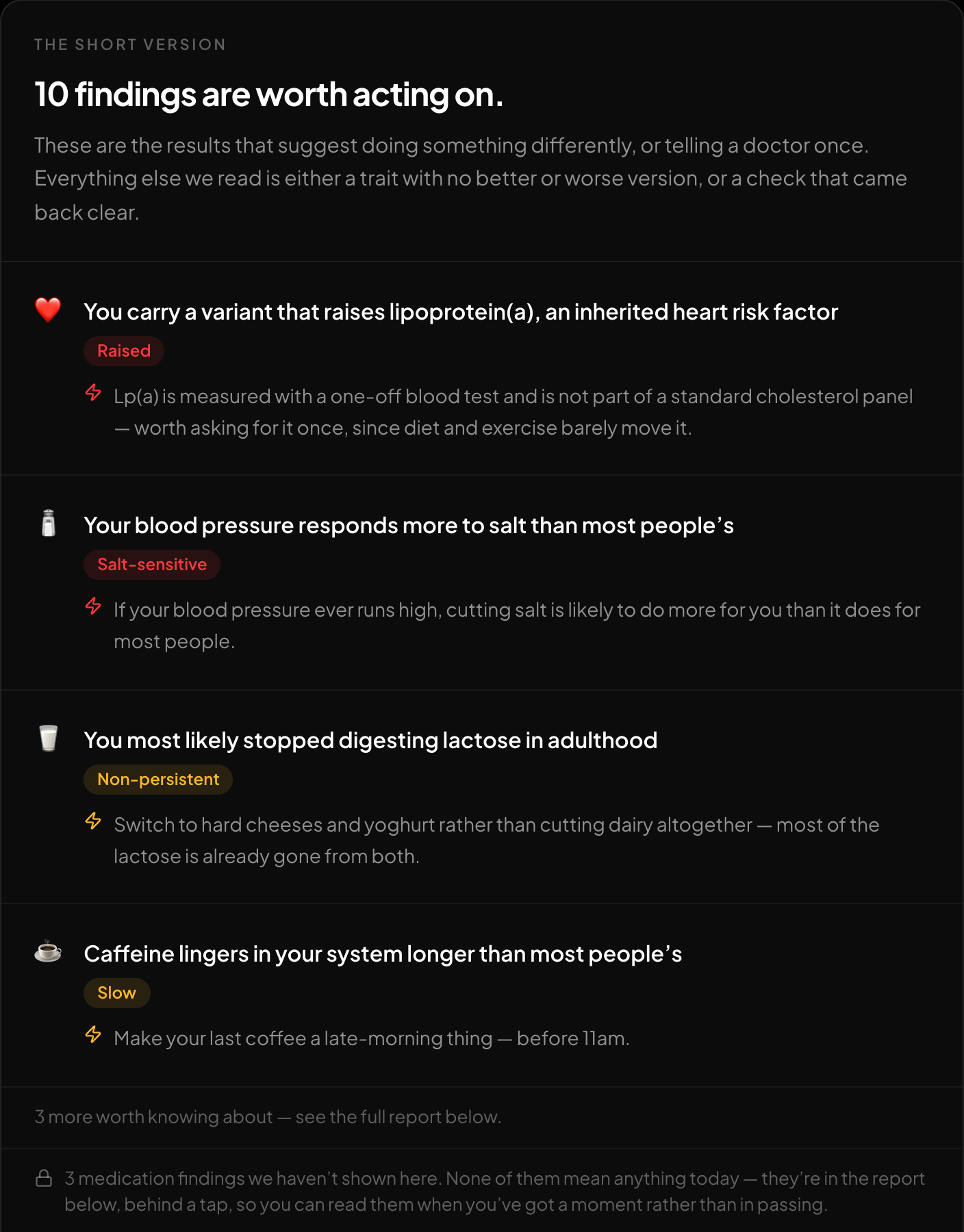
The short version: what is worth acting on, first.
If you would rather see the result than parse it by hand, the free reader at healthosx.com/dna takes a whole-genome VCF (.vcf or .vcf.gz) and reads it in your browser, reporting traits, medication response and carrier-relevant findings. To check a file first, use healthosx.com/dna/check, and to look up one rsID, use healthosx.com/dna/lookup. Whole-genome VCFs are also screened in the browser against ClinVar for pathogenic or likely pathogenic variants. A clear panel is not a diagnostic all-clear.
New to raw DNA files? Start with the full guide: 23andMe Raw Data Interpretation Free in Your Browser
Written by
HealthOSX Research