Does Cilantro Taste Like Soap Because of OR6A2 and Can My 23andMe Raw Data Show It
rs72921001 near OR6A2 is linked to cilantro tasting soapy. The A allele goes with slightly lower odds, the C allele with slightly higher. It sits in your 23andMe raw data, but it only nudges the odds and cannot predict your taste.
Partly. And yes, if your chip version includes it, you can look it up in a 23andMe raw data file, but the result is a nudge and not a verdict. The variant rs72921001 sits near the olfactory receptor gene OR6A2 on chromosome 11. In a study of 23andMe customers, the minor A allele went with lower odds of saying cilantro (coriander) tastes like soap, and the C allele with higher odds. Carrying either one moves the odds a little. It cannot tell you what cilantro tastes like to you.
How to find rs72921001 in your raw data
Both 23andMe and AncestryDNA let you download the raw file. The steps below are written for 23andMe, with the AncestryDNA difference noted.
- 1.Download the raw data from your account settings and unzip it. It is a plain text file, so any text editor opens it.
- 2.Search for
rs72921001. A 23andMe line has four columns: the rsID, the chromosome (this one is 11), the position, and your genotype as two letters in one column. An AncestryDNA line has five columns, because the two alleles sit in separate columns (allele1 and allele2). - 3.Read the two letters. A or C are the ones you expect here.
If the search finds nothing in a chip file, your chip version did not include that position. That is not a result, it is a gap. Chips differ between versions and between companies, so I would not assume either company's file has it.
A whole-genome VCF is different. Many of them list only positions that differ from the reference, so a missing rs72921001 line usually means you carry the reference allele at that spot, not that the position was not read. Check how your file was produced before relying on that.
What each genotype means
| What you carry | Approximate odds of a soapy taste vs CC | |
|---|---|---|
| CC | No copy of the A allele | Comparison group (1.0) |
| AC | One copy of the A allele | About 0.8 times the CC odds |
| AA | Two copies of the A allele | About 0.65 times the CC odds |
Scroll the table sideways for the rest →
Direction only, illustrative. Letters as read on the 23andMe forward strand. The A allele goes with lower odds of a soapy taste and C with higher. Relative odds are derived from an odds ratio of about 0.81 per A allele (Eriksson 2012) and are approximate. Each row is a change in group odds, not a prediction for one person.
The table above is the whole interpretation, and it shows direction only. Each copy of the A allele goes with somewhat lower odds of a soapy taste, so two copies of A is the group least enriched for it, one copy sits between, and two copies of C is the group most enriched. Check the strand if your file comes from somewhere other than 23andMe, because the same variant can be written as the complementary letters (T for A, G for C) on the other strand.
The crucial word is enriched. Plenty of people with two C alleles love cilantro, and plenty with two A alleles think it tastes like a bar of hand soap. The genotype changes how many people in a group say so, not what any one of them experiences.
Why one common variant only nudges the odds
The finding is from Eriksson et al., 2012, which ran genome-wide association analyses within 23andMe cohorts of European ancestry. About 14,600 people answered the soap question and about 11,850 the like/dislike question, with overlap between the two groups. rs72921001 stood out for the soapy-taste phenotype, with an odds ratio of about 0.81 per A allele and a p value of about 6e-9.
To scale that nudge, look at the population numbers. Mauer and El-Sohemy (2012) measured cilantro dislike, not soapy taste, and found that disliking cilantro ranged from about 3% to 21% by ancestry. A per-allele odds ratio near 0.8 is small next to that spread, so a single variant cannot account for it.
Three limits keep the result modest:
- The variant is common, and common variants usually carry little effect each.
- The study population was of European ancestry, so the effect may not carry over to other groups.
- rs72921001 is a marker in a region packed with olfactory receptor genes. It points at OR6A2 as the likely player, but nobody has pinned down the exact causal change.
OR6A2 is a receptor that responds to aldehydes, which also give many soaps and lotions their scent. So the story hangs together: a receptor tuned a bit differently, a molecule it catches, a smell that reads as soap. But hangs together is not the same as proven end to end.
The smell chemistry and what you ate as a kid
Most of what you call taste is smell, carried up the back of your throat while you chew. That is why a blocked nose flattens a meal, and why cilantro is a smell problem more than a tongue problem.
The soapy note is attributed to aldehydes in the fresh leaf. One suggested explanation, popularised by Harold McGee, is that crushing or chopping the leaves lets plant enzymes break some of them down, which would explain why a pounded paste can taste milder than a whole sprig. It is not a well-established mechanism. Cooking changes things too, and people who dislike raw cilantro often tolerate it in a sauce.
Then there is exposure. People raised on cilantro-heavy food tend to like it, and some people report the soapy note fading after repeated tries. How much exposure can override the variant is not settled. I would treat it as plausible, not as a method.
A common variant near OR6A2 shifts the odds of a soapy taste. It does not decide what your cilantro tastes like.
Does the free report cover OR6A2, and can Ask your DNA answer it?
The free HealthOSX report does not. Its findings list has no entry for OR6A2. The nearest relatives are TAS2R38, which explains why broccoli tastes different to different people, and OR2M7, which concerns smelling asparagus in urine.
What does exist is Ask your DNA, the chat on top of the report. If you chose to store your file, you can ask it whether you will like coriander. It answers from a polygenic score, placed among the 2,504 people of 1000 Genomes. That is a relative position, not a prediction. A chip file is first completed by imputation against 1000 Genomes, which takes about ten minutes. Without a stored file the chat only sees a short summary, so it cannot compute the coriander score.
Common mistakes with this result
- Reading AA or CC as a yes or no. Neither tells you how you will react.
- Mixing up the direction. The A allele goes with lower odds of a soapy taste, the C allele with higher.
- Treating a missing rs72921001 line as a negative result. In a chip file it is a gap, and in a variants-only VCF it usually means the reference allele.
- Forgetting the strand when a file lists the complementary letters.
- Assuming it is fixed. Preparation and repeated exposure both seem to change how the leaf reads.
The cheapest test remains a leaf. Chew one fresh, then try the same herb crushed into a paste. If the two differ, the aldehyde chemistry may be doing some of the work.
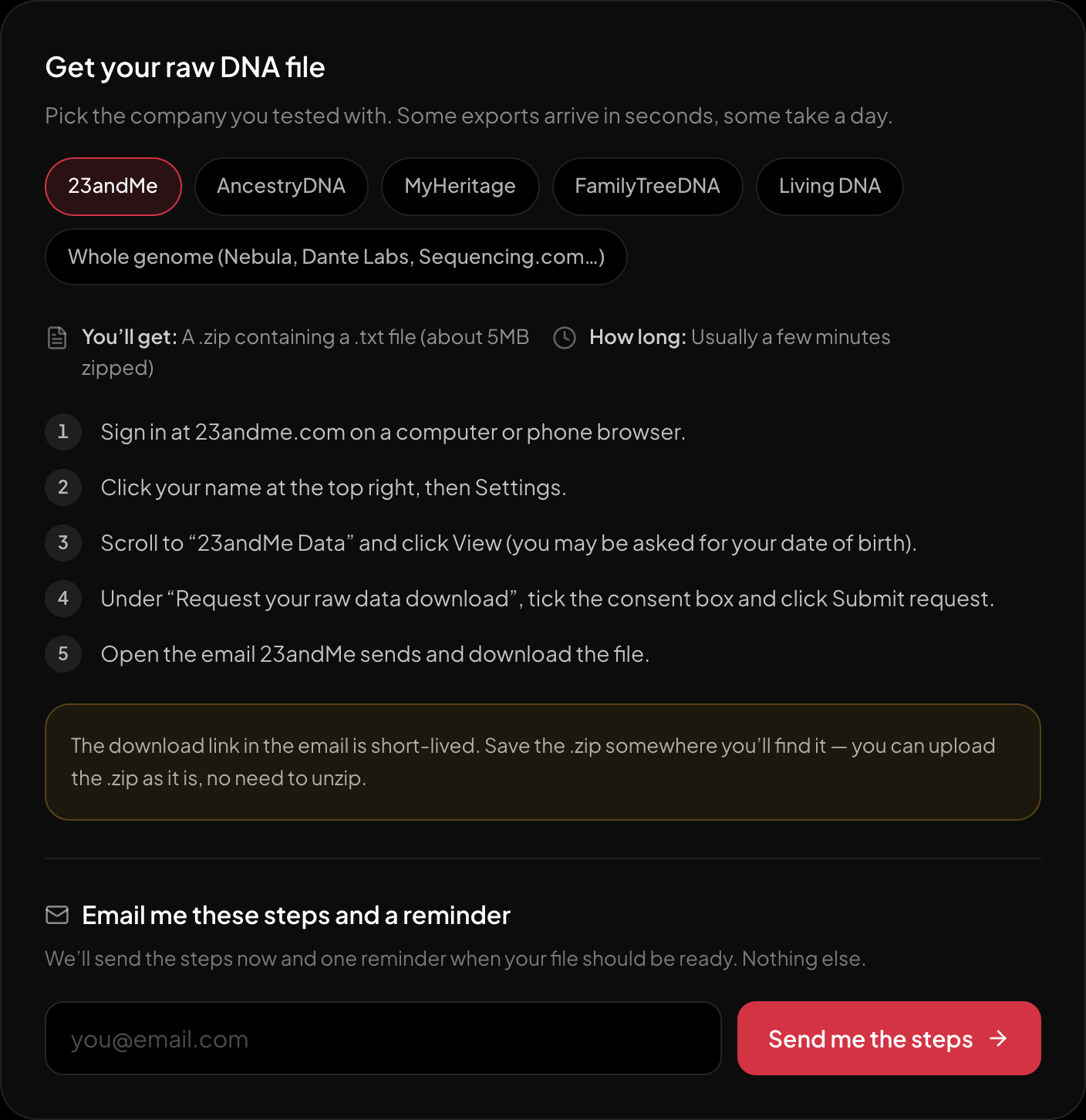
The download steps for 23andMe, on the page itself.

The short version: what is worth acting on, first.
To look up this one variant, paste the rsID into healthosx.com/dna/lookup. For the coriander tendency itself, store your file and ask Ask your DNA. Separately, the free report at healthosx.com/dna reads a 23andMe, AncestryDNA, MyHeritage or whole-genome VCF file in your browser and reports traits, medication response and carrier-relevant findings. Cilantro will not be on that list, but you will see what a single variant can and cannot say about you.
New to raw DNA files? Start with the full guide: 23andMe Raw Data Interpretation Free in Your Browser
Written by
HealthOSX Research