Can a DNA Test Tell Me If I Am Amazigh or Arab
A DNA test cannot sort you into Amazigh or Arab, because both are language and cultural identities. It can show your North African, Levantine and Arabian shares, among others.
No DNA test can tell you whether you are Amazigh or Arab, because neither word is a genetic category. They describe language, culture and how a family sees itself, and most North Africans carry a blend: a local North African component plus Levantine or Arabian shares, and often smaller sub-Saharan and European shares. What a test can do is show how much of that blend you have, and a few lineage markers, such as Y haplogroup E-M81 and mtDNA U6, lean toward the older North African side.
Why Amazigh and Arab are not two genetic boxes
Amazigh (Berber) means a family of languages and the people who speak or descend from speakers of them. Arab, in North Africa, mostly means Arabic-speaking and tied to the Arabic language and the Islamic expansion that reached the region from the 7th century. A second wave, the 11th-century Banu Hilal migration, brought more Arabic speakers, so "Arab migration" is not a single date. Language spreads faster than genes. Whole communities switched from Amazigh languages to Arabic over centuries without being replaced, and some Arabic-speaking families have more local ancestry than some Amazigh-speaking ones.
So the genetic picture is a gradient, not a border. Population studies such as Henn et al. 2012 and Arauna et al. 2017 describe ancestry that changes gradually across North Africa, with Middle Eastern related ancestry generally increasing toward the east. People who call themselves Arab can have a large North African component, and people who call themselves Amazigh often have some Levantine or Arabian share from centuries of contact, marriage and migration. A test can describe your genome. It cannot hand you the label.
What a good ancestry result actually shows
It can tell you what proportions your DNA resembles, and that is the useful part. A good result separates regions that many tests lump together:
- North Africa: ancestry that looks most like present-day populations of the Maghreb, which includes the older local component.
- Levant: ancestry closest to people in Lebanon, Syria, Palestine and Jordan.
- Arabia: ancestry closest to people on the Arabian Peninsula.
Two more shares are common in Maghreb genomes and can surprise readers. A sub-Saharan African share and a European or Iberian share both turn up in many results. They are not errors.
Someone with a high North Africa share and small Levant and Arabia shares fits the common pattern for Maghreb families, whichever language they speak at home. A larger Arabia share can reflect Arab migration into the region, though it can also come from other contact, and the test cannot tell which. Many consumer tests lump these regions together or use sparse panels, which can hide the split you are asking about.
Illustrative only. These are made-up examples, not real people or real averages, and the segment names are illustrative rather than the tool's own region names. Person A could speak Arabic and Person B Tamazight: the language at home does not follow the blend.
What Y-DNA E-M81 and mtDNA U6 can suggest
The Y chromosome follows the father's father's line, and only men carry one. Women can read only their mtDNA, or would need a father or brother to take the test to see a Y line. The mitochondrial DNA follows the mother's mother's line, and everyone has it. Each is one thread out of the hundreds of ancestors you have, so each is a clue and never a verdict.
For men, Y haplogroup E-M81 is common in many Maghreb populations and much less common in most other regions. Studies of North African Y chromosomes, such as Bosch et al. 2001 and Arauna et al. 2017, find it reaching very high frequencies in some Amazigh-speaking groups, while it is lower in Egypt and the Levant. It is widely treated as a marker of the local paternal ancestry. If you carry it, your direct paternal line probably stayed in North Africa a long time. Many Arabic-speaking North Africans carry it too.
mtDNA U6 is a maternal lineage that is found mostly in North Africa, and it is more common in some Berber-speaking groups than elsewhere. Across the Maghreb it is a minority of maternal lines, and the exact share varies a lot from one population to the next, so check the study for your group rather than trusting a single number. Having it points to deep local maternal roots. Not having it means very little, since most North Africans carry other maternal lineages.
The common mistake is reading one haplogroup as your whole ancestry. A man with E-M81 can have a mother, grandmothers and great-grandfathers from anywhere. The line is real, but it is a thin slice.
| Signal | What it reads | What it can suggest | What it cannot say |
|---|---|---|---|
| North Africa region share | Whole genome | How much matches Maghreb populations | Your language, your identity, or which migration brought which share |
| Y haplogroup E-M81 | Father's father's line (men only) | Deep local paternal roots | The other 99% of your ancestors |
| mtDNA U6 | Mother's mother's line | Deep local maternal roots | The other 99% of your ancestors, or anything if you lack it |
| Levant and Arabia shares | Whole genome | Contact with the east, date unknown | Which migration or century it came from |
Scroll the table sideways for the rest →
Lineage markers are single threads of ancestry, not totals.
What no test settles
- Whether you "are" Amazigh or Arab. That is identity, and your family and community decide it.
- Which ancestors came when. A consumer ancestry result does not date when the mixing happened, so it cannot tell you which migration brought which share.
- A tribe, a village or a named people. Reference panels are groups of present-day volunteers, not tribes.
- Exact percentages. Every share has a range, and small shares of a few percent are often noise.
Still argued about: how much of the Arabian and Levantine share arrived with the Islamic expansion and how much came earlier through trade, Phoenician and other contact. The data fits more than one story.
If your result looks "too mixed" or surprises you
That is common, not necessarily an error. A mixed result like the two imaginary ones in the figure above would not mean the test failed, since Maghreb ancestry is itself a blend. Check the range on each share before you worry, because a 4% with a ±4 is not a finding. Your closest reference populations and PCA position are often easier to read than a pie chart, because you can see where you sit among real groups.
Amazigh and Arab are things you speak and belong to. DNA can only show the mix underneath.
Reading your own file for free
If you already tested with 23andMe, AncestryDNA, MyHeritage or similar, you do not need to buy another kit. The free tool at healthosx.com/dna reads the raw file. It reports North Africa, Levant and Arabia as separate regions with a ± range on each share. It also reads your mtDNA and Y haplogroup (men only) on your device. How deep each call goes depends on which markers your chip carries, so a Y line may stop at a broader parent branch such as E-M35 (or E-L19 if your chip has it) rather than reaching E-M81. Ancestry runs on the server and only with your consent, so look at that screen before you agree.
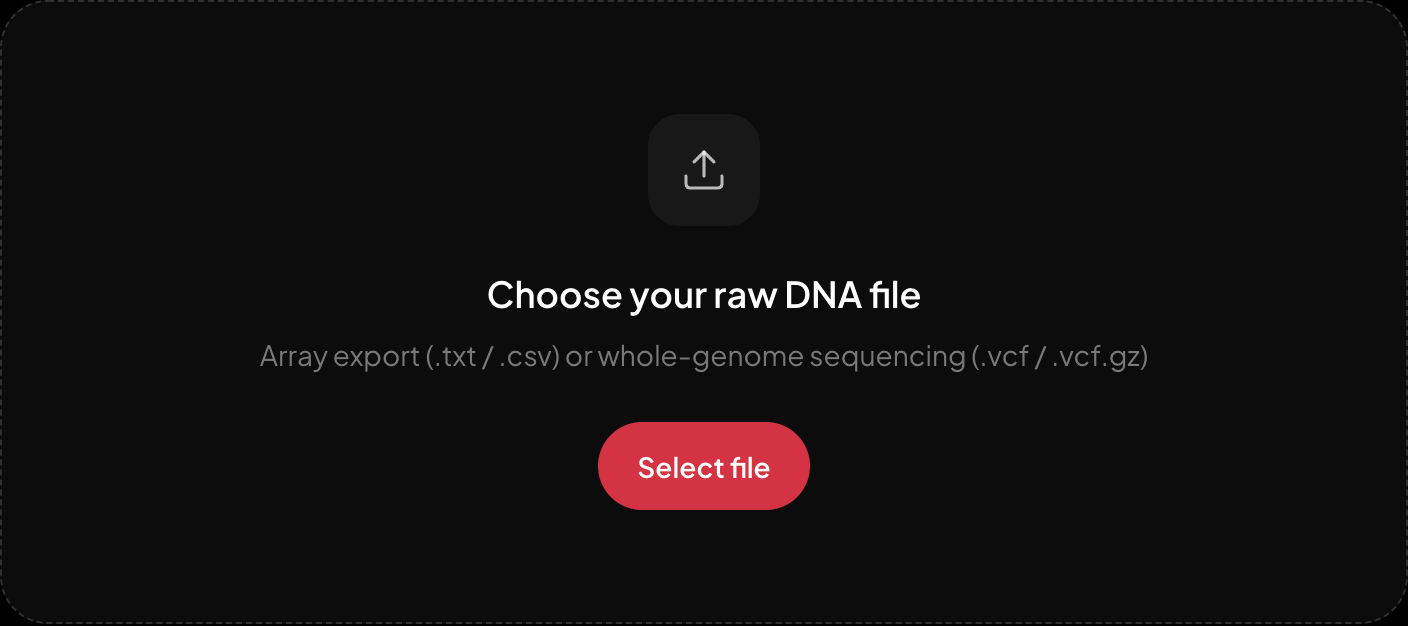
Choosing a file. The report is read on your own device.

The short version: what is worth acting on, first.
If you prefer Arabic, the whole tool, chat included, is available at healthosx.com/ar/dna.
New to raw DNA files? Start with the full guide: 23andMe Raw Data Interpretation Free in Your Browser
Written by
HealthOSX Research