Can My 23andMe or AncestryDNA Raw Data Show If I Have the Huntington's Disease Gene
A 23andMe or AncestryDNA raw file cannot show Huntington's, because the HTT CAG repeat is a length and a chip reads single letters. Here is why, and where to go instead.
No. A 23andMe or AncestryDNA raw data file cannot show whether you carry the Huntington's disease gene change, because the cause is a CAG repeat in the HTT gene that is too long, and a genotyping chip records single-letter variants, not repeat lengths. A clear file therefore says nothing about Huntington's, and the free HealthOSX report does not cover HTT.
Can 23andMe raw data show Huntington's disease?
The file you download is a long list. Each line is a marker name (an rsID), a chromosome, a position and a genotype such as AG or CC. The chip behind it tests several hundred thousand of these positions, each one a spot where people commonly differ by a single letter.
Huntington's is not that kind of change. Nobody has it because an A became a G. They have it because a three-letter stretch, CAG, is copied too many times in a row. The question is how many copies, and a list of letters at fixed positions has no column for that.
The common mistake is reading silence as reassurance. No HTT line in your file does not mean HTT was checked and found normal. It means nobody looked at the repeat.
The repeat is a length, and the length is the diagnosis
In the HTT gene on chromosome 4, the CAG stretch sits near the start of the coding sequence. How many copies you have decides the outcome:
| Repeat | Normal | Intermediate | Disease range | |
|---|---|---|---|---|
| Huntington's (HTT) | CAG | 26 or fewer | 27 to 35 (no disease, may expand in children) | 36 to 39 reduced penetrance; 40 or more full penetrance |
| Fragile X (FMR1) | CGG | 5 to 44 | 45 to 54 | 55 to 200 premutation; over 200 full mutation |
| Myotonic dystrophy 1 (DMPK) | CTG | 5 to 34 | 35 to 49 (may expand) | 50 or more |
Scroll the table sideways for the rest →
Approximate, simplified ranges. Each band is a count, so 35 and 36 repeats mean different things, and intermediate alleles can lengthen when inherited.
Huntington's is dominant, so one expanded copy is enough, and a child of an affected parent has a 50% chance of inheriting it. The middle ranges are the awkward part. People with 27 to 35 repeats are not expected to develop the disease, but the repeat can grow when passed on, especially from a father, so a child can end up in a higher range. At 36 to 39 the picture is uncertain: some people become ill late in life and some never do. At the other end, 60 or more repeats is associated with juvenile-onset Huntington's, so the number matters at the high end too.
So the answer is a number, and the number has to be counted exactly. Being off by a few repeats can change what a result means.
Why a chip cannot count it
A chip works by hybridisation. A short probe is built for one position and lights up differently depending on which letter sits there. That design is excellent for a variant like the lactase persistence marker and useless for a repeat, because a stretch of 17 copies and a stretch of 45 copies look the same at the anchoring positions on either side. Nearby single-letter markers may travel with expanded alleles in some families, but that is a statistical hint in research, not a measurement of your repeat.
23andMe's own health reports do not test for Huntington's, and third-party tools that re-read your raw data face the same limit, because they start from the same list of single letters.
Fragile X and the other repeat conditions
The same limit applies to every disease caused by a repeat expansion. Fragile X is the best known after Huntington's: a CGG repeat in the FMR1 gene, where over 200 copies is the full mutation. Myotonic dystrophy type 1 is a CTG repeat in DMPK. Friedreich ataxia is a GAA repeat in FXN, and a GGGGCC repeat in C9orf72 is a known cause of familial ALS and frontotemporal dementia.
In each, the condition is a length. A chip file can contain thousands of perfectly good genotypes and still be blind to all of them.
What a 30x whole-genome VCF can and cannot say
Whole-genome sequencing is a different technology, and it does read the region. But a standard 30x genome is made of short reads, usually around 150 letters each. Forty CAG repeats is 120 letters of the same three-letter unit. To count them, a read has to cover the whole stretch and reach unique sequence on both sides, and long expansions run past what a single read can span.
There are specialist tools, such as ExpansionHunter, that estimate repeat sizes from short-read data by modelling the reads that fall inside the repeat. They can be informative. They are also less certain for large expansions, and a research estimate is not a diagnosis. The decisive practical point is that ExpansionHunter and similar tools run on the aligned reads (the BAM or CRAM file), not on the VCF. A VCF only lists differences from the reference genome, so it cannot be re-analysed for the repeat, and a standard VCF usually has no call for HTT. Long-read sequencing handles repeats better, but that is not what a 30x file is.
| Sizes the HTT repeat? | Why | |
|---|---|---|
| 23andMe or AncestryDNA raw file | No | Reads single-letter positions, no repeat length |
| 30x whole-genome VCF | Sometimes | Only with repeat tools run on the BAM/CRAM; a standard VCF usually has no call |
| Clinical repeat-sizing test | Yes | Built to count the repeats exactly |
Scroll the table sideways for the rest →
What decides the answer is whether the repeat itself was measured, not how much of the genome was read.
Check whether your provider delivered a BAM or CRAM alongside the VCF. If you only have the VCF, ask the provider whether the aligned reads are available, because without them the repeat cannot be re-checked.
The HealthOSX whole-genome ClinVar screen reads listed variants and does not size the HTT repeat, so a clear panel there says nothing about Huntington's either.
If Huntington's runs in your family
The route is a genetic counsellor, usually through your doctor or a neurology or clinical genetics service. A clinical lab sizes the repeat directly, with a test built for that single job.
Predictive testing, meaning testing someone with no symptoms, is normally done with counselling beforehand, because the result cannot be undone and there is no cure to act on. That is the reason for the process. Things worth raising with a counsellor:
- Whether you want to know at all. Choosing not to test is a legitimate decision.
- How a result could affect life, disability or income-protection insurance where you live. Rules differ by country.
- What it would mean for your children and for relatives who have not asked.
- Whether a relative already has a confirmed diagnosis, which makes interpreting your result far easier.
If you or a relative already have symptoms such as involuntary movements or changes in mood and thinking, that is a diagnostic question for a neurologist, not a raw data question.
What your raw file is still good for
It is good for what a single-letter chip does read:
- How you process caffeine, lactose or folate.
- Whether certain medicines are likely to suit you.
- Carrier status for conditions caused by specific variants.
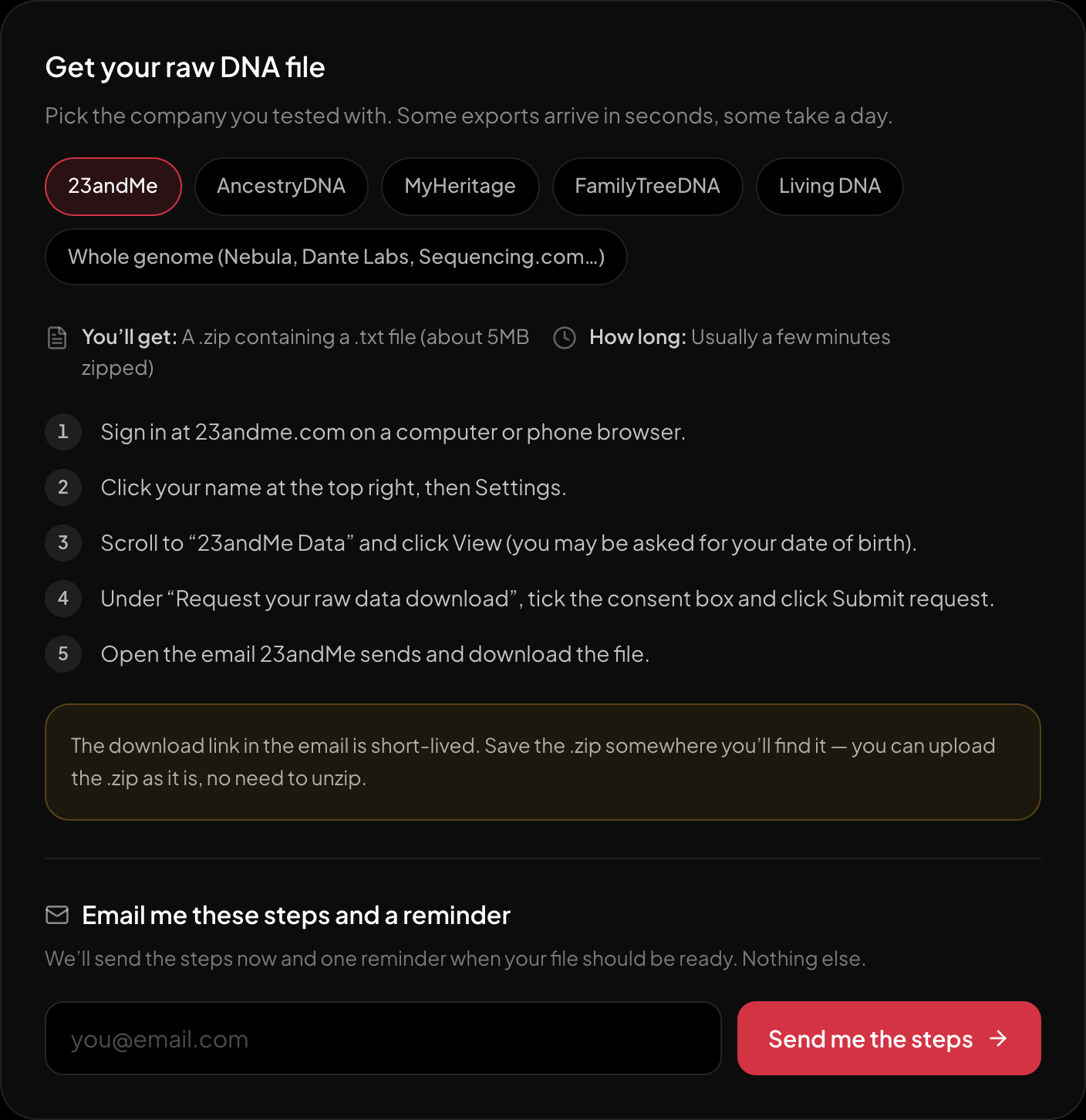
The download steps for 23andMe, on the page itself.
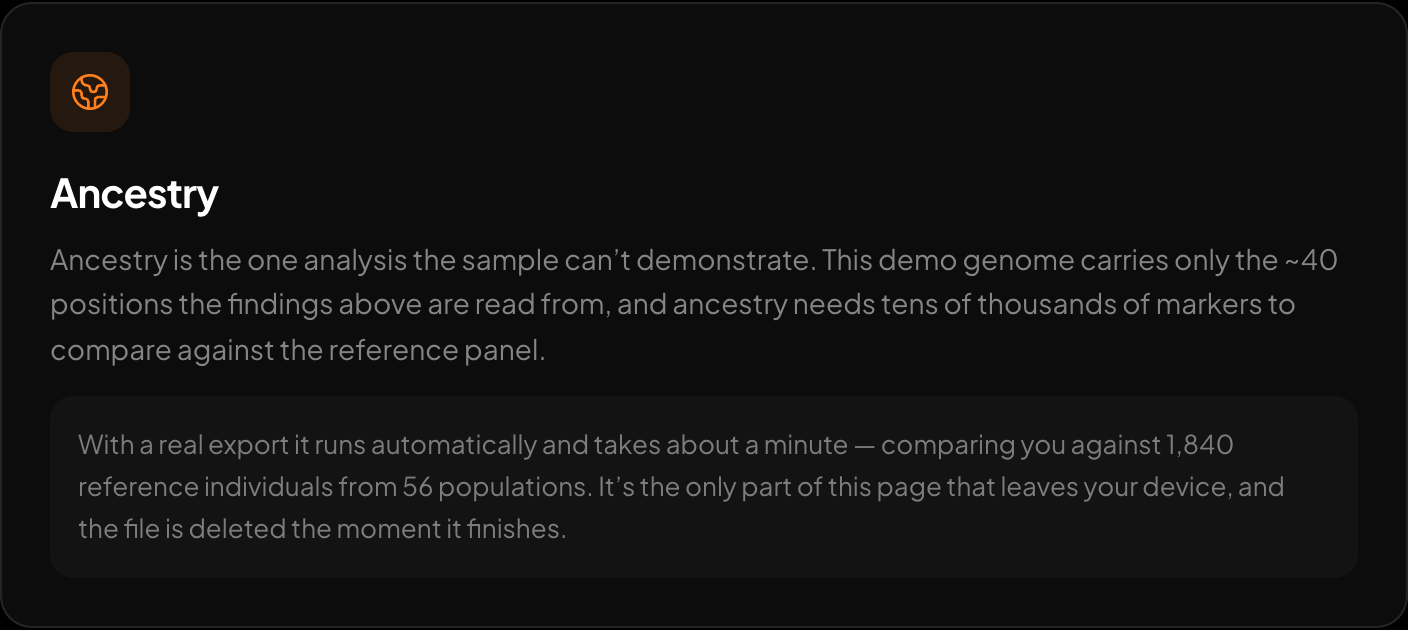
Ancestry across 15 regions and 157 reference populations.
The free report lists 56 findings by gene, and HTT is not among them. The variant-based health findings it does include, such as LRRK2, GBA or SERPINA1, are single-position changes, which is exactly the type a chip can read. You can run your own file through the free DNA tool at HealthOSX and see which genes it covers, which is also a quick way to see where the file stops.
New to raw DNA files? Start with the full guide: 23andMe Raw Data Interpretation Free in Your Browser
Written by
HealthOSX Research