What ANKK1 Taq1A rs1800497 Means in Your 23andMe Raw Data and Is It the Dopamine Receptor Gene
rs1800497 (Taq1A) is named after DRD2 but sits in the neighbouring ANKK1 gene. Here is how to find it in your raw file, read GG, AG or AA, and why the findings are weak.
rs1800497, known as Taq1A, is a single-letter variant in the ANKK1 gene on chromosome 11. It is not inside DRD2, the dopamine D2 receptor gene, though it lies about 10,000 bases away and still carries that gene's name. In a 23andMe, AncestryDNA or MyHeritage file you will see GG, AG or AA, where A is the so-called A1 allele and G is A2.
The studies tying it to addiction, weight or reward are small and inconsistent, and they cannot say anything diagnostic about you.
Why a DRD2 name sits on an ANKK1 variant
The name is a historical accident. In the 1980s and 90s, variants were found by cutting DNA with enzymes. The enzyme Taq1 cut one version of this spot and not the other. The version that was not cut became A1 (the A letter on the forward strand), and the version that was cut became A2 (the G letter). The cut site was found near DRD2 and assumed to belong to it, so the label stuck: DRD2 Taq1A.
Later mapping put it in exon 8 of ANKK1, a neighbouring gene, where the letter change swaps one amino acid: glutamate to lysine at position 713 (Glu713Lys, p.E713K). DRD2 and ANKK1 are close enough to be inherited together in blocks. So the SNP can act as a marker for variation in or near DRD2 without being in DRD2.
So is it the dopamine receptor gene? Only by neighbourhood. DRD2 builds the D2 receptor, which is where dopamine acts in the brain's reward circuits. ANKK1 builds a kinase, a signalling enzyme, whose job in the brain is still not well pinned down. That is an open question, not a settled one.
Where the reward-deficit story came from
In the late 1990s, PET and SPECT imaging studies of D2 receptor availability in the striatum, including work in Finland and Sweden, reported that people carrying the A1 allele had lower availability. The tidy story followed: fewer receptors, a quieter reward signal, more seeking of rewards. But those studies were small, and other imaging studies and post-mortem work did not reproduce the finding. The SNP may also only be tagging other variants inside DRD2 that do the real work. Large genome-wide association studies (GWAS) do find the DRD2 region for problematic alcohol use and for schizophrenia, so the locus is not empty, but Taq1A itself is not the lead signal there.
Reading GG, AG and AA
| Genotype | Allele naming | Expected share, European (about) | Expected share, East Asian (about) | What association studies report |
|---|---|---|---|---|
| GG | A2/A2 | 64% | 36% | The reference group in most studies |
| AG | A1/A2 | 32% | 48% | One A1 copy. Some studies report lower striatal D2 receptor availability or slightly higher odds of dependence or higher weight; many found no difference |
| AA | A1/A1 | 4% | 16% | Two A1 copies. Studies that found a difference usually saw it largest here; many found none |
Scroll the table sideways for the rest →
Expected frequencies are derived, not counted: they apply Hardy-Weinberg proportions to rounded 1000 Genomes A1 allele frequencies of about 0.2 (European) and about 0.4 (East Asian), so treat them as approximate. African and South Asian columns are left out because the draft has no checked frequencies for them. Study descriptions reflect association studies only, which are small, inconsistent and not diagnostic.
G is the reference allele (A2). A1 (A) is the minority allele in Europeans but common in East Asians: according to 1000 Genomes data, its frequency is about 0.2 in European samples and about 0.4 in East Asian samples. So an AA result is unusual in one group and ordinary in another. That matters, because it is one of the reasons the research is messy (see below).
Before you trust the letters you see:
- Strand. 23andMe, AncestryDNA and MyHeritage report the forward (plus) strand, so the files show G and A. A tool or paper that shows C and T is reading the opposite strand of the same variant: C pairs with G, T pairs with A.
- Order. AG and GA are the same genotype.
- Chip version. Not every chip version carries this marker, so the row can be absent from your file. A double dash is a no-call. Neither means GG.
- Sequencing files. In a whole-genome VCF, the reference allele is G (A2) and the alternative is A (A1).
How to find it in your file
Raw files run to hundreds of thousands of lines, so search rather than scroll.
- 1.Unzip the download if it is a .zip, then open the .txt or .csv in a text editor.
- 2.Use Find and type rs1800497.
- 3.Read the row: rsid, chromosome (11), position, then the genotype.
AncestryDNA splits the genotype into two columns, allele1 and allele2, so AG appears as A in one and G in the other. MyHeritage puts it in a single quoted RESULT column. 23andMe puts it in a single genotype column.
What the studies found, and why it is weak
A1 has been linked in papers to alcohol, nicotine, cocaine and opioid dependence, to obesity, and to how strongly people respond to rewards. The reported effects are small. Results flip between studies, and some meta-analyses find modest associations while others find little. Whether the true effect is zero or just small is still argued.
There are concrete reasons for the mess:
- Early candidate-gene studies used small samples, and positive findings were more likely to be published.
- Allele frequency differs by ancestry. If cases and controls are not matched, a difference in ancestry can look like a difference in disease.
- Addiction and weight depend heavily on environment, stress, family and access. One SNP explains very little of that.
The most common mistake is reading A1 as a verdict: a reward deficit, a craving gene, a destiny. It is not. An AA person and a GG person overlap almost completely in behaviour.
Taq1A is named after DRD2 but lives in ANKK1, and what it says about your reward system is a hint, not a result.
Is it in the free HealthOSX report
No. The free report does not cover ANKK1 or DRD2, so it will not show your Taq1A genotype. To see it directly, the lookup tool at healthosx.com/dna/lookup shows the genotype at a single rsID, so type rs1800497 there. If you stored your file, Ask your DNA can look up any variant for you. The report does cover genes that touch the same ground more solidly, such as CHRNA5 for how hard nicotine would be to put down and FTO for how easily a meal registers as finished.
Where to go next
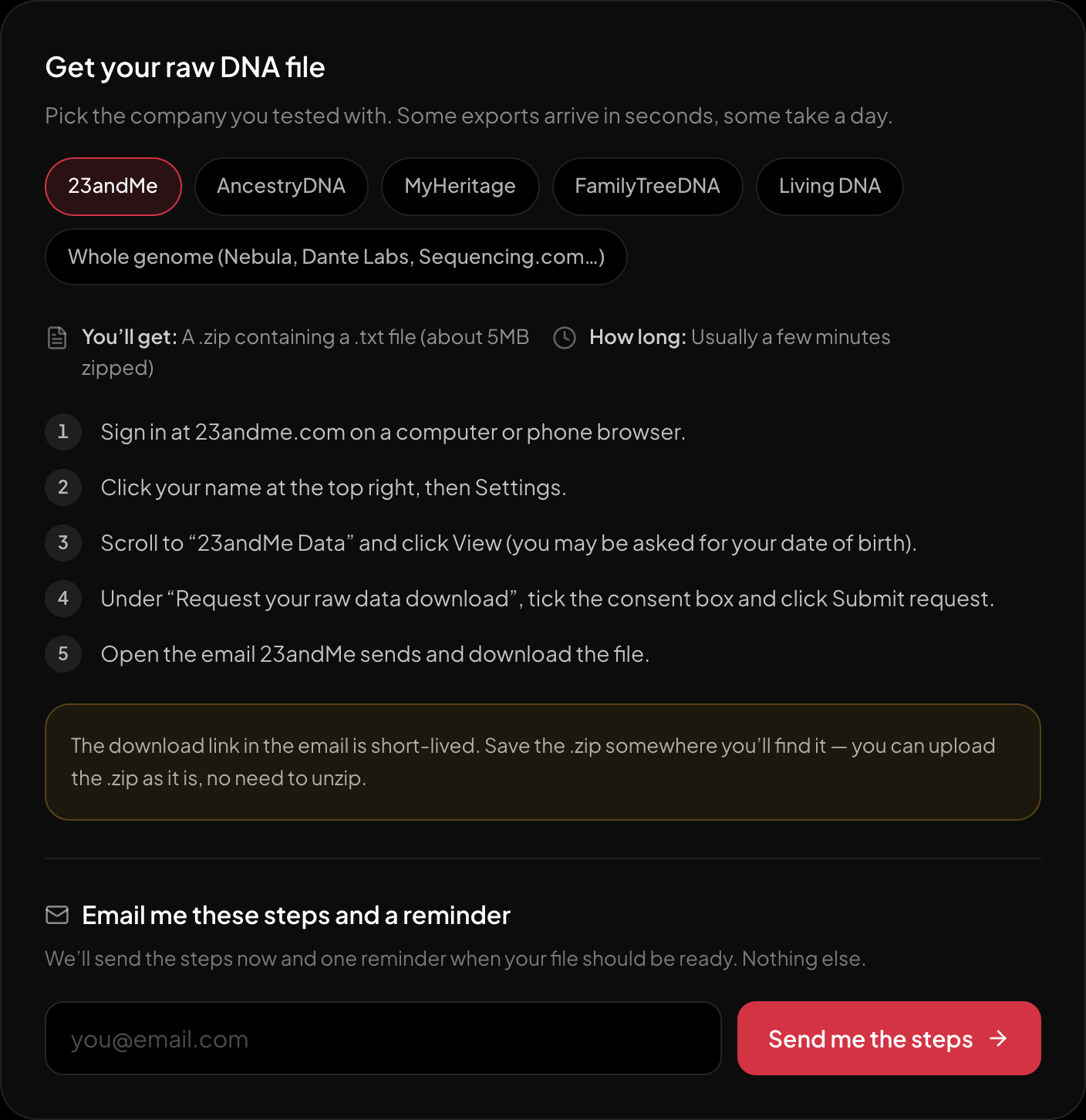
The download steps for 23andMe, on the page itself.
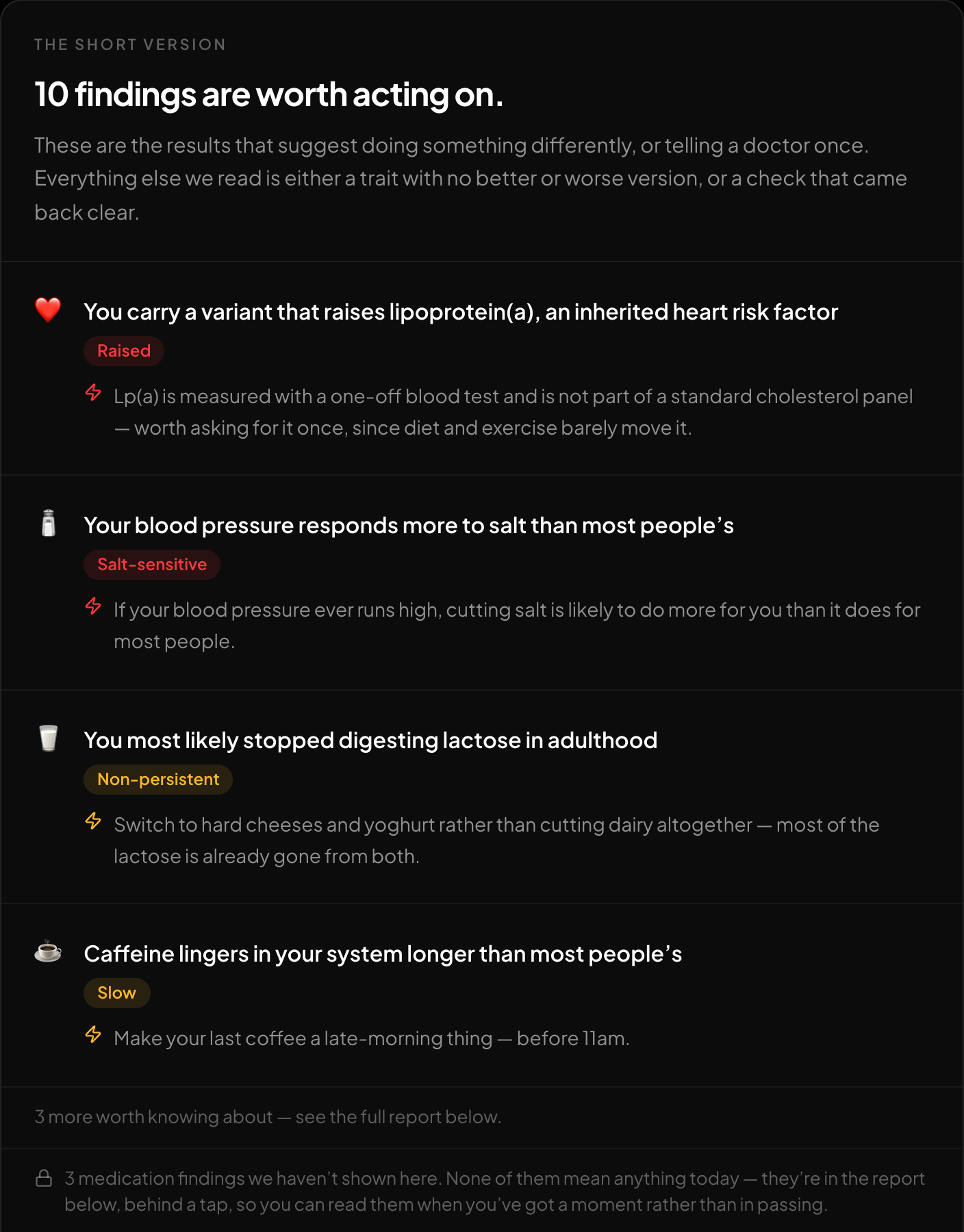
The short version: what is worth acting on, first.
If you want to see what your raw file says about traits, medication response and carrier-relevant findings, the free DNA tool at healthosx.com/dna reads a 23andMe, AncestryDNA, MyHeritage or whole-genome VCF file in your browser. A genetic ancestry breakdown is optional: it runs on the server and only starts after you give explicit consent. Taq1A will not be on the list, but the findings that are there rest on firmer ground.
New to raw DNA files? Start with the full guide: 23andMe Raw Data Interpretation Free in Your Browser
Written by
HealthOSX Research